.jpg)
Vaphio
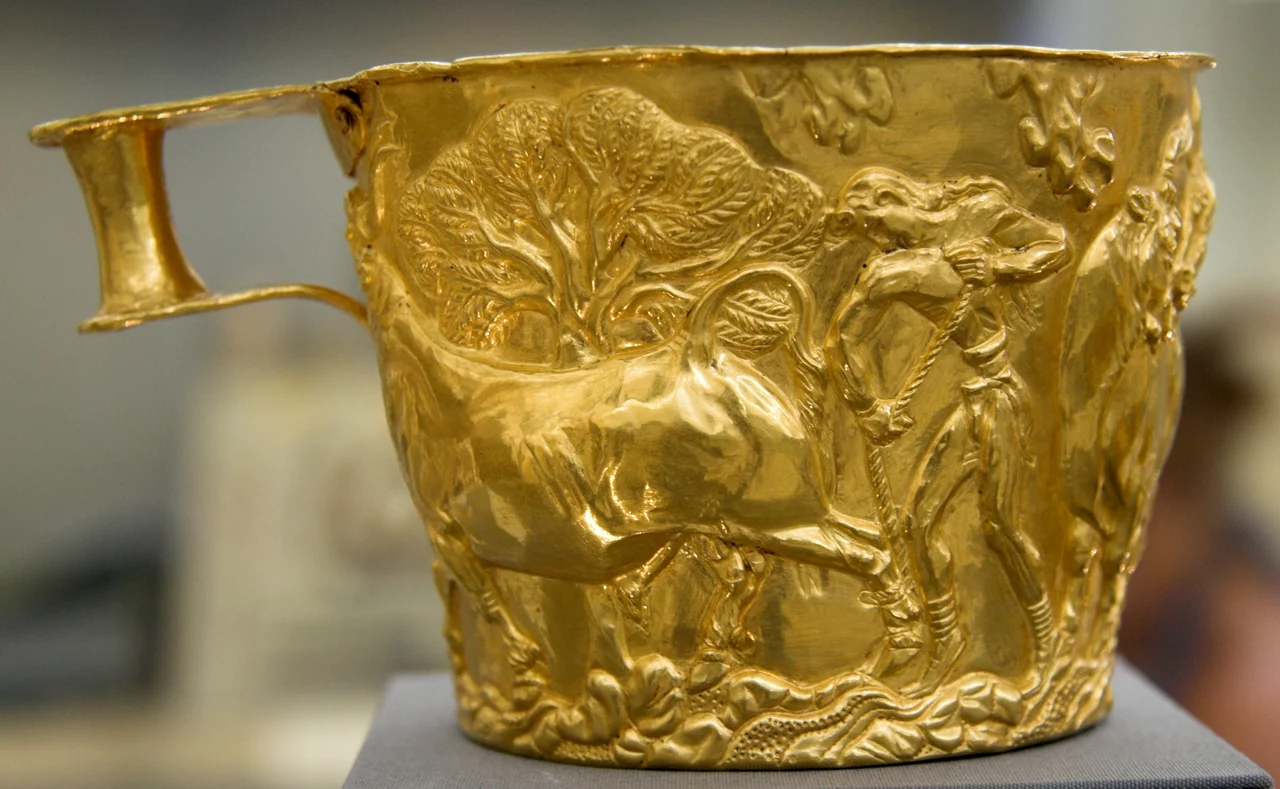
Two golden cups, palm-sized and hammered with breathtaking skill, changed everything archaeologists thought they knew about Bronze Age Greece. Excavated in 1889 from a beehive-shaped tomb on the right bank of the Eurotas River — just five miles south of Sparta — they showed wild bulls in repoussé relief so vivid that art historian Sir Kenneth Clark observed the men depicted alongside them are "insignificant compared to the stupendous bulls." The site is called Vaphio, a low hill in the Laconian plain, and the person buried there some 3,500 years ago was no ordinary chieftain.
A Beehive Beneath the Plain
Tholos tombs are an architectural statement as much as a burial chamber. The Mycenaean builders who constructed Vaphio's tomb shaped a walled dromos — a formal approach corridor some 97 feet long — that funneled mourners toward a corbelled vault roughly 33 feet across. Cut into the floor of that vaulted chamber was the grave itself, as if the dead man required a room within a room. Christos Tsountas, one of the founding figures of Greek archaeology, excavated the site in 1889 and found it had been robbed of larger objects long before his arrival. What robbers left behind turned out to be remarkable enough. The tomb suffered additional damage in the decades after excavation, and restoration work in 1962 rebuilt the walls to approximately six meters in height. Today the mound is still visible, a quiet rise in the Eurotas plain, unremarkable from a distance.
The Cups That Divided Scholars
The Vaphio Cups now rest in the National Archaeological Museum of Athens, and they are among the most debated objects in Aegean archaeology. Each cup carries a different scene in hammered gold relief, and the two scenes work as a diptych: one depicts the quiet seduction of a bull by a tethered cow — a leg is roped while the animals mate — earning it the name the "Quiet Cup" or "Peaceful Cup." The other, the "Violent Cup," shows bulls stampeded into nets, one animal bursting through, knocking catchers aside. The compositional differences between the cups are not just stylistic. Art historian Ellen Davis demonstrated that one cup appears Minoan in origin and the other Mycenaean, a conclusion that Sinclair Hood accepted and that is now the standard view. The Cretan "seduction" cup is generally considered the finer work, its surfaces more refined, its spatial organization more assured. Marcus Niebuhr Tod called them together "perhaps the most perfect works of Mycenaean or Minoan art which have survived."
A Princely Wrist, a Connected World
Beyond the cups, the tomb produced a remarkable collection of carved gem seals — 43 in total, across a range of fine stones including gold — making Vaphio the largest known find of Mycenaean and Minoan seals in the Aegean. The distinction matters: these are actual engraved stones worn as jewelry, not the clay impressions sealings leave behind. The prince interred at Vaphio seems to have worn them on his wrists, like charm bracelets, a detail that collapses the distance between a Bronze Age Laconian chieftain and a modern person layering jewelry before going out. The seals were supplemented by objects in silver, bronze, iron, lead, amber, and crystal. The pottery dates the burial to roughly 1500 to 1450 BC, though the gold objects and carved gems may have been older when placed in the ground. Someone of extraordinary reach and wealth was buried here — connected by trade or alliance or warfare to both the Minoan civilization of Crete and the emerging Mycenaean culture of the mainland.
What the Bulls Mean
The scenes on the cups almost certainly depict methods of capturing bulls — perhaps for the bull-leaping ceremonies central to Minoan ritual, perhaps for sacrifice. Plato's dialogue Critias, describing the laws of Atlantis, contains a passage about Atlantean nobles capturing bulls for sacrifice using no iron tools or weapons that bears a striking resemblance to the "Violent Cup." Whether Plato knew images like these, or both drew on a common cultural memory, remains an open question. A charging bull painted on the walls of the Palace of Knossos on Crete shows similar vigor. The cups are a window into a world where the bull was a creature of power and religious weight, and where craftsmen could capture that power in gold no thicker than modern foil. The word "Vapheio cup" has since become an archaeological term for the specific shape of the vessel — a category now applied to pottery as well as metalwork across the Aegean — which is a strange kind of immortality for a rural Laconian tomb.
Laconian Plain from the Air
Vaphio sits at 37.020°N, 22.468°E, on the eastern flank of the Eurotas valley south of Sparta. From altitude, the plain of Laconia opens broadly between the dark wall of Mount Taygetos to the west and the gentler ridge of Parnonas to the east, with the Eurotas threading silver through olive groves and wheat fields below. The tholos mound is not visually dramatic from above, but the geography explains the tomb's placement: this was fertile, defensible land within easy distance of the Spartan heartland. The nearest commercial airport is LGKL (Kalamata International), approximately 55 kilometers west-southwest across the Taygetos range. Light aircraft approaching from the south along the Eurotas valley will see Sparta's modern grid and the ancient theater of Amyklai before reaching the Vaphio area at low altitude. Visibility is typically excellent in summer; afternoon thermals over the Taygetos are common.
From the Air
Vaphio is at 37.020°N, 22.468°E on the right (east) bank of the Eurotas River, approximately 8 km south of modern Sparta. Approach from the south along the Eurotas valley at 2,000–3,000 feet for good viewing of the Laconian plain. The nearest airport is LGKL (Kalamata International), approximately 55 km west-southwest. The twin massifs of Taygetos (west) and Parnonas (east) frame the valley and are visible landmarks.
Nearby Stories
- Iklaina 6.6 km away
- Kalamakia Cave Site 7.8 km away
- Cleomenean War 9.7 km away
- Epidaurus Limera 16 km away
- Leonidio 18 km away
- Lepreum 20 km away
- Franchthi Cave 30 km away
- El-Kouf National Park 448 km away