.jpg)
Vase Rock
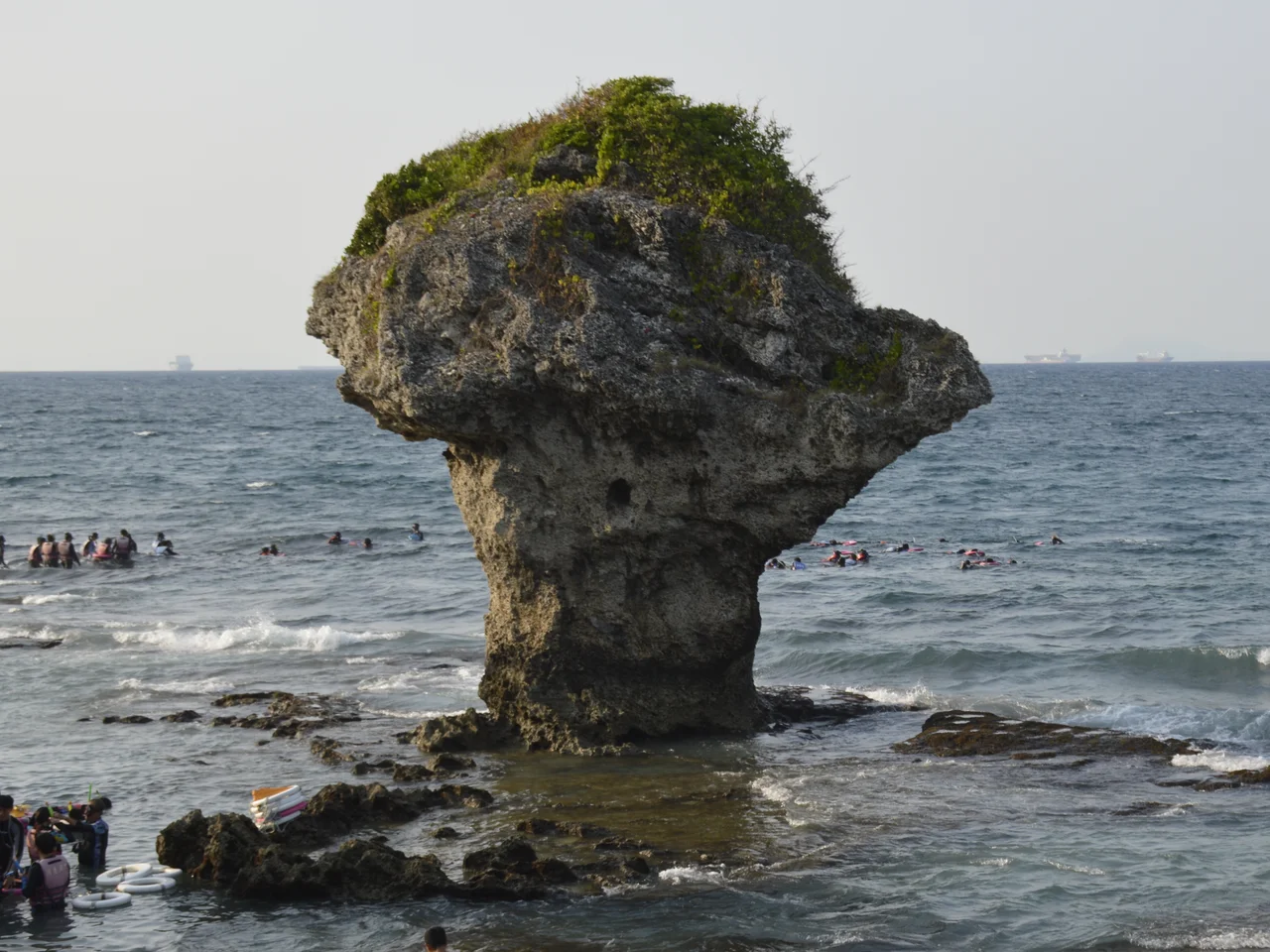
The sea did all the work. For thousands of years, waves struck the base of a coral limestone outcrop just off the north coast of Liuqiu Island, hollowing the lower section while the upper mass held firm. The result is a nine-meter formation that narrows dramatically at the waterline and widens again above — a vase shape, if a vase were made of ancient reef and salt-scoured rock. Vase Rock is Liuqiu Island's most photographed landmark, and it stands in water close enough to shore to wade toward at low tide. What the photographs rarely mention is what the name behind the name refers to.
Coral Built by Time
Vase Rock is not volcanic, not glacially deposited, not the result of any dramatic geological event. It is simply what happens when coral reef is uplifted by tectonic pressure, exposed to the open Pacific, and then left to the patient erosion of waves. The upper portion — dense, compressed limestone that accumulated grain by grain over millennia — resisted the water. The lower portion, less consolidated or more directly exposed, wore away. At 9 meters tall, the rock is modest by any scenic standard, but its proportions are precise: it genuinely looks like the object it is named for, which is rarer than it sounds for a geological formation. The surrounding seafloor is the same material — coral reef shelf, tidal platform, honeycombed with small life. Liuqiu Island itself is built this way, which is why it is Taiwan's only coral island.
The Name the Brochures Tell
The official tourism narrative offered by Liuqiu Township for years attributed the island's former name — Golden Lion Island — to Vase Rock. The rock, it was said, resembles a lion's head, and so the island took on the lion's name. It is the kind of origin story that makes good signage, and it has circulated widely. The actual etymology points somewhere darker. The name "Golden Lion Island" honors the crew of the Dutch East India Company vessel Gouden Leeuw — the Dutch words meaning golden lion — whose sailors were killed here in the seventeenth century. The punitive expeditions that followed, carried out by the VOC against the island's indigenous Malay-speaking inhabitants, were severe enough to have a name of their own: the Liuqiu Island Massacre. The events of the 1630s and 1640s largely depopulated the island. A small formation of coral rock, picturesque at low tide, carried inside its name a chapter of colonial violence that the tourism copy had quietly set aside.
The View from the Shore
None of that history is visible to someone standing on the viewing platform that the township has built opposite the rock. What you see from there is beautiful in a simple, literal way: turquoise water, the column of pale limestone with its narrow waist, sea spray at the base when the swell is up. Green sea turtles are sometimes visible in the water between the rock and the shore — Liuqiu's turtle population has grown under conservation protections, and the area around Vase Rock is one of the places they surface. The ring road that circles the island passes within easy walking distance of the rock, making it a natural stop on the counterclockwise or clockwise circuit that most visitors follow. In the early morning, before the tour groups arrive from the Donggang ferry, the light falls on the rock at an angle that makes the limestone look almost translucent.
A Small Rock, a Long Memory
Geological formations do not carry memory the way that buildings do. They do not hold bullet holes or ancestral tablets. But Vase Rock manages to concentrate several layers of Liuqiu Island's history into a single image: the coral geology that makes this island unlike any other in Taiwan; the Dutch colonial presence that renamed the place after their own killed; the tourism infrastructure that reshaped the island's economy in recent decades. The rock itself is indifferent to all of it. It stands in the same water it has always stood in, slightly narrower than it was a century ago, slightly narrower than it will be in another century. The sea is patient. So is limestone.
From the Air
Vase Rock lies at approximately 22.36°N, 120.38°E, just off the north coast of Liuqiu Island (Xiaoliuqiu). From the air, Liuqiu Island is easily identified as a small oval of green in the Taiwan Strait, about 25 km southwest of Donggang on the Pingtung coast. The rock itself is too small to distinguish from altitude, but the coral shelf surrounding the island shows as a lighter blue in the water around its edges. Nearest major airport: RCKH (Kaohsiung International), approximately 40 km to the northeast. Recommended viewing altitude: 2,000–3,000 feet for the full island silhouette and visible reef coloring.
Nearby Stories
- Zhiben Hot Spring 8.7 km away
- Fo Guang Shan 8.8 km away
- Duoliang Station 11 km away
- Checheng Fu'an Temple 32 km away
- Orchid Island 62 km away
- Dongji Island 68 km away
- South Penghu Marine National Park 96 km away
- Hong Kong 12 548 km away