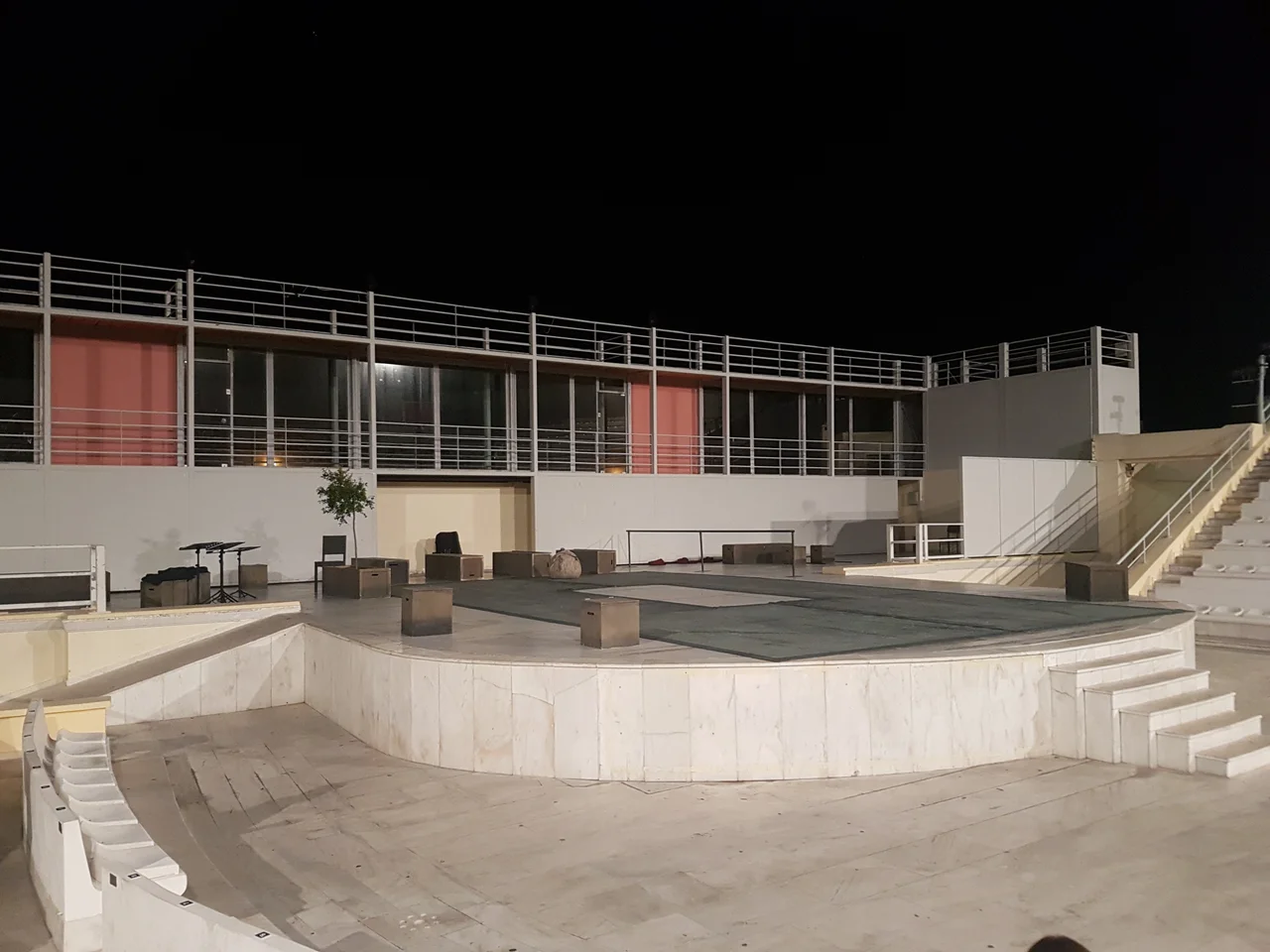

Veakeio Municipal Theater
On summer evenings, 2,000 people climb Kastella hill in Piraeus and settle into an open-air amphitheatre with a view across the Saronic Gulf. Below them, the lights of the harbour reflect off the water; beyond that, the dark shapes of islands. The stage faces the sea. This is the Veakeio — or the Veakio, as it is also spelled — a summer theatre whose history carries an irony built into its bones: it was constructed in 1969 by order of a junta-appointed mayor, and renamed seven years later to honour a man who had resisted the kind of regime that built it.
A Hilltop Above the Harbour
Kastella is the residential hill that rises behind Mikrolimano, Piraeus's small circular harbour. The neighbourhood is old, dense, and characterful — one of the parts of Piraeus that feels like a proper town rather than an extension of Athens. The Veakeio sits near the summit, on the hill also known as Profiti Ilias (Prophet Elijah Hill), at approximately 87 metres above sea level. The design follows the principles of ancient Greek theatre architecture: semicircular seating, open air, the landscape as backdrop. It seats 2,000 people and operates exclusively as a summer venue, from June through September. In the winter months it sits empty, the stone tiers exposed to weather, waiting for the season to turn.
Built by the Junta, Claimed by Democracy
The theatre was built in 1969 under the authority of Aristeidis Skylitsis, the junta-appointed mayor of Piraeus who served from August 1967 to September 1974. The original name was Skylitsio — simply the mayor's own name attached to the venue he had commissioned. When democracy was restored following the collapse of the military junta, the theatre was renamed in 1976 to honour Aimilios Veakis, one of the most celebrated Greek actors of the 20th century and a fighter in the Greek Resistance during the Second World War. Veakis had died in 1951. The renaming was a deliberate act of reclamation: a space built by the dictatorship given the name of someone who had fought against occupation and tyranny. The theatre had a new identity.
Who Was Aimilios Veakis?
Aimilios Veakis was a stage actor whose career in Greek theatre spanned decades and whose reputation placed him among the great figures of the tradition. He was also a Resistance fighter during the Axis occupation of Greece — a fact that made his name, after 1976, an appropriate counter-weight to the junta-era origins of the building. By naming the theatre after him, the municipality of Piraeus connected a summer open-air venue to something larger: the insistence that Greek culture, and Greek democratic life, belongs to people like Veakis rather than to the men who appoint mayors to build vanity projects on hillsides.
What the Stage Has Held
The Veakeio's programming reflects its dual inheritance as both a classical space and a popular summer venue. Ancient Greek drama appears regularly — the semicircular form invites it. Contemporary theatre, musical concerts ranging from classical to popular Greek music, dance performances, children's theatre, and stand-up comedy have all appeared on its stage. For the 2025 summer season, the municipality of Piraeus scheduled over 90 events. The theatre has also hosted less conventional programming: on September 15, 1970, the Miss Europe beauty pageant was held here, an event documented in the National Audiovisual Archive. The venue underwent renovation in 2024–2025. It remains fully operational. The sea is still visible from the seats.
The Other Theatre
Piraeus has more than one theatre with municipal connections, and the confusion is worth clearing up. The Veakeio should not be mistaken for the Municipal Theatre of Piraeus — an entirely separate indoor venue, built in a neoclassical style between 1881 and 1883, inaugurated on April 9, 1895, and designed by architect Ioannis Lazarimos with a capacity of around 1,300 seats. That building represents 19th-century European opera house design; the Veakeio represents a 20th-century attempt to revive the ancient open-air form. They share a city and a municipal management structure, but very little else.
From the Air
The Veakeio Municipal Theater is located at approximately 37.939°N, 23.656°E on Kastella hill in Piraeus, west of central Athens. From the air approaching from the west over the Saronic Gulf, Piraeus's peninsula is clearly visible — its commercial port to the north, the small circular harbour of Mikrolimano below Kastella to the east. The rounded hill of Kastella rises distinctly from the surrounding urban grid. Athens Eleftherios Venizelos International Airport (LGAV) lies approximately 24 km to the east-northeast. Recommended viewing altitude: 1,500–2,500 ft AGL provides excellent detail of the Piraeus peninsula and its harbours, with the Saronic Gulf extending south toward Aegina.
Nearby Stories
- Parnitha 3.4 km away
- Kea (island) 7.3 km away
- Sanctuary of Apollo Maleatas 11 km away
- Sousaki Volcano 12 km away
- Battle of Leuctra 14 km away
- Great Sand Beach 18 km away
- Agios Georgios (island) 23 km away
- Skyros 84 km away