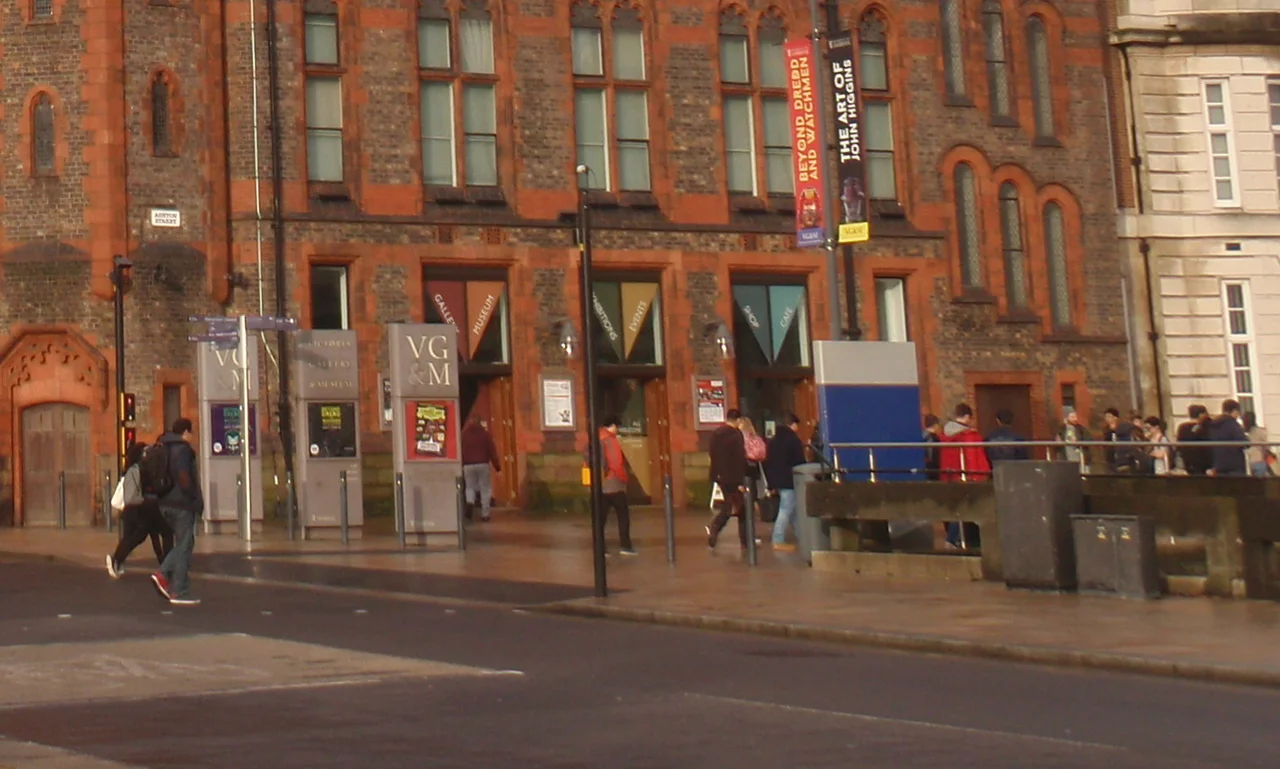

Victoria Gallery & Museum
Other universities have redbricks. The Victoria Building on Brownlow Hill, completed in 1892 to designs by the prolific Victorian architect Alfred Waterhouse, is the redbrick - the building that gave the entire generation of provincial English universities the nickname they still go by. Waterhouse, the same architect who shaped the Natural History Museum in London and Manchester Town Hall, built this place out of pressed Ruabon brick and Burmantofts terracotta in muscular Romanesque arches, with a clock tower that has loomed over Liverpool's university quarter for more than 130 years. After an 8.6-million-pound restoration, the Victoria Gallery and Museum opened inside it on 28 May 2008 - a Grade II listed building given a second life as a free public museum.
Audubon Under the Arches
The first floor is given over to the University of Liverpool's art collection - a teaching collection built by donation, bequest, and the accumulated taste of a university across a century and a half. Joseph Wright of Derby's portrait of Liverpool merchant Charles Goore stares out from one wall, all candlelit gravity. J. M. W. Turner's 1815 oil of the eruption of the Soufrière Mountains in St Vincent burns in another room - smoke and sulphur rendered in the painter's late, dissolving style. There are Lucian Freud nudes, an Elisabeth Frink sculpture, prints from the long British nineteenth century. The treasure for many visitors, though, is the cabinet displaying plates from John James Audubon's Birds of America - the double-elephant folio whose page-and-a-half life-size birds are among the most expensive printed books ever made. A copy was sold in 2010 for 7.3 million pounds. The University's pages turn periodically, so the wild turkey or the Carolina parakeet may be on view depending on when you visit.
Lightbulb Moments
The top floor is the Tate Hall Museum, named for the Liverpool sugar merchant Henry Tate (yes, the same Tate that funded the London gallery) who endowed teaching space here in the original building. The current exhibition is called Lightbulb Moments and is an unusual experiment: instead of organising objects by department, the curators have laid them out around the question of where ideas come from. A dental teaching skull sits near an archaeological cache. An oceanographic instrument shares space with a Victorian zoological specimen. Engineering models lean toward early medical apparatus. The premise is that good ideas come from cross-pollination - from noticing patterns one discipline cannot see alone - and that university collections, ramshackle and broad, are uniquely suited to making that argument. Visitors are invited to consider how their own ideas might come from spotting connections between seemingly unrelated things.
The Original Redbrick
Waterhouse's building was originally University College Liverpool - one of three institutions (with Manchester and Leeds) that made up the federated Victoria University of Manchester. The name still resonates here. "THE ORIGINAL REDBRICK," the museum's homepage announces, claiming the bragging rights for the entire category. After Liverpool gained its own university charter in 1903, the building remained the symbolic heart of the campus even as the institution sprawled around it. By the late twentieth century it had become underused. The 2008 transformation kept Waterhouse's sequence of vaulted rooms - the tiled floors, the stone staircase, the carved capitals - and threaded the museum into them. The Waterhouse Café occupies the ground floor under the brick groins. The Leggate Lecture Theatre still holds talks, as it has since the 1890s. It is the rare museum where the building is as much the subject as the collection.
From the Air
The Victoria Gallery and Museum sits at 53.406 degrees north, 2.966 degrees west, on Brownlow Hill in Liverpool's university quarter, half a mile east of the city centre. The Waterhouse clock tower rises above the surrounding modern campus and is one of the more distinctive Victorian silhouettes in central Liverpool. The Metropolitan Cathedral of Christ the King (Paddy's Wigwam) is a quarter-mile northwest and a far more dramatic visual landmark from the air. Liverpool John Lennon Airport (EGGP) lies about seven nautical miles south-southeast. Recommended viewing altitude 2,000 to 3,000 feet to see the campus quarter clearly.
Nearby Stories
- RAF Wrexham 3.3 km away
- Birkdale Palace Hotel 3.7 km away
- Turton Tower 4.1 km away
- Tatton Park 5.6 km away
- Abergele Rail Disaster 9.6 km away
- Diglake Colliery Disaster 13 km away
- Ysbyty Ifan 16 km away
- Celtic Array 62 km away