
Victoria, Hong Kong
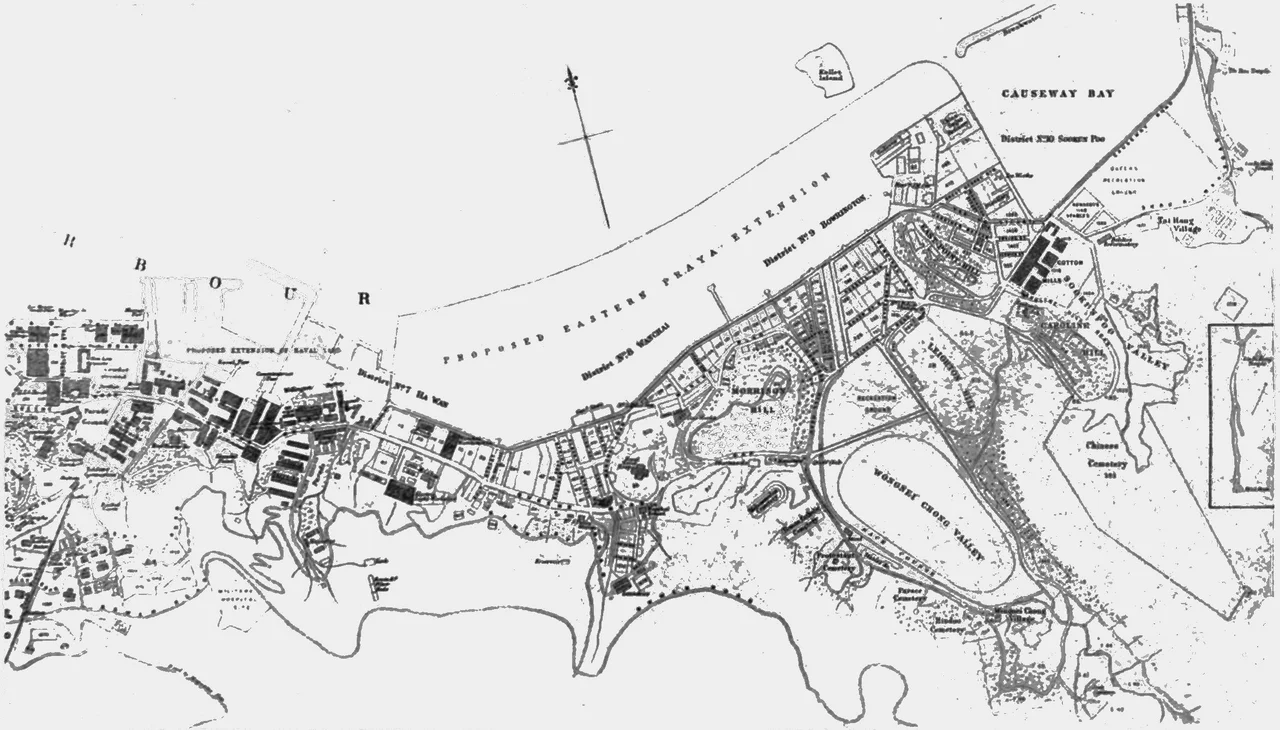
Granite boundary stones still stand at the edges of a city that, officially, no longer exists. Between 1903 and 2021, ten of these markers were set into hillsides and street corners across Hong Kong Island, demarcating a place called the City of Victoria — the original colonial settlement that stretched four miles along the northern coast and climbed toward the Peak. Most Hongkongers today say they live in Central, or Wan Chai, or Kennedy Town. Rarely Victoria. Yet the name endures, embedded in the island's geography like sediment: Victoria Harbour, Victoria Peak, Victoria Park, Victoria Prison. A city renamed by habit, still legible if you know where to look.
Letters Patent and Granite Markers
The name appeared first on the statute books in 1845, though informal usage preceded that. On 11 May 1849, letters patent formally conferred city status and created the City of Victoria — a legal instrument that gave this place its official shape. The city was named in 1843 for Queen Victoria, whose reign had only recently extended to this rocky outcrop in the Pearl River Delta. Its legal boundaries were precise enough to be chiseled into stone: ten boundary markers, set in 1903, traced the city's limits from Kennedy Town in the west to Causeway Bay in the east. Most survive. One disappeared in June 2007; its whereabouts remain unknown. Three more were discovered in December 2021, hiding in plain sight on hillsides for more than a century.
A City That Became a District
In the 1890s, Victoria stretched for four miles along the coastal strip — granite and brick buildings lining what the colonists called the Praya, the seafront esplanade. The tramway opened in 1904, threading east and west through the city's middle. Streets climbed the hillside to the Mid-Levels. By then the city encompassed what today maps call Central, Admiralty, Sheung Wan, Wan Chai, Happy Valley, Kennedy Town, and everything up to the Peak. These were not distinct neighbourhoods in the Victorian sense but a single urban entity that simply went by the name of the woman on the throne. Over the following century, each district gradually acquired its own identity and its own name. Victoria receded into the background, official but invisible.
A Barony That Took Its Name
One reminder of Victoria's legal weight arrived in 1982. Sir Crawford Murray MacLehose, who had governed Hong Kong from 1971 to 1982, was made a life peer upon his retirement. His title — Baron MacLehose of Beoch, of Maybole in the District of Kyle and Carrick, and of Victoria in Hong Kong — gave the city equal billing with his Scottish hometown as the territorial designation of his barony. The gesture was formal and slightly archaic, the kind of legal precision that the British imperial system excelled at. MacLehose's barony went extinct when he died on 27 May 2000, and with it one more thread connecting the place to its official name.
The Name That Would Not Fade
Languages handle this differently. In Cantonese, the city was always 維多利亞城, Wai Do Lei Aa Sing — a transliteration that carries the full Victorian weight without abbreviation. In English, Central long ago eclipsed Victoria in casual speech. But the landscape has a longer memory. The harbour that separates Hong Kong Island from Kowloon is still Victoria Harbour, one of the great natural anchorages of the world. The hill that presides over the island is still Victoria Peak. The park in Causeway Bay, where generations of Hongkongers gather for flower shows, protests, and Tiananmen vigils, is still Victoria Park. The Victorian era ended in 1901. The name it left on this city has not.
From the Air
Coordinates: 22.278°N, 114.174°E. The City of Victoria occupied the entire northern strip of Hong Kong Island, clearly visible from cruising altitude as the dense urban core between the mountainous interior and Victoria Harbour. Approaching from the east, the harbour narrows between Kowloon Peninsula to the north and the island's northern shore — this corridor is the historic heart of Victoria. The nearest major airport is Hong Kong International Airport (VHHH), located at Chek Lap Kok on Lantau Island, approximately 34 km west-southwest. Recommended viewing altitude 3,000–5,000 feet to take in the full east-west sweep of the original city limits, from Kennedy Town to Causeway Bay, with the Peak rising 552 m to the south.
Nearby Stories
- Lok Ma Chau Loop 2.3 km away
- Portas do Cerco 2.3 km away
- Kweilin Incident 17 km away
- Wanshan Archipelago Campaign 34 km away
- Nanxiong Formation 115 km away
- Battle of Nanpeng Island 148 km away
- Heyuan 169 km away
- Cape Maobitou 632 km away