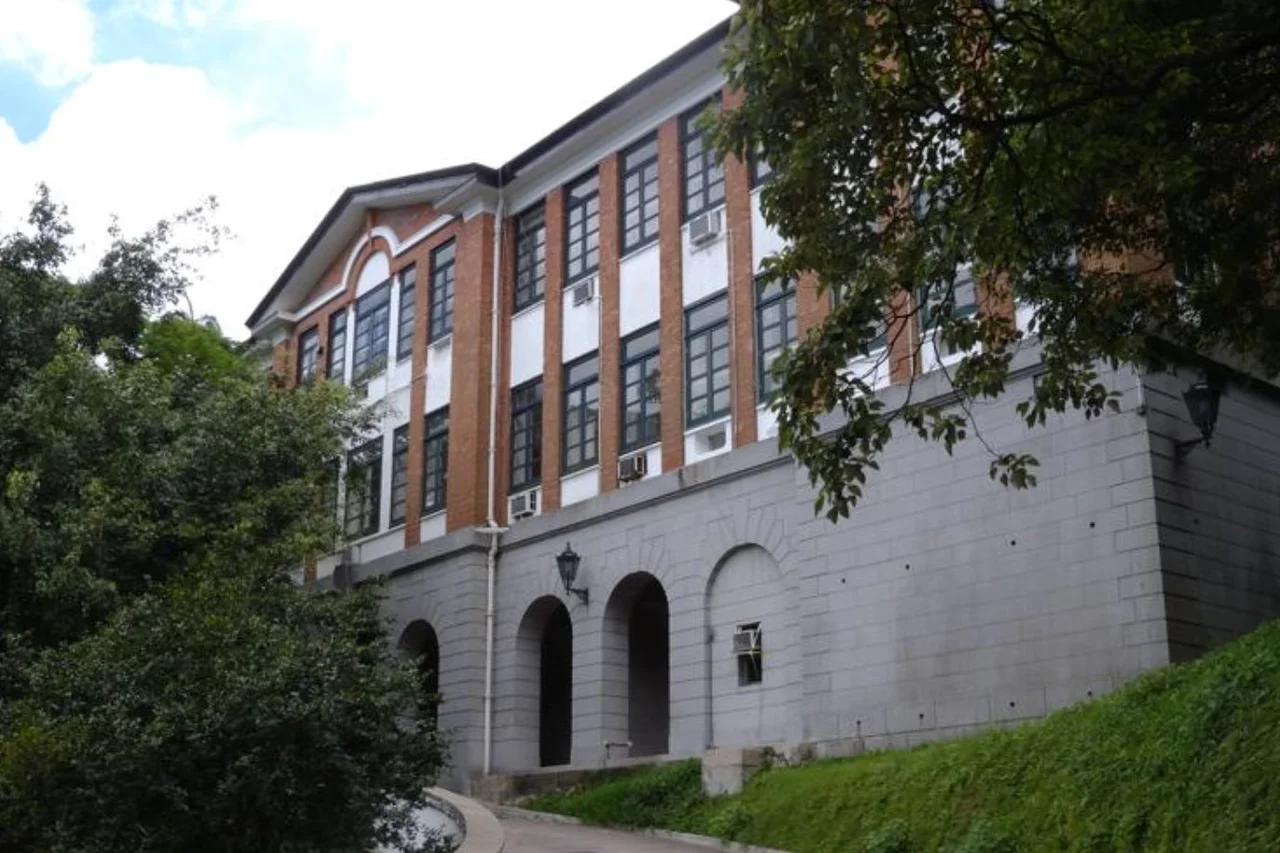

Victoria Hospital, Hong Kong
The timing was deliberate. When Queen Victoria completed her sixtieth year on the throne in 1897, Hong Kong's colonial community wanted to mark the occasion with something lasting. A subscription campaign raised funds. Governor Sir William Robinson unveiled a foundation stone on 23 June 1897. And on Barker Road, high above the harbour at an elevation of roughly 1,100 feet, construction began on a hospital that would serve the colony for half a century — until war and its aftermath took it away.
A Jubilee Gift on a Hill
The project began as celebration, not necessity. The Jubilee Committee that raised the funds had no formal connection to the colonial medical establishment; it was a civic gesture, an act of commemoration shaped into brick and mortar. The architects Palmer and Turner — already established in Hong Kong — drew up the plans and oversaw construction. The government provided the land at Barker Road; the committee funded everything else. Total expenditure reached $118,891.05, of which the government contributed just $3,342.43. It opened formally on 7 November 1903, formally handed over to the government that day as the 1903 Public Works Report recorded in its deliberate, measured prose. The early name, Victoria Jubilee Hospital, held the reason for its existence in every syllable.
Wards, Wings, and the Work of a Small Hospital
The main building occupied two floors: two general wards of twelve beds each, a children's ward with eight beds, and four private wards offering one, two, four, and five beds respectively — forty-four beds in total. Sisters' rooms, an office, an operating theatre, and an isolation ward rounded out the facility. The isolation ward sat in a separate wing, connected by a covered walkway that must have been welcome in Hong Kong's subtropical heat. Staff quarters — a pair of semi-detached houses — were linked to the main building by another covered passage. Expansion came in 1923, when a maternity ward opened to the west of the main building, providing accommodation for patients in three classes. A new block followed in 1924, adding a storey to existing structures and creating more rooms for doctors and nurses.
The War Comes to Barker Road
The Japanese occupation of Hong Kong, which began in December 1941, was devastating for the city's institutions. Victoria Hospital was heavily damaged during the fighting and looted in the aftermath. By the time the colony began to reassemble itself in 1945 and 1946, the building was assessed as beyond repair. In 1947, the decision was made: demolish the main structure and use the site for civil servant housing. The maternity block had fared better. Less badly damaged, it was repaired and converted into what became known as Victoria Flats. The site of the demolished hospital became Victoria House, completed in 1951, which today serves as the official residence of Hong Kong's Chief Secretary for Administration.
What Remains
The hospital is gone, but its address persists at the center of Hong Kong's administrative hierarchy. The Barker Road site that the Jubilee Committee chose for its hilltop hospital now holds two of the colony's — and later Special Administrative Region's — most senior official residences. Victoria House stands where the wards once stood. Victoria Flats, the converted maternity block, still bears the hospital's name in its. A boundary stone from 1903, marking the outer limits of the City of Victoria, stands within walking distance. The jubilee that prompted the hospital's construction belongs to an era before living memory, but on this particular stretch of Barker Road, the name that commemorated it has not moved an inch.
From the Air
Coordinates: 22.270°N, 114.159°E. The Victoria Hospital site on Barker Road sits on the southern flank of the Peak residential district, approximately 335 meters above sea level, set back from the main ridge of Victoria Peak. From the air, Barker Road is identifiable as the arc of road curving below the Peak's summit telecommunications towers. Nearest major airport: Hong Kong International (VHHH), approximately 33 km west-southwest on Lantau Island. Recommended viewing altitude 2,500–4,000 feet — at that height the relationship between the hospital's former hilltop site and the harbour below becomes clear, and the reason colonial administrators chose this airy elevation for a medical facility is immediately visible.
Nearby Stories
- Lok Ma Chau Loop 2.3 km away
- Portas do Cerco 2.3 km away
- Kweilin Incident 17 km away
- Wanshan Archipelago Campaign 34 km away
- Nanxiong Formation 115 km away
- Battle of Nanpeng Island 148 km away
- Heyuan 169 km away
- Cape Maobitou 632 km away