
Victoria Park (Hong Kong)
The statue of Queen Victoria that stands in Victoria Park has led an unusual life. Cast in Pimlico, London, towards the end of the nineteenth century and erected in Hong Kong's Central District, it was removed during the Japanese occupation and shipped to Japan to be melted down. It survived. Restored after the war, it was relocated to the newly opened park in Causeway Bay in 1955 — two years before the park officially opened — where it now presides over a landscape that has become, by any measure, the most publicly active piece of ground in Hong Kong.
Built From the Sea
Before Victoria Park existed, the site was water: the Causeway Bay Typhoon Shelter, where small fishing boats and yachts rode out storms during typhoon seasons. In the 1950s, the former bay was filled in, the shoreline pushed northward, and the government decided that the reclaimed land would become a public park. The decision was straightforward; the construction took years. The park opened in October 1957, with 19 hectares of new ground stretching between Causeway Road to the south and the harbour edge to the north. A new typhoon shelter was built north of the park to replace the one that had been lost to the landfill. What had been sea became the largest public park on Hong Kong Island.
The Park in Everyday Life
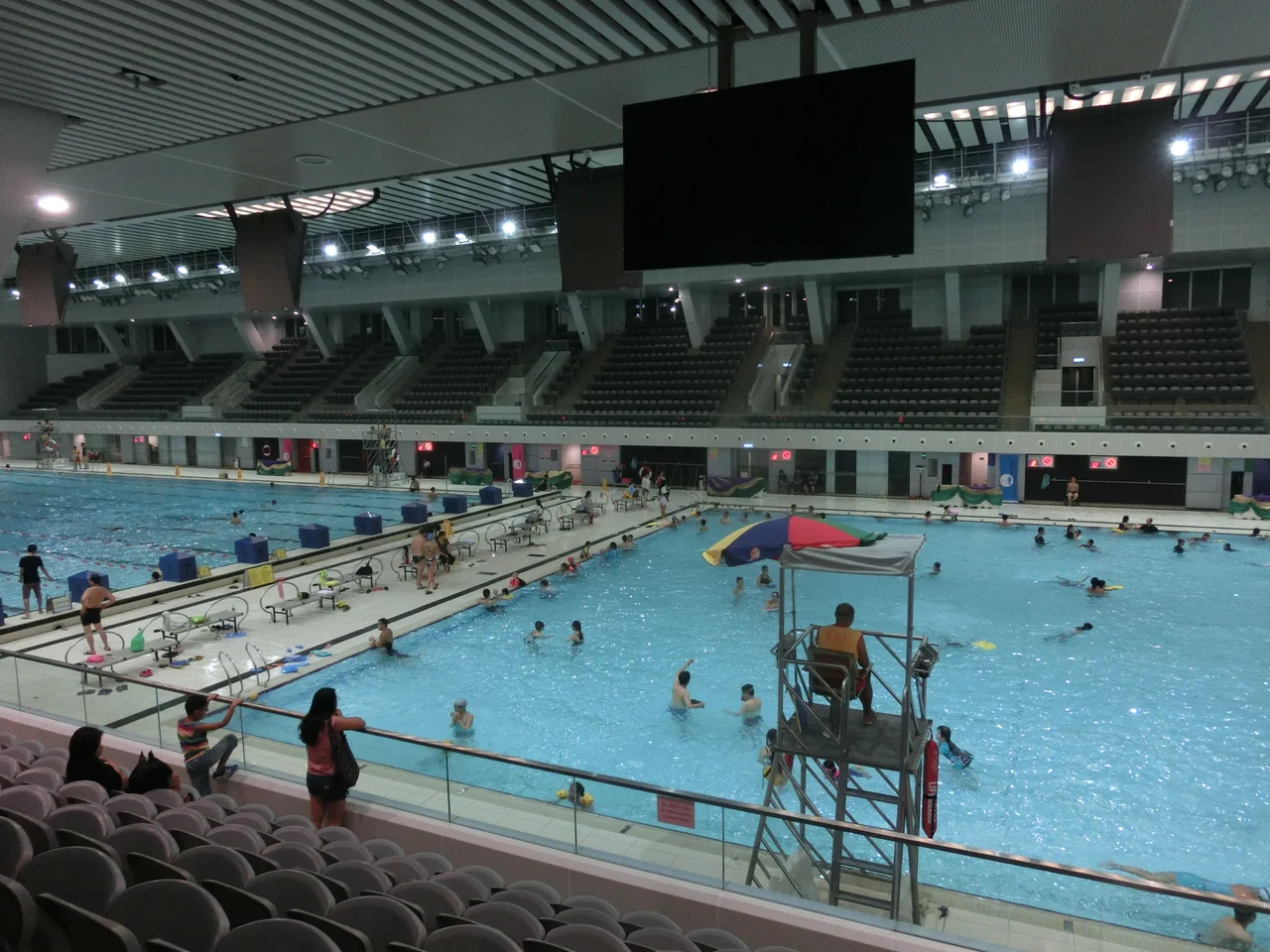
On any given morning, the park is already busy. Tai chi practitioners claim corners of the central lawn before dawn. Joggers loop the 625-meter fitness trail that circles the lawn, stopping at any of six exercise stations. Fourteen tennis courts occupy the central section — the main court, built in 1981, seats approximately 3,600 spectators — while nearby bowling greens, basketball courts, roller rinks, and six football pitches fill through the day. Elderly men play chess on stone tables; children clamber on equipment in four separate playgrounds. A 954-square-meter model yacht pond sits north of the lawn, and a bandstand capable of holding a hundred spectators hosts weekend performances. The indoor swimming complex, which opened in September 2013 at a cost of nearly HK$800 million, replaced the original outdoor pools that opened with the park in 1957 — the first public swimming pool in Hong Kong.
A Park That Belongs to Everyone
The park draws communities that might not otherwise share the same city. On weekends, tens of thousands of Indonesian domestic workers gather in and around Victoria Park, making it the social center of the city's large Indonesian community; nearby Sugar Street is lined with Indonesian food shops, spice vendors, and bookstores. The Lunar New Year Fair transforms the grounds each spring, packed with stalls and noise and the smell of street food. The Hong Kong Flower Show, the Hong Kong Marathon staging area, the Mid-Autumn Festival lantern displays — the park accommodates them all. Each year it receives more visitors than Hong Kong Park and Kowloon Park combined.
The Ground Beneath the Vigils
For decades, Victoria Park was where Hong Kong marked 4 June — the anniversary of the 1989 crackdown in Beijing's Tiananmen Square. Tens of thousands gathered each year by candlelight, sometimes hundreds of thousands, in what became one of the largest annual June Fourth commemorations anywhere in the world. The vigils were organized by the Hong Kong Alliance in Support of Patriotic Democratic Movements of China, and they continued uninterrupted for thirty years. The park was closed to the commemoration in June 2020 and June 2021 — the authorities cited pandemic restrictions, then enforcement of the national security law — and again in 2022 and 2023 for what was officially described as maintenance. The candles that once lit the park are now lit elsewhere, or not at all. But the park itself remains, and the ground remembers the weight of those crowds.
From the Air
Coordinates: 22.282°N, 114.188°E. Victoria Park is one of the most recognizable landmarks on Hong Kong Island from the air — a large rectangle of green set against the dense towers of Causeway Bay, separated from Victoria Harbour to the north by the Island Eastern Corridor elevated highway. It sits roughly 4 km east of Central and 2 km west of the Cross-Harbour Tunnel approach. Nearest major airport: Hong Kong International (VHHH), approximately 37 km west on Lantau Island. Recommended viewing altitude 1,500–3,000 feet: at lower altitudes the park's internal layout — tennis courts, central lawn, swimming complex — is clearly visible against the surrounding urban density.
Nearby Stories
- Lok Ma Chau Loop 2.3 km away
- Portas do Cerco 2.3 km away
- Kweilin Incident 17 km away
- Wanshan Archipelago Campaign 34 km away
- Nanxiong Formation 115 km away
- Battle of Nanpeng Island 148 km away
- Heyuan 169 km away
- Cape Maobitou 632 km away