.jpg)
Victoria Peak
For forty-two years, from 1904 to 1946, Chinese people were legally barred from living on Victoria Peak. The Peak District Reservation Ordinance designated the mountain as an exclusive residential enclave for non-Chinese residents, and the Peak Tram was reserved for their use during peak hours. In the 1920s, Sir Robert Hotung — a prominent comprador and philanthropist considered mixed-race at the time — became the first person of Chinese descent to live there, not because the law had changed but because his racial classification was contested. The ordinance endured until after the Second World War. Today the Peak is one of the most expensive residential addresses on the planet, and the people who live there are sorted by wealth, not by ancestry.
Before the Tram
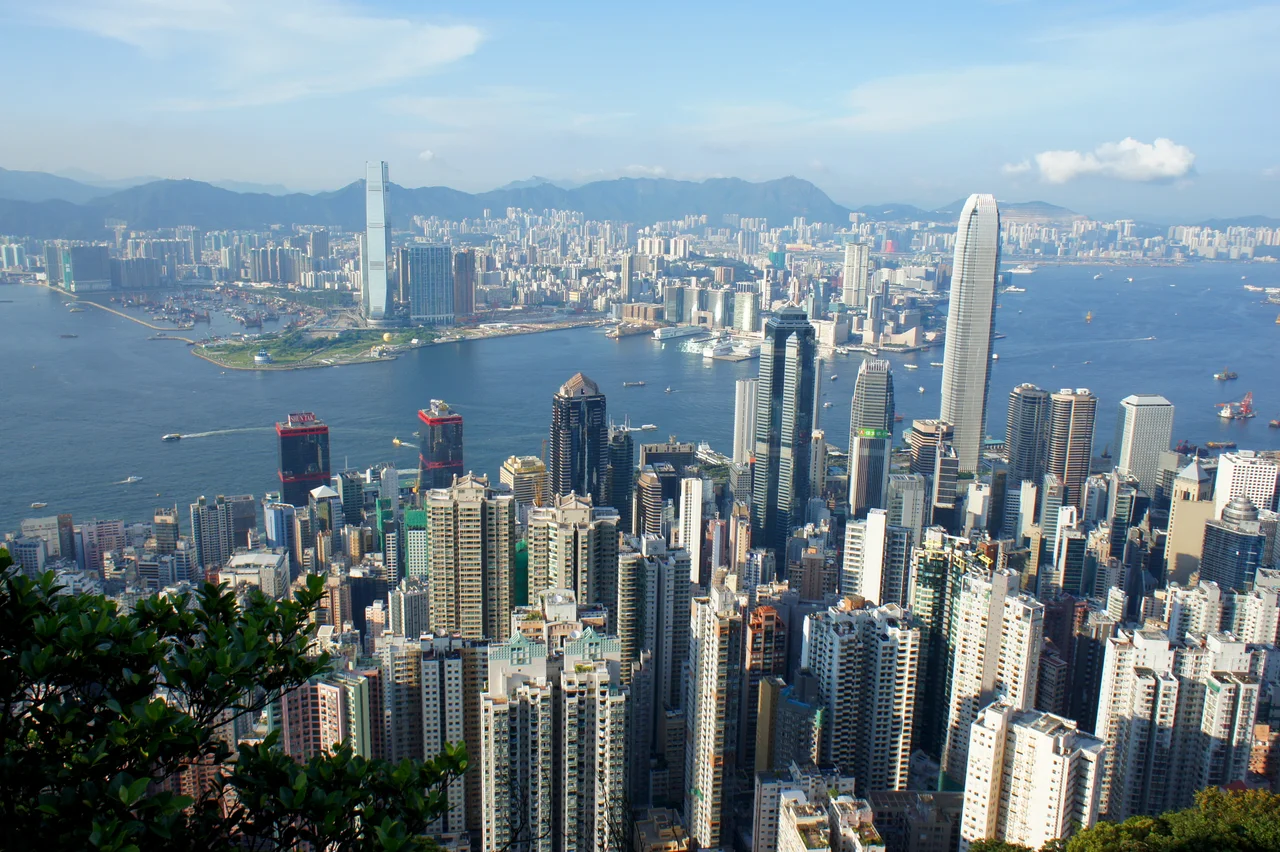
Victoria Peak rises 552 meters above sea level, the tallest hill on Hong Kong Island and the 29th tallest in the territory. Its summit, occupied by telecommunications infrastructure and closed to the public, looks out over Central, Victoria Harbour, Lamma Island, and — on clear days — the islands stretching south toward open water. European colonists noticed early that the Peak offered something the lowlands did not: a cooler, drier climate that stood apart from Hong Kong's subtropical heat and humidity. The sixth Governor, Sir Richard MacDonnell, had a summer residence built here around 1868. Early residents gave their houses names like The Eyrie and the Austin Arms. Getting there required sedan chairs carried by people up and down the steep slope — an arrangement that limited development considerably and made the Peak's residents as dependent on human labor as they were insulated from the city below.
The Tram Changes Everything
The Peak Tram funicular opened in 1888, and the mountain's social geography shifted immediately. Accessibility creates demand: within two decades, the Peak had attracted enough wealthy residents that the colonial government formalized its exclusivity through the Peak Reservation Ordinance of 1904. The tram itself, running from near St. John's Cathedral in Central up to Victoria Gap, became integral to the Peak's character — both as the infrastructure that made the hilltop livable and as the emblem of a distinctly colonial arrangement. In 1905, the Pinewood Battery was completed on the Peak's western side, and Harlech Road was built to supply it. The road now loops the summit, offering what many consider the finest harbour views in Hong Kong. Seven million visitors come annually to see what the Peak Tram's passengers saw for the first time in 1888.
The Ordinance and Its Legacy
The Peak District Reservation Ordinance did not merely restrict residence — it expressed a hierarchy that organized colonial Hong Kong. Chinese people worked on the Peak as servants, sedan-chair carriers, and maintenance staff. They could not own or lease homes there. When Robert Hotung settled at 75 Peak Road, he did so through the ambiguity of his own racial classification, not through any relaxation of the rule. The ordinance was not repealed until 1946, the same year that Victoria Hospital was demolished and the Colony was reassembling itself after occupation. The Peak's post-war story is one of wealth replacing race as the organizing principle. Jack Ma bought a house on Barker Road in 2015 for HK$1.5 billion. Lee Shau Kee, Chairman of Henderson Land Development, spent HK$1.82 billion on a Barker Road site in 2010 and rebuilt it as family dwellings. The houses still carry the whimsical names — Skyhigh, Genesis — but the legal prohibition that once defined the mountain's social order is gone from the statute books and from living memory.
The Summit and What Lives There
The public cannot access Victoria Peak's actual summit; it is occupied by radio telecommunications facilities. What draws seven million visitors a year is everything just below: the Peak Tower and Peak Galleria at Victoria Gap, the Lugard and Harlech Road loop that circles the summit at roughly the same elevation, and the views that open in all directions above the city's upper canopy. Black kites — the raptors that are as integral to Hong Kong's skyline as any skyscraper — are common here, riding thermals above the ridge. Wild boar and porcupines move through the forest after dark. Butterflies are numerous. The ecology of the upper Peak is richer and more diverse than most visitors expect from what they assume is a tourist-industrial development. The summit itself is sealed off by fence and telecommunications infrastructure. But the views from just below it — the harbour laid out below, Kowloon and its hills across the water, Lantau's peaks to the west — are what the colony's governors saw when they looked out from Mountain Lodge, and what no amount of development has changed.
From the Air
Coordinates: 22.275°N, 114.144°E. Victoria Peak's summit rises to 552 meters (1,811 feet) above sea level on the western half of Hong Kong Island — a significant terrain obstacle that requires careful attention in low-visibility conditions. The summit telecommunications towers are prominently visible from cruising altitude and serve as a useful navigation fix. Nearest major airport: Hong Kong International (VHHH) on Lantau Island, approximately 30 km west-southwest; the airport's runway 25R/07L approach path passes north of the Peak over the channel between Hong Kong Island and Lantau. Recommended viewing altitude 3,000–5,000 feet for context on the Peak's relationship to the harbour and the Kowloon peninsula to the north. The Peak Tram lower terminal is visible in Central near the St. John's Cathedral area.
Nearby Stories
- Lok Ma Chau Loop 2.3 km away
- Portas do Cerco 2.3 km away
- Kweilin Incident 17 km away
- Wanshan Archipelago Campaign 34 km away
- Nanxiong Formation 115 km away
- Battle of Nanpeng Island 148 km away
- Heyuan 169 km away
- Cape Maobitou 632 km away