
Victoria Rooms
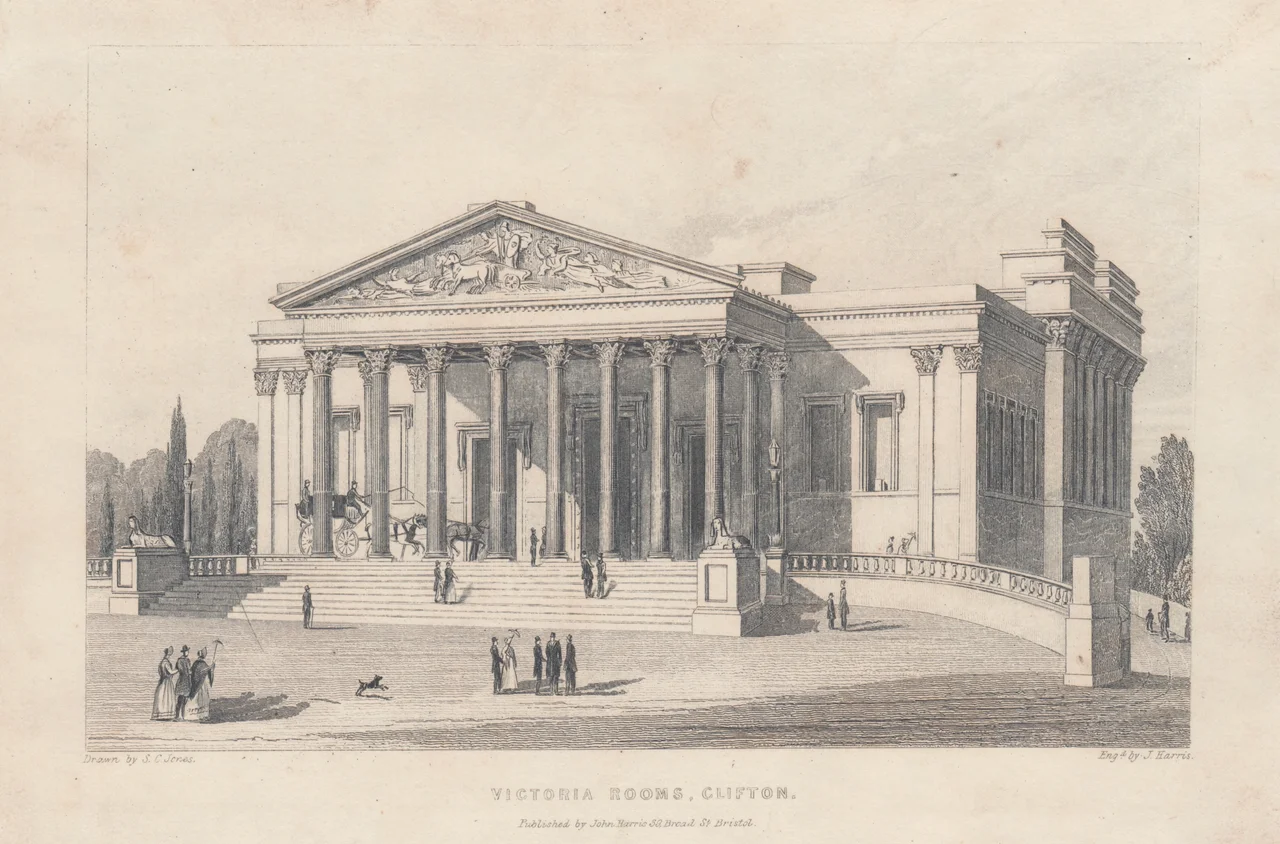
On 24 May 1838, Queen Victoria turned nineteen years old. In Bristol, on a corner of Whiteladies Road in Clifton, a group of Conservative citizens laid the foundation stone of a new assembly building and named it for her. The President of the new society opened the ceremony with a speech declaring that the rooms were 'intended for Conservative purposes - rooms where all may meet to assert their loyalty and attachment to the throne.' The architect was Charles Dyer. Four years and £23,000 later, the Victoria Rooms opened on the same date - the Queen's 23rd birthday. The eight Corinthian columns of its enormous portico have presided over the junction of Queens Road and Whiteladies Road ever since.
Columns, carriages, and a heated speech
Charles Dyer's design is full-blooded Greek Revival - an eight-column Corinthian portico thirty feet tall, set on dressed ashlar with a slate roof. Two sloping ramps were built so that carriages could be driven straight up to the entrance, depositing guests under cover. The pediment above the columns carries a relief sculpture, sometimes attributed to Musgrave Watson, sometimes to Jabez Tyley - readings differ on what exactly it depicts. Andrew Foyle calls it 'Wisdom in her chariot ushering in the morning, and followed by the Three Graces.' Inside, beyond the vestibule and through an octagonal room with a domed ceiling, lay the 665-seat main auditorium. A correspondent of the Bristol Mercury, in 1846, marvelled at the building's central heating: a single cast-iron stove burning less than half a hundredweight - about 25 kilograms - of Welsh anthracite per day, kept the interior 30 to 40 degrees Fahrenheit warmer than the air outside.
Performers and politics
Jenny Lind sang here - the Swedish soprano whose tours of Britain in the 1840s sparked something close to celebrity hysteria. Charles Dickens performed his readings here, on the circuit that wore him into exhausted middle age. The Victoria Rooms hosted the banquet to celebrate the opening of Brunel's Clifton Suspension Bridge in 1864, and the great dinner to mark the quatercentennial of John Cabot's voyage from Bristol to North America. On 11 June 1874, a meeting in the Victoria Rooms - attended by the President of the British Association and Sir William Thomson, later Lord Kelvin - launched the campaign to found a College of Science and Literature for the West of England, which became University College, Bristol, and in turn the University of Bristol. The Fry family of Bristol chocolate fame - Lewis Fry and Albert Fry, sons of Joseph Storrs Fry - threw their weight behind it.
Suffragettes at home
In the early 1900s, Annie Kenney and Clara Codd - the local organisers of the Women's Social and Political Union, the militant suffragette movement led nationally by the Pankhursts - used the Victoria Rooms to host 'at-homes': informal gatherings to which all were invited, where the case for women's suffrage was put with practised force. Bristol was an important provincial centre for the campaign, and the Victoria Rooms gave it a respectable, central venue. The building was a tool of polite political organising in an era when women carrying placards through the streets could expect to be arrested, force-fed, and brutalised. The Vic Rooms, with their Corinthian columns and their slate-roof respectability, offered the suffragettes a platform exactly as conventional as their cause was radical.
Fire, and the fountains outside
Out on the forecourt, in 1912, a memorial statue of Edward VII was unveiled - designed by Edwin Alfred Rickards, executed by the sculptor Henry Poole. Around the statue, the architects laid out a curved pool, ornamental crouching lions, balustrades and steps, and a set of Art Nouveau fountains with figure sculpture. Two stone sphinxes that had previously guarded the building were carted away to make room for the new ensemble. An anemometer - a wind gauge - controls the fountains: on windy days, the water flow is automatically reduced, so that spray does not blow across the road. The statue and fountains have been Grade II* listed since. Inside the building, things went less well. On 1 December 1934, a fire started under the stage of the main hall. The fine electric organ was destroyed. The Times reported that the brigades managed only to stop the fire from spreading into the lesser hall and recreation rooms.
From cinema to Pink Floyd to the music department
After the First World War, the wealthy industrialist Sir George Wills - of the Wills tobacco family that helped pay for so much of modern Bristol - bought the Victoria Rooms in 1920 and gave them to the University of Bristol for its students' union. In March 1924 the building briefly housed the Clifton Cinema; all seats were 1 shilling and threepence. After the 1934 fire, the university refurbished the great hall. The students' union remained here until 1964, when it moved into purpose-built premises on Queens Road. The Victoria Rooms then became an exhibition and conference centre, and twice - in 1967 and 1969 - hosted concerts by Pink Floyd, in the prime years of the band's early psychedelic phase. In 1987, the building briefly housed Richard Gregory's hands-on science centre The Exploratory, the forerunner of At-Bristol. In 1996, the University Music Department moved in. The Victoria Rooms are still, in essence, what they were designed to be: a place where Bristol comes to hear music.
From the Air
Victoria Rooms at 51.4584 N, 2.6097 W on the junction of Queens Road and Whiteladies Road in Clifton, Bristol. Best viewed from low altitude (1,500-3,000 ft) over the Clifton district. Visual landmarks: the Wills Memorial Building tower a short distance south-east, Clifton Suspension Bridge to the west, the Floating Harbour to the south. Nearest airports: Bristol (EGGD) approximately 7 nm south-west.
Nearby Stories
- Cosmeston Medieval Village 1.4 km away
- Glastonbury Festival 3.5 km away
- Tintern Abbey 3.6 km away
- Quantock Hills 4.8 km away
- Ebbw Vale Steelworks 10 km away
- New Wardour Castle 12 km away
- Windmill Hill, Avebury 16 km away
- Cotswolds 18 km away