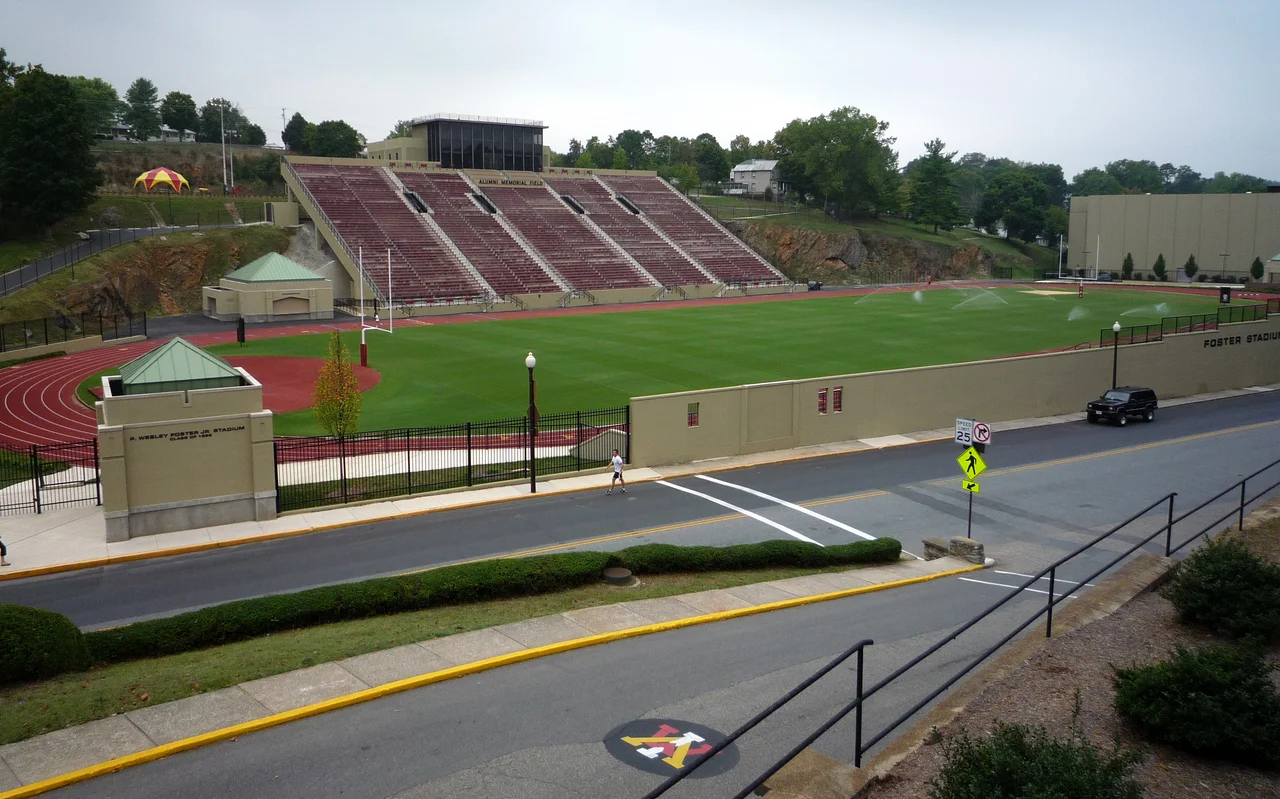

Virginia Military Institute
On May 15, 1864, ten teenage cadets walked across a muddy field at New Market, Virginia, and into rifle fire. Five did not walk back. Another five lived a few days more before their wounds killed them. General John C. Breckinridge, the Confederate commander who had held them in reserve as long as he could, watched them go and said: "Put the boys in, and may God forgive me for the order."
The field is now owned and operated by VMI as the Virginia Museum of the Civil War. Every May 15, the cadets at Lexington call the roll for the ten who died at New Market. Since 2021, the ceremony has expanded to include every VMI graduate who has died in service to the United States. That "United States" includes the country those boys at New Market were fighting against. The institution has spent 160 years learning how to hold both halves of that fact at once.
Guarding the Arsenal
Lexington didn't want a military school. Lexington wanted its arsenal guarded properly. After the War of 1812, Virginia had stashed weapons in a building here against the possibility of invasion or slave revolt, and the soldiers assigned to watch over them spent their off-duty hours drinking and fighting. In 1826, one guard beat another to death. The town wanted the weapons gone or the guards replaced. In 1834, the Franklin Society, a debate club, asked whether the state should establish a military school at the arsenal modeled on West Point. They voted yes. A Lexington attorney named John Thomas Lewis Preston spent the next two years convincing the legislature, and in 1836 the law passed. The first superintendent was Francis H. Smith, a West Point graduate who shaped the curriculum on that model. The first president of the Board of Visitors was Claudius Crozet, a French engineer who had served under Napoleon, then taught at West Point, then become Virginia's chief engineer. Thomas Jefferson had called Crozet the smartest mathematician in the United States. VMI opened formally on November 11, 1839. There has been a cadet sentinel on duty almost every hour since.
The Field of Honor
In 1851 a major named Thomas Jackson took the chair of Natural and Experimental Philosophy at VMI. The cadets found him strange, devout, and absent-minded. He taught at the Institute until 1861, when Virginia seceded and he went to war with the army that would soon call him Stonewall. About 1,800 VMI alumni would serve the Confederacy, 250 of them killed in action. Before his death at Chancellorsville, Jackson surveyed his commanders, noted how many were VMI men, and said: "The Institute will be heard from today." Fourteen times during the war, the Confederacy ordered VMI cadets themselves into combat. The Institute carries only one battle streamer, for New Market. It is one of only five American institutions to be awarded a battle streamer at all. The cost was five boys killed on the field and five more dead of wounds in the days after. Their names are still read on May 15. The first Jewish cadet to graduate, Moses Jacob Ezekiel of the class of 1866, fought beside them at New Market. He became a sculptor. His work is on display at VMI.
Rats and Brother Rats
First-year cadets at VMI are called Rats. The term has been used since the 1850s. Folklore traces it to the gray uniforms that, from a distance, looked like a colony of small mammals; the cadets in turn called the wealthier Washington College students next door Minks. Rats spend their first six months in the Ratline, walking strict prescribed paths through the barracks at exaggerated attention, called straining. They begin with Hell Week, when select upperclassmen called Cadre teach them to march, clean their M14 rifles, and wear their uniforms. They sleep on foam mats called hays that must be rolled every morning. They cannot watch television or listen to music outside of class. Each is paired with a senior mentor called a Dyke, named for an older Southern pronunciation of decking out, dressing for parade. The Ratline ends with Breakout, in which the Rats climb a muddy hill while the upper classes try to drag them back down. The ones who make it become fourth class cadets and are no longer required to strain. They call each other Brother Rats for the rest of their lives.
Who Belongs Here
The U.S. Department of Justice sued VMI in 1990 over its all-male admissions policy. The case took six years. On June 26, 1996, in a 7-to-1 decision in United States v. Virginia, the Supreme Court ruled that a publicly funded school could not exclude women. The first co-ed class of thirty women entered the next year. Initially they were required to shave their heads. In a 2021 Washington Post investigation, women cadets described derision, misogyny, and sexual assault as continuous problems. The institution commissioned an equity audit that documented the issues in detail. The first African American cadets were admitted in 1968, more than a century after the Institute opened. Darren McDew, class of 1982, became the first African American regimental commander and went on to lead United States Transportation Command as a four-star Air Force general. Sun Li-jen, class of 1927, returned to China to become a senior commander in the National Revolutionary Army.
What the Sentinel Watches
VMI's alumni list includes George C. Marshall, the architect of the postwar order and Nobel laureate; Ralph Northam, the recent governor of Virginia; thirteen Rhodes Scholars; Medal of Honor recipients; and an Academy Award winner. About 65 percent of every graduating class accepts a commission in one of the six branches of the U.S. military, making VMI one of the largest sources of officers in the country outside the service academies. The Keydets compete in NCAA Division I in the Southern Conference. Approximately one-third of all cadets play on at least one varsity team. The 1976 men's basketball squad reached the East Regional Final of the NCAA tournament before losing to undefeated Rutgers. The sentinel posted at the barracks gate is still armed, still in uniform, still walking the same route established in 1839. He has been there, with very few exceptions, for every hour of every school year for 187 years.
From the Air
VMI's post lies in Lexington at 37.79 degrees north, 79.44 degrees west, at the edge of the city next to Washington and Lee University in the Shenandoah Valley between the Blue Ridge and the Allegheny Mountains. The recognizable visual landmark is the parade ground bordered by the Gothic Revival barracks, best viewed at 3,000 to 5,000 feet AGL. Shenandoah Valley Regional Airport (KSHD) lies 35 nm north and Lynchburg Regional (KLYH) is 40 nm east-southeast. Afternoon light brings out the yellow-tan of the barracks walls against green parade ground.
Nearby Stories
- The Omni Homestead Resort 3.7 km away
- Appomattox-Buckingham State Forest 5.6 km away
- Randolph College 9.3 km away
- Hollins University 16 km away
- Albemarle County, Virginia 18 km away
- Alleghany County, Virginia 20 km away
- Elliott Knob 22 km away
- Murder of Hannah Graham 27 km away