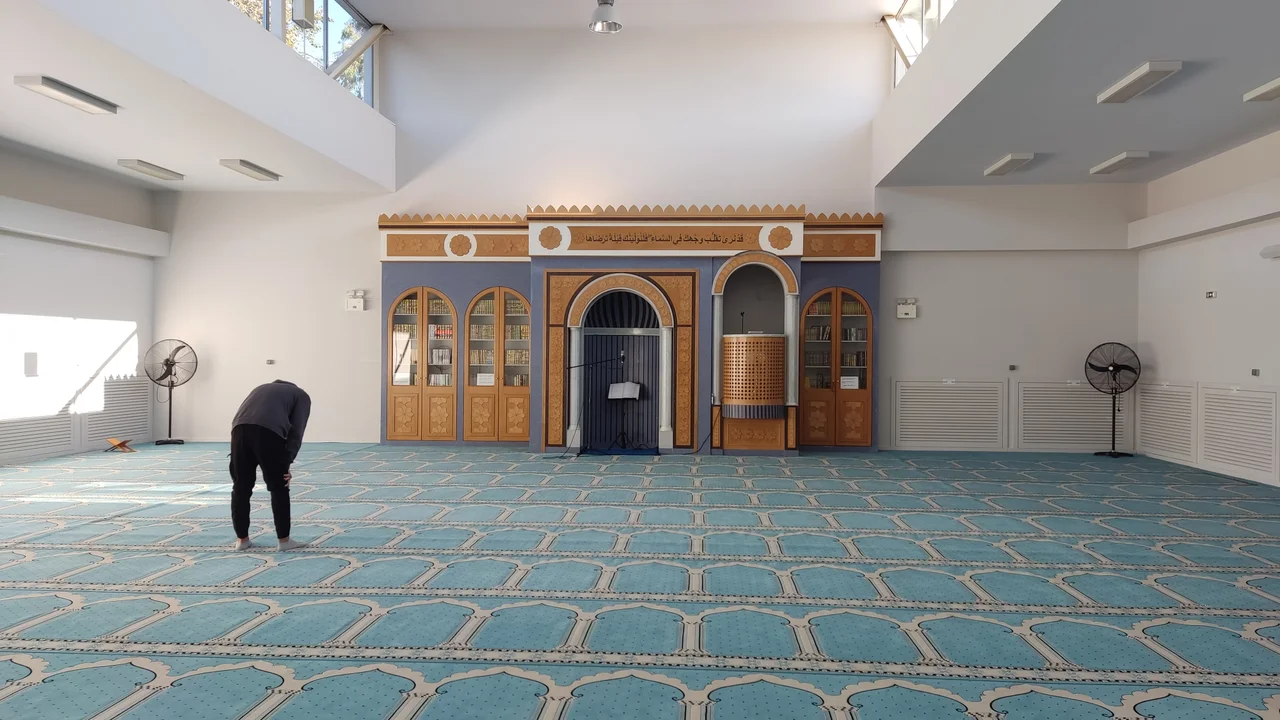

Votanikos Mosque
For most of the twentieth century, Athens held an unusual distinction among the capitals of Europe: it was the only one without a single official mosque. A city of millions, with an estimated 200,000 Muslims in its metropolitan area, had no formal place for them to gather and pray. That changed in 2020, when the Votanikos Mosque finally opened its doors in a quiet industrial neighborhood west of the center - the first official mosque to serve the Greek capital since the country won its independence from Ottoman rule nearly two centuries earlier.
A Capital Without a Mosque
Athens had mosques once. The Ottoman-era Tzistarakis and Fethiye mosques still stand in the old city, but they became archaeological monuments long ago and have not been used for worship since the 1920s. As the city's Muslim population grew through immigration in the late 20th and early 21st centuries, the absence of a formal place of worship became increasingly hard to sustain. With no official mosque, many of the city's Muslims prayed in informal prayer rooms - in basements, garages, and converted apartments scattered across Athens. The gap between the size of the community and the spaces available to it widened with every passing year.
More Than a Century of Delay
The idea was old. The Greek Parliament first passed a law about building a mosque in the Athens area back in 1890. In 1970, Arab states offered to fund one, but nothing came of it. A more concrete attempt followed a law in 2000, which proposed a Saudi-financed mosque outside the city - a plan that stalled amid opposition from the Orthodox Church and local residents. The project that finally succeeded was a different kind of effort: financed entirely by the Greek state, making the Votanikos Mosque the only mosque in a European capital built solely with government funds. The path was not smooth. Construction was opposed by the Greek Orthodox Church and met with civil and judicial challenges, and four successive public tenders drew no bidders before a fifth, in 2016, was awarded to a consortium of major Greek construction firms.
Opening at Last
The site was a former naval garage at Votanikos, a 1.7-hectare plot handed over by the Hellenic Navy. Before construction could begin, police had to clear the location of protesters who had occupied it. The finished building is modest and deliberately plain - around 1,000 square meters, with a prayer hall for 500 men and a separate space for 50 women, a fountain, and a courtyard, but no minaret. When it opened in 2020, after roughly fourteen years of design, dispute, and construction, the moment arrived under strange circumstances: the COVID-19 pandemic meant the long-awaited mosque opened to a city under restrictions, its first congregations small and masked. For the worshippers who had waited generations, it was, as one of them put it, a dream come true. Its first imam, Zaki Mohammed, leads prayers there still.
From the Air
The Votanikos Mosque sits at roughly 37.9864 N, 23.7000 E, in the Votanikos district west of central Athens, in an area of former industrial and military land between the city center and the port suburbs. From the air, look for a low, modern complex amid the warehouses and rail lines northwest of the Acropolis, which lies about three kilometers to the southeast. Athens International Airport (LGAV) is roughly 33 km east. The building's plain profile and lack of a minaret make it easiest to locate by its open courtyard and surrounding cleared grounds.
Nearby Stories
- Great Sand Beach 5 km away
- Battle of Delium 7.7 km away
- Tower of Aliartos 9 km away
- HMHS Britannic 10 km away
- Saronic Gulf 15 km away
- Sousaki Volcano 17 km away
- Sanctuary of Apollo Maleatas 24 km away
- Skyros 66 km away