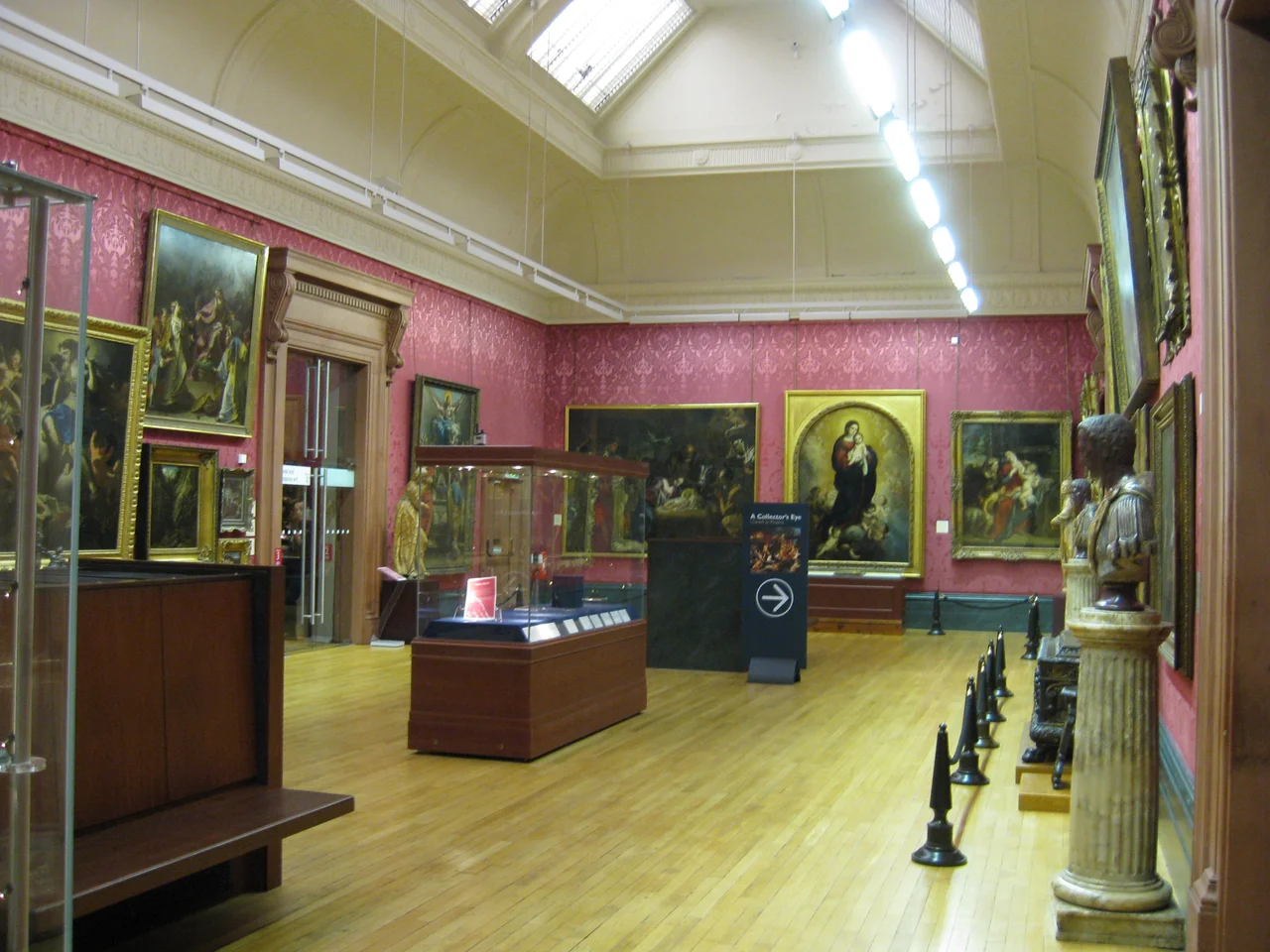

Walker Art Gallery
It started with a banker who went bankrupt. In 1819, the Liverpool Royal Institution bought 37 paintings from William Roscoe - poet, abolitionist, and failed banker - whose collection had been saved from auction by friends scrambling to keep his beloved Italian Renaissance pictures together. Those thirty-seven paintings became the founding nucleus of what is now the Walker Art Gallery: a vast neoclassical pile on William Brown Street, opened in 1877 by the Earl of Derby and named for the Scottish brewer who paid for it. The Walker today holds one of the largest collections of art in England outside London, and the building it sits in - all Corinthian columns, lion-flanked steps, and high galleried halls - is itself a Grade II* listed monument to Victorian municipal swagger.
A Gift from the Beer Trade
Sir Andrew Barclay Walker was born in Ayrshire in 1824 and made his fortune in beer. The family brewery, founded in Scotland, expanded south and Walker eventually settled in Gateacre in Liverpool. By the 1870s he was mayor of the city and rich enough to fund a permanent home for its growing art collection - the William Brown Library and Museum next door, opened in 1860, had run out of wall space almost immediately. Walker put up the money. The Liverpool architects Cornelius Sherlock and H. H. Vale designed a Greek-revival temple of art with carved pediments, allegorical statues of Painting and Sculpture on the parapet, and Wellington's Column rising next door on its own granite plinth. On 6 September 1877, Edward Henry Stanley, the 15th Earl of Derby, opened the doors. Walker had bought himself a knighthood, a baronetcy, and a place on the wall of every Liverpudlian's mental map of the city centre.
Pre-Raphaelites and a Banksy
The Walker's collection is unusually deep in nineteenth-century British painting. W. F. Yeames' "And When Did You Last See Your Father?" - the Cavalier child being interrogated by Roundhead soldiers, a Victorian schoolbook image for generations of British children - hangs here. So does Dante Gabriel Rossetti's "Dante's Dream," the largest painting Rossetti ever made, an immense Pre-Raphaelite vision of the poet beside Beatrice's deathbed. The earlier rooms run from Italian and Netherlandish panels of the fourteenth century up through Rembrandt, Poussin, and Degas. The twentieth century rooms hold Lucian Freud, David Hockney, Gilbert and George. Stuart Sutcliffe - the original Beatles bassist who left the band in Hamburg and died of a brain haemorrhage at twenty-one - has the only painting of his on permanent display in Liverpool here, a quiet reminder that the city's musical history is also an art-school history. And in Room Three, among the seventeenth-century Old Masters, hangs Banksy's "Cardinal Sin": an eighteenth-century stone bust of a priest whose face the graffiti artist sawed off and replaced with pixellated bathroom tiles. The piece was donated in 2011, a comment on the cover-up of clerical abuse.
Painting Competition and Refurbishment
The first John Moores Painting Prize was held at the Walker in 1957. Sponsored by Sir John Moores - the Liverpool entrepreneur who built the Littlewoods football pools and mail-order empire - it has run every two years since and is the biggest painting prize in the United Kingdom. Past winners include David Hockney, Peter Doig, and Mary Martin. The gallery's twentieth century was not without trauma. During the Second World War the building was requisitioned by the Ministry of Food and the collection scattered for safety. It reopened in 1951 and gained national status in 1986 as part of what is now National Museums Liverpool. A major refurbishment finished in 2002 returned the galleries to something close to their Victorian appearance while quietly modernising the lighting, climate control, and access. Today the Walker draws over half a million visitors a year. Admission is free.
From the Air
The Walker Art Gallery sits at 53.410 degrees north, 2.980 degrees west, on William Brown Street in central Liverpool. Its immediate neighbours are St George's Hall to the south, Lime Street Station across William Brown Street, and the World Museum and Liverpool Central Library to the immediate west - one of the densest concentrations of Victorian civic architecture in Europe. Wellington's Column rises beside the building. Liverpool John Lennon Airport (EGGP) lies about seven nautical miles south-southeast on the Mersey. Recommended viewing altitude 2,000 to 3,000 feet to pick out the William Brown Street ensemble - the neoclassical pediments form a tight cluster just east of the city's twin cathedrals.
Nearby Stories
- RAF Wrexham 3.3 km away
- Birkdale Palace Hotel 3.7 km away
- Turton Tower 4.1 km away
- Tatton Park 5.6 km away
- Abergele Rail Disaster 9.6 km away
- Diglake Colliery Disaster 13 km away
- Ysbyty Ifan 16 km away
- Celtic Array 62 km away