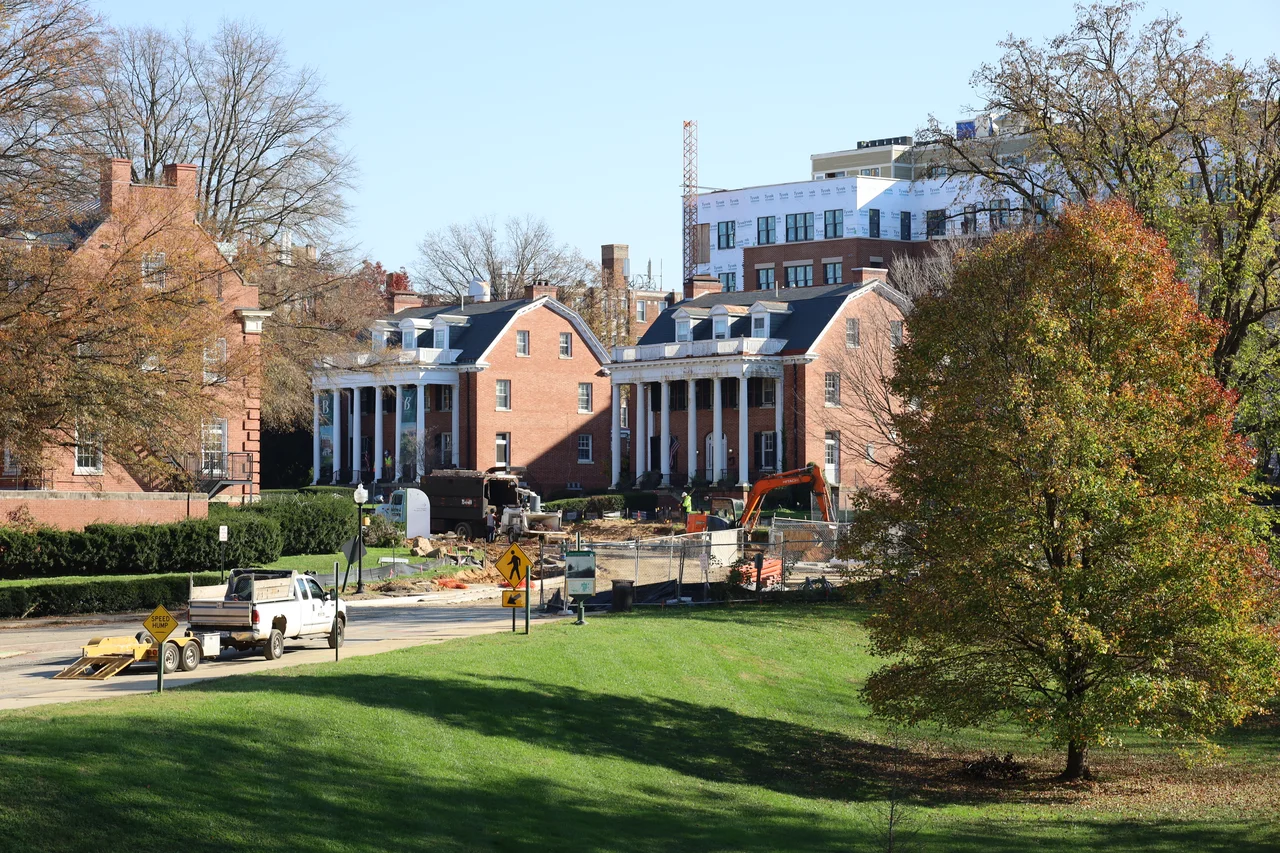

Walter Reed Army Medical Center
Major Walter Reed died on November 23, 1902, of complications from emergency appendix surgery at the Washington Barracks hospital, where he had been camp surgeon twenty years earlier. He was fifty-one years old. He had spent the final years of his life proving, through experiments on his colleagues and consenting volunteers - American soldiers and Spanish immigrants - in Havana, that yellow fever was transmitted not by direct contact - the consensus medical view of the time - but by the Aedes aegypti mosquito. His work made possible the construction of the Panama Canal, which had defeated the French in part because their workers kept dying of yellow fever in such numbers. Seven years after Reed's death, in 1909, the Army opened a new general hospital named after him on a 113-acre site on Georgia Avenue NW. The Walter Reed General Hospital, expanded in 1923 and rebranded as the Walter Reed Army Medical Center in 1951, served as the Army's flagship medical center for 102 years.
From Washington Barracks
Walter Reed General Hospital had a predecessor: the small Victorian-era post hospital at Washington Barracks, what is now Fort Lesley J. McNair in southwest Washington. Reed had been camp surgeon there from 1881 to 1882, and returned later as Professor of Medicine and Curator of the Army Medical Museum. He worked, ate, and lived in the same brick building in which he ultimately died. By 1908 the Army needed a larger, modern facility, and Congress appropriated $192,000 for the construction of the new hospital. The architectural firm Marsh and Peter designed the central Georgian Revival Building 1; Cramp and Company won the construction contract. The new hospital opened on May 1, 1909. The transfer of patients from the Washington Barracks hospital was carried out with horse-drawn ambulances and one experimental steam-driven ambulance - eleven patients made the trip due north through Washington to the new 65-bed facility. The Washington Barracks hospital lasted as a smaller post clinic until 1911, when its west wing was converted to other uses. The building itself still stands at Fort McNair.
Pershing's Hospital
In 1923, General John J. Pershing - by then U.S. Army Chief of Staff and the senior surviving commander of American Expeditionary Forces in World War I - signed an order establishing the Army Medical Center on the same Georgia Avenue campus as the Walter Reed General Hospital. The Army Medical School moved up from Louisiana Avenue and became the Medical Department Professional Service School in the new Building 40. The combined campus eventually held about 100 rose-brick Georgian Revival buildings spread across landscaped grounds. Pershing lived at Walter Reed from 1944 until his death on July 15, 1948 - a four-year residency in the hospital named for the doctor whose mosquito work had saved his army from yellow fever. Dwight D. Eisenhower died at Walter Reed on March 28, 1969. Mamie Eisenhower, his wife, died there ten years later. John Foster Dulles died there in 1959. Douglas MacArthur was treated there. So were George Marshall, Leslie Groves (builder of the Pentagon and director of the Manhattan Project), Mike Mansfield, Everett Dirksen, and the mathematician John von Neumann, who lay there dying of cancer in 1957 - the first man to articulate the doctrine of mutual assured destruction succumbing to bone cancer that may have been caused by radiation exposure during the Manhattan Project.
The 2007 Scandal
In February 2007, The Washington Post ran a two-day investigation by Dana Priest and Anne Hull documenting conditions in Building 18 - the outpatient barracks housing wounded soldiers from Iraq and Afghanistan. The building had mold on the walls, holes in the ceilings, rodents, and broken plumbing. The bureaucratic systems supporting outpatient soldiers had collapsed under the war's volume; soldiers spent months waiting for medical-board hearings, disability ratings, and rehabilitation services. The Post described one soldier's mother sleeping on a couch in a hallway because no family lodging was available. The story became a national scandal. The hospital's commanding general, Major General George W. Weightman, was fired within days. Secretary of the Army Francis J. Harvey resigned at the request of Defense Secretary Robert Gates. Lieutenant General Kevin Kiley, the former Walter Reed commander who had become Army Surgeon General, was forced to retire. Congressional hearings followed. Vice President Cheney visited the hospital. President Bush, who had appointed Harvey, made a personal apology. The Department of Defense Independent Review Group, the Independent Review of the Care for the Wounded Warrior, and four other federal investigations followed. Reform legislation followed. The story has been credited with prompting much of the wounded-warrior reform that defined Army outpatient care in the decade after.
BRAC and Closure
In 2005, eighteen months before the Building 18 scandal broke, the Base Realignment and Closure Commission had already recommended that Walter Reed close. The proposal was to consolidate it with the National Naval Medical Center in Bethesda, seven miles north, into a new joint-service facility serving Army, Navy, and Air Force personnel: the Walter Reed National Military Medical Center. The transfer would be gradual. Patients, staff, and equipment moved north over six years. The Walter Reed Army Medical Center on Georgia Avenue closed on August 27, 2011, after exactly 102 years of operations. The total cost of the closure and consolidation had ballooned from initial estimates to $2.6 billion. The 113-acre campus was transferred to the District of Columbia for redevelopment as The Parks at Walter Reed, a mixed-use neighborhood that incorporates many of the original Georgian Revival buildings. Building 1, the original 1909 hospital, has been preserved. The campus's Memorial Chapel, Doss Memorial Hall, the Borden Pavilion, and the Walter Reed Monument all remain. Mologne House, the visitor's lodge that housed thousands of family members of wounded soldiers, has been converted to apartments.
The Name Lives On
Walter Reed himself remains one of the most celebrated American physicians of the late nineteenth century, primarily for the yellow fever work. He was born in Belroi, Virginia, on September 13, 1851, and entered the University of Virginia at fifteen - the youngest student in the school's history at that time. He took his medical degree there at seventeen, then a second medical degree at New York University at age eighteen. He joined the Army Medical Department in 1875 and spent most of his early career on frontier posts in Arizona, Nebraska, and Dakota Territory. The Yellow Fever Commission he led in Havana in 1900 confirmed Cuban physician Carlos Finlay's twenty-year-old hypothesis about mosquito transmission and made eradication possible. Reed died two years later, before the Nobel Prize in Physiology or Medicine had been awarded to anyone for tropical-disease work. The Walter Reed name now applies to the consolidated military medical center in Bethesda, the Walter Reed Army Institute of Research at Forest Glen, the Walter Reed Society at the University of Virginia, and the original 1909 campus that the District of Columbia has redeveloped. The name has outlived nearly everything Walter Reed himself lived to see.
From the Air
The former Walter Reed Army Medical Center occupied 113 acres at 6900 Georgia Avenue NW, centered near 38.9759 degrees N, 77.0292 degrees W in the Brightwood neighborhood of upper Northwest Washington. From the air the campus reads as a large rectangular complex of rose-brick Georgian Revival buildings around a central great lawn, immediately south of the District line with Maryland. Best viewed at 1,500 to 3,000 feet AGL; the entire site lies within the Washington FRZ. Nearest airports are College Park (KCGS) 4 nm east, Ronald Reagan Washington National (KDCA) 6 nm south, and Washington Dulles (KIAD) 22 nm west.
Nearby Stories
- Gunston Hall 1.1 km away
- 2023 Baltimore Shooting 4.9 km away
- Battle of Middleburg 6.6 km away
- Crownsville Hospital Center 10 km away
- Battle of Loudoun Heights 13 km away
- First Battle of Rappahannock Station 20 km away
- Howard County, Maryland 21 km away
- Harriet Tubman Underground Railroad 50 km away