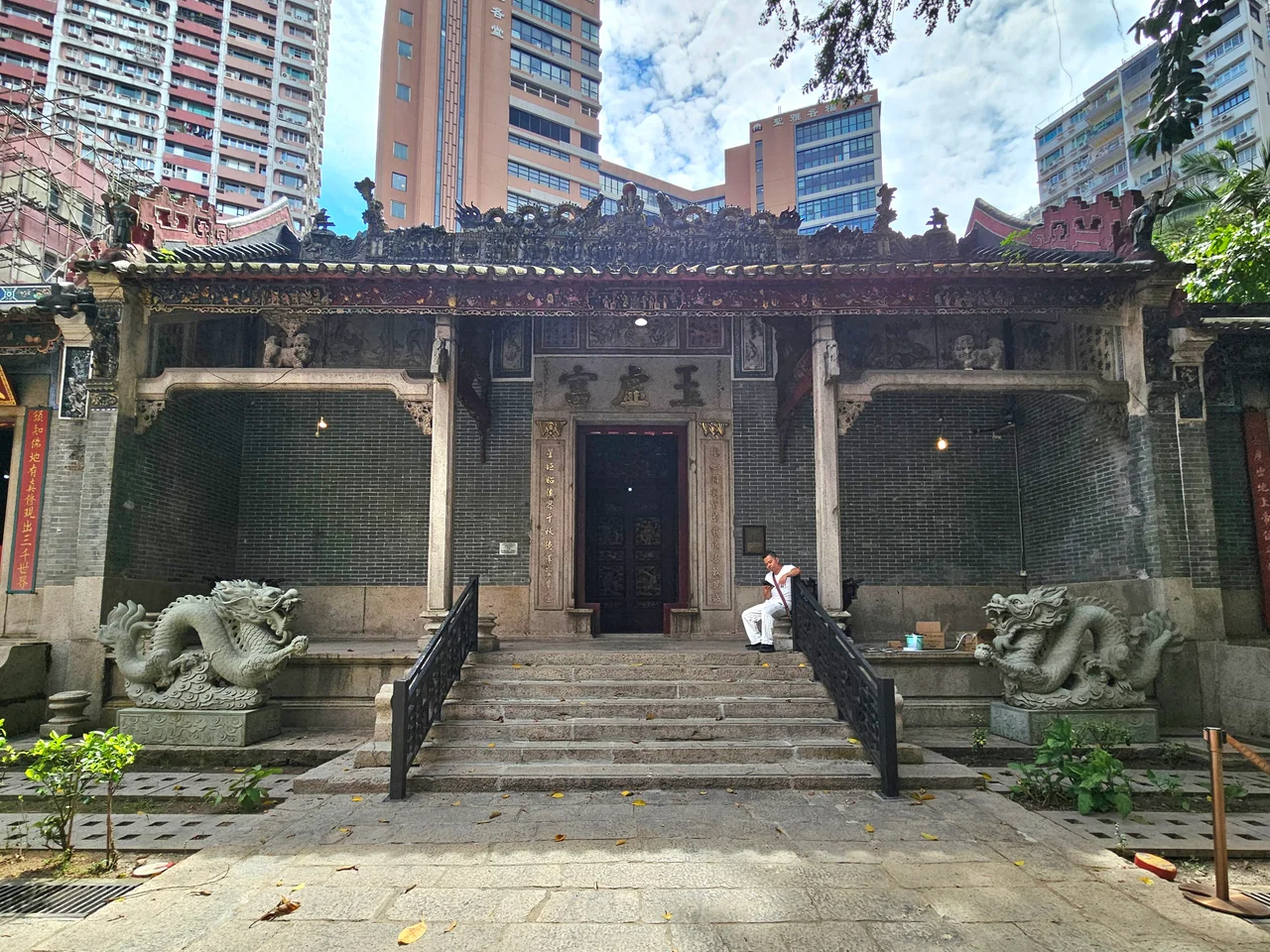

Wan Chai Pak Tai Temple
The statue inside is older than the building that holds it. Standing three metres tall, the Ming Dynasty bronze figure of Pak Tai was cast in 1603 — 260 years before the temple on Lung On Street was completed in 1863. The deity he represents, Pak Tai, is a martial figure in the Taoist pantheon: the Supreme Emperor of the Dark Heaven, ruler of the northern sky, guardian against evil and chaos. That a statue made under the Wanli Emperor should end up in a neighbourhood temple in what was then a small fishing and agricultural community on Hong Kong Island is the kind of trajectory that needs no embellishment. The Wan Chai Pak Tai Temple, also known as Yuk Hui Kung, was built by locals. It has been a declared monument of Hong Kong since 1991.
The God of the Temple
Pak Tai — whose name translates roughly as Supreme Emperor of the Dark North — occupies a significant position in southern Chinese folk religion and Taoism. He is a martial deity associated with water, the northern sky, and protection from evil. In Hong Kong, his worship is particularly strong in communities with fishing and maritime connections, which explains his presence in a neighbourhood that once faced directly onto the harbour. The three-metre statue is the temple's visual and spiritual centrepiece: seated, robed, solemn, flanked by ceremonial objects. Surrounding him are the various subsidiary halls and deities that populate a fully functioning traditional temple — to his left, a Hall of Lung Mo and a Hall of the God of Wealth; to his right, a Hall of Three Treasures. The keeper's quarters adjoin the complex. Taken together, these spaces constitute a small but complete devotional world within the dense streets of Wan Chai.
Lotus Lanterns and Antique Bells
The 1863 bells are still here. Cast in the same year the temple was built, they represent the community's investment in the site from the very beginning — not a utilitarian structure later adorned, but a place conceived with ceremony and permanence in mind. The lotus lanterns that decorate the interior are a traditional element of Chinese temple ornamentation, symbols of purity and enlightenment in both Taoist and Buddhist contexts. Their presence, alongside the ancestral tablets, incense spirals, and donated offerings that accumulate in any active temple, gives the Pak Tai Temple the feel of a place still in use rather than merely preserved. Services continue. The Chinese Temples Committee, which administers dozens of temples across Hong Kong, maintains the site. It is a monument that still functions as what it was built to be.
A Neighbourhood Landmark
Lung On Street in Wan Chai is not a grand thoroughfare. It is a quiet lane near the upper end of Stone Nullah Lane, in the older, hillier part of the district that climbs away from the harbourfront towers. The temple sits within the residential grain of this neighbourhood, rather than isolated on a plinth or plaza. As one of the stops on the Wan Chai Heritage Trail, it connects to the broader story of old Wan Chai's built environment — the tong-laus, the markets, the other temples — as a thread in a community fabric rather than an isolated curiosity. Visitors arriving from the trail's lower sections walk uphill to reach it, which feels appropriate. The effort of the climb, past laundries and small shops and the sounds of a neighbourhood going about its day, prepares you for the relative quiet of the courtyard and the presence of the three-metre figure waiting inside.
From the Air
The Wan Chai Pak Tai Temple is located at approximately 22.2729°N, 114.1738°E, on Lung On Street in the residential uphill section of Wan Chai. From 1,500 feet, the temple's traditional curved roof tiles are distinguishable against the surrounding low-rise urban texture, south of the main Queen's Road East commercial strip. The temple sits roughly 600 metres south of the Victoria Harbour waterfront. Hong Kong International Airport (VHHH) is about 35 km to the west at Lantau Island.
Nearby Stories
- Lok Ma Chau Loop 2.3 km away
- Portas do Cerco 2.3 km away
- Kweilin Incident 17 km away
- Wanshan Archipelago Campaign 34 km away
- Nanxiong Formation 115 km away
- Battle of Nanpeng Island 148 km away
- Heyuan 169 km away
- Cape Maobitou 632 km away