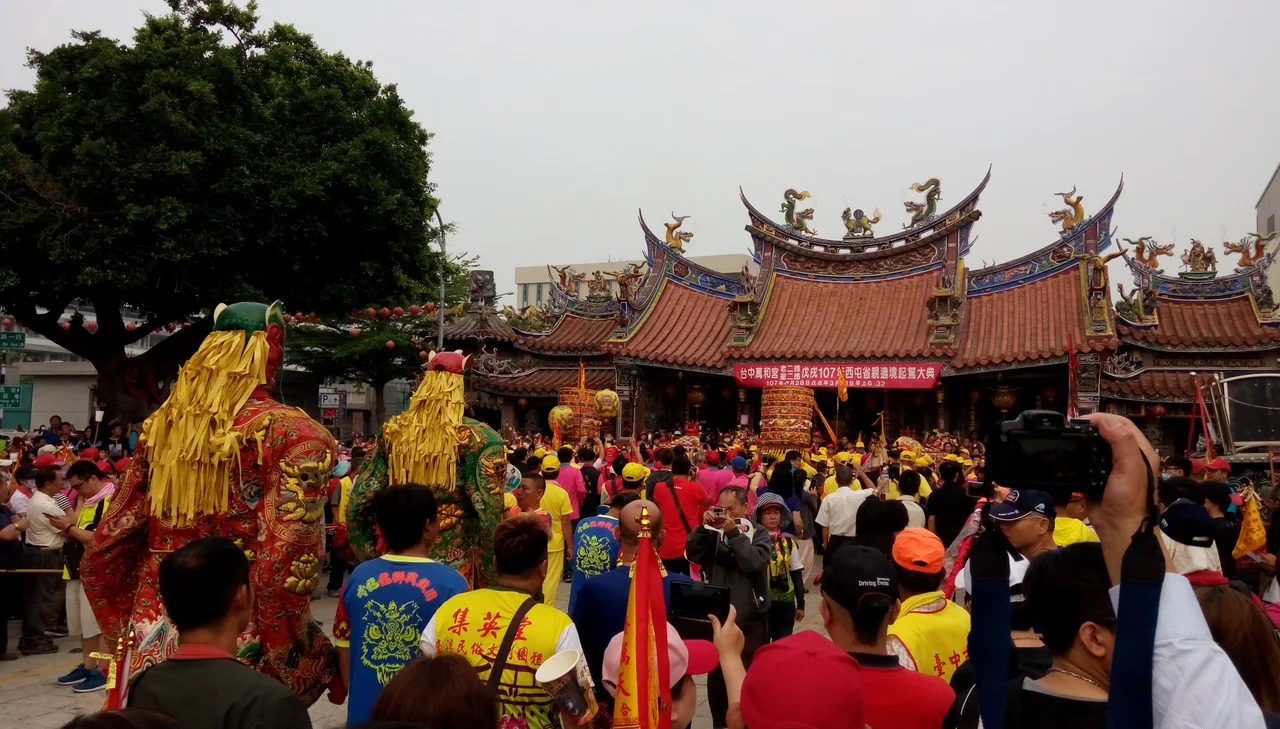

Wanhe Temple
The name was chosen carefully. When eleven families joined together in 1726 to build a temple for Mazu, the sea goddess, in the village then called Litoudian, they picked the name "Wanhe" — meaning "ten thousand harmony" — as a deliberate wish: that different families and clans might live peacefully alongside each other. Nearly three centuries later, Wanhe Temple still stands in what is now the Nantun District of Taichung City, a city monument since 1985 and one of the oldest temples continuously operating in the city.
From Meizhou to Litoudian
The story begins with a Qing Dynasty official from Quanzhou who brought a copy of a Mazu statue from the goddess's birthplace on Meizhou Island to the site of what would become Wanhe Temple. Mazu — protector of sailors and fisherfolk, one of the most widely venerated figures in Chinese popular religion — had a particular hold in Taiwan, where migrants crossing the treacherous Taiwan Strait had long sought her intercession. When Litoudian grew into a larger village, Zhang Guo's descendants and ten other founding families built the temple in 1726, formalizing what had been a local devotional practice into a permanent institution. The temple faced east from its founding, an orientation it still maintains. Taichung City itself would not be formally established until the Japanese colonial period; Wanhe Temple predates the city's modern incarnation by nearly two centuries.
A Building That Has Survived Everything
No part of the original 1726 structure survives. Wanhe Temple has been damaged, repaired, damaged again, and rebuilt so many times that the oldest visible fabric dates only to the Japanese era of the late 19th and early 20th centuries. The litany of damage is worth recounting: an earthquake in 1821, the Tai Chao-chuen incident of 1862 (a serious civil conflict in Taiwan), and then renovations in 1913, 1953, 1961, and 1977. In 1961, the temple was formally appropriated with demolition as the intended outcome; temple officials negotiated their way out of that fate and used the settlement to purchase the land in front of the building as a public plaza. What stands today has three central halls facing east, two flanking halls built in 1991, and a main hall displaying multiple Mazu statues made in different dynasties — Laodama from the founding era, Lao'erma from the Jiaqing period, figures from the Guangxu era, and one from the postwar years. The rear hall holds Guanyin at center, flanked by Guan Yu and Shennong.
The Statue That Wept
The most haunting story attached to Wanhe Temple involves the Lao'erma statue, created in 1803. According to temple tradition, a merchant passing through the village had a vision: a young woman's spirit appeared and gave him her family name — Liao — and her village — Xitun — and asked him to tell her parents where to find money she had left hidden beneath a tree. The merchant delivered the message. When the family rushed to their daughter's room, they found that she had died. They came to Wanhe Temple to mourn, and on the face of the newly made Lao'erma statue, they found tear streaks. The belief took root that their daughter's spirit had entered the statue. Every three years since, the residents of Xitun embark on a pilgrimage to Wanhe Temple, taking Lao'erma "home" to Qingling Temple in Xitun, where the statue rests for a time before returning. The pilgrimage continues today.
Opera for the Goddess
Each year during the third month of the Chinese lunar calendar, Wanhe Temple hosts a practice called Zixingxi — literally, a rotation of opera performances organized by surname group. The custom traces to 1824, when Wanhe Temple joined Lecheng Temple on an annual eighteen-village pilgrimage and the litter carrying Mazu became suddenly, inexplicably heavy at the gate of Wanhe Temple. Poe divination — the casting of crescent-shaped blocks to read a deity's wishes — was performed, and the interpretation came back clear: Mazu wanted to watch Chinese opera. Every year since, each of the eleven founding families has sent an opera troupe to perform in the temple plaza. As of 2019, the tradition had run uninterrupted for 195 years. The performances are not for tourists. They are for the goddess.
From the Air
Wanhe Temple is located at 24.14°N, 120.64°E in Nantun District, in the southwestern part of Taichung City. Approaching Taichung from the west at 6,000 feet over the Taiwan Strait, the city's grid becomes visible as the coastline gives way to the Taichung Basin. Taichung International Airport (RCMQ) sits approximately 8 kilometers northwest. The temple itself is not visually distinguishable from altitude, set within the dense urban fabric of Nantun, but the broad grid of the district's streets surrounding the older commercial core provides geographic orientation.
Nearby Stories
- Taroko National Park 4.5 km away
- Jiji, Nantou 9 km away
- Miaoli Ceramics Museum 9.2 km away
- Smangus 17 km away
- Taixi, Yunlin 23 km away
- Lintianshan Forestry Culture Park 24 km away
- Taiwan Strait 52 km away
- China Airlines Flight 611 60 km away