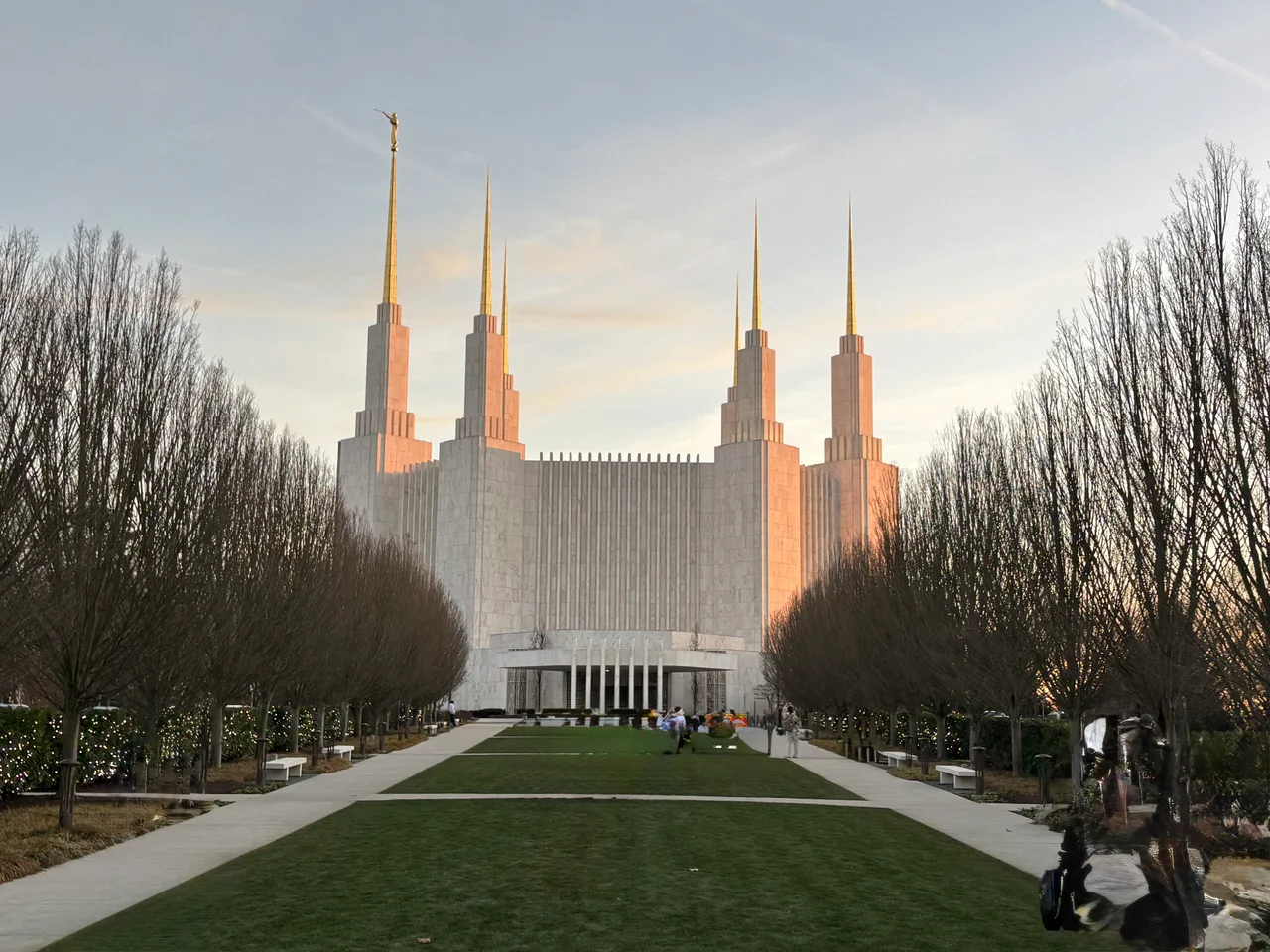

Washington D.C. Temple
Sometime in the early 1970s, a Beltway commuter looked at the six gilded spires rising over the trees of Kensington, Maryland, and saw the Emerald City. The Washington D.C. Temple - just completed by the Church of Jesus Christ of Latter-day Saints, 288 feet tall at its central tower, sheathed in white Alabama marble with six spires tipped in twenty-four-carat gold - did, viewed from a certain angle on the Outer Loop heading north, look uncannily like the city Dorothy approached at the end of the yellow brick road. In 1973 or 1974, somebody climbed onto the railroad bridge that crosses the Beltway just south of the temple and spray-painted two words on the concrete: SURRENDER DOROTHY. The graffiti was painted over. It was repainted. The pattern continued for decades. The Washington Post in the 1990s called it the single most famous graffito in the Washington area. The church, the paper noted, reportedly did not love it. By the 2010s the bridge had been repainted with anti-graffiti coatings and the words appeared less often. A generation of Washingtonians still hears Dorothy whisper when they see the spires.
First Temple East of the Mississippi
The Washington temple was the first Latter-day Saints temple built east of the Mississippi River since the original Nauvoo Temple of 1846 - which was destroyed by arson in 1848 after the Saints had been driven from Illinois and made their crossing to the Great Basin. Church president David O. McKay announced the Washington temple project on November 15, 1968, with the Washington area's Latter-day Saint population having grown enough since the 1950s federal-government boom to warrant a temple of its own. Construction began in May 1971. The dedication took place on November 19, 1974 - by which time President McKay had died and Spencer W. Kimball was leading the church. More than 750,000 people attended the seven-week public open house that preceded the dedication, walking through the temple's sealing rooms, baptistry, and celestial room before the building was reserved for members with current temple recommends. The 1974 attendance figures made it one of the largest pre-dedication open houses in church history. At 160,000 square feet, it remains the church's third-largest operating temple.
The Race Question
The decision to build the temple in metropolitan Washington was contested inside the church's senior leadership. When David O. McKay presented the plan to the Quorum of the Twelve Apostles in 1968, two of the more conservative apostles - Mark E. Petersen and Harold B. Lee, who would later become church president - objected to the location specifically because of the District's significant African American population. At that time the church had policies that barred Black men from holding the priesthood and Black members from temple ordinances, and the apostles feared the temple site would attract protests from civil rights advocates. Lee favored building the temple in Valley Forge, Pennsylvania, where the surrounding population was overwhelmingly white. McKay overruled them, and construction proceeded as planned. The church's racial restrictions were lifted in June 1978 by a revelation announced by President Spencer W. Kimball - four years after the temple's dedication, with the temple already in operation. The historical irony is recorded in the Deseret News and other church publications: the temple Lee and Petersen wanted to put elsewhere has, since 1978, served members of all races, including the growing Black Latter-day Saint membership in the Washington region.
Marble, Gold, and Stained Glass
The building is reinforced concrete and structural steel, sheathed in white Alabama marble (Sylacauga marble, specifically - the same stone used for the Lincoln Memorial). The six spires are coated in twenty-four-carat gold leaf. The central eastern tower, the tallest, supports an eighteen-foot gilded statue of the angel Moroni - in this case shown holding a set of golden plates, one of the first temple Moronis to depict the angel in this way. Two large stained-glass windows light the easternmost and westernmost spires. During the 2018-2022 renovation, an architectural-glass firm took charcoal rubbings of every leaded panel, cleaned and recast each piece in resin, and reinstalled the windows to match the original 1974 design. The temple uses the Big Dipper (pointing at Polaris, the North Star) as one of its decorative motifs - one of the only LDS temples to do so - meant to symbolize the church's leadership constantly pointing followers toward God. The fifty-seven-acre site sits at the bend of Stoneybrook Drive and the Capital Beltway, with mature hardwoods surrounding the building. Only eleven acres are developed; the rest is woods.
The Festival of Lights
Since 1978, the temple's visitors center has hosted an annual Festival of Lights running from late November through early January. Millions of small white lights are strung through the grounds. The Washington D.C. Temple Choir performs. A narrated outdoor nativity scene is staged at one end of the grounds. The festival is free and open to the public - one of the few times non-members can come onto the temple grounds at night. Beginning in 1989, the church began inviting a different foreign ambassador each year to co-host the festival's opening ceremony as a gesture of interfaith and international diplomacy. Past co-hosts have included ambassadors from Jordan, Brazil, the Philippines, Norway, and Vatican City. The Festival of Lights draws tens of thousands of visitors annually from across the metropolitan area, and is one of the most-attended seasonal events in the Washington suburbs. The lighting ceremony each year is one of the few moments at the temple when the building's massive scale is fully visible - lit from below, all six spires glowing gold against the winter sky.
Renovation and Reopening
In February 2017 the church announced that the temple would close in March 2018 for a comprehensive three-year renovation to update mechanical systems, refurbish interior finishes, and commission new artwork. The visitors center remained open throughout. The renovation took longer than planned; the COVID-19 pandemic delayed the public open house and rededication first scheduled for late 2020. The renovated temple finally reopened to the public on April 28, 2022, with the rededication held on August 14, 2022. Over 250,000 people visited during the 2022 public open house. The new artwork commissioned for the rededication explicitly reflected the church's increasingly global and racially diverse membership - paintings of Latter-day Saint pioneers from Nigeria, the Philippines, Brazil, and other countries joined the more traditional depictions of nineteenth-century American Saints. Church historian Emily Utt described the artwork choices as a deliberate visual representation of how much the church had changed since 1974. The temple now serves about 38 stakes across Maryland, Virginia, Pennsylvania, the District of Columbia, and West Virginia. Surrender Dorothy still occasionally appears on the bridge.
From the Air
The Washington D.C. Temple sits at 39.0142 degrees N, 77.0656 degrees W in Kensington, Maryland, on a 57-acre wooded site between Stoneybrook Drive and the Capital Beltway (I-495). From the air the building is immediately recognizable - a six-spired white marble structure rising from a green hilltop, the central tower at 288 feet visible from many miles in clear weather. Best viewed at 2,000 to 4,000 feet AGL; the site lies just outside the DC FRZ but within the SFRA. Nearest airports are Montgomery County Airpark (KGAI) 7 nm north, Ronald Reagan Washington National (KDCA) 8 nm south, and Washington Dulles (KIAD) 18 nm west.
Nearby Stories
- Gunston Hall 1.1 km away
- 2023 Baltimore Shooting 4.9 km away
- Battle of Middleburg 6.6 km away
- Crownsville Hospital Center 10 km away
- Battle of Loudoun Heights 13 km away
- First Battle of Rappahannock Station 20 km away
- Howard County, Maryland 21 km away
- Harriet Tubman Underground Railroad 50 km away