
West End
Lafayette Square holds the densest known squirrel population in any urban park on Earth. Biologists at the Smithsonian have estimated the density at over fifteen squirrels per acre - several times the average city park rate. The black squirrels visible among the more common gray ones are descendants of eight Canadian black squirrels sent from Ontario in 1902 as part of a National Zoo exchange, intended to add natural variety to the Zoo's collection. Some escaped. They liked Lafayette Square - which sits directly across from the White House, framed on its four corners by bronze statues of Lafayette, Rochambeau, Kosciuszko, and Friedrich von Steuben, all foreign-born generals who fought in the American Revolution. The Park Service has been mowing around their burrows ever since. The squirrels do not care that the most famous house in the world is across the street. They simply care that the tourists drop popcorn.
1600 Pennsylvania
Construction on the White House began in 1792, under the supervision of the Irish-born architect James Hoban, who modeled the building on Leinster House in Dublin (now the seat of the Irish parliament). The construction force included enslaved African Americans hired from their owners, free African Americans, and European immigrants - principally Scottish stonemasons recruited specifically for the sandstone work. John Adams moved in on November 1, 1800, the first president to occupy the residence. Thomas Jefferson opened the building to the general public, a practice that continued in some form until the security concerns of the September 11 attacks restricted access. British troops burned the building on August 24, 1814; the Hoban sandstone walls survived, and James Madison's architects rebuilt the interior over the following three years, with a coat of white paint applied to mask the smoke damage on the sandstone. The name 'White House' was officially adopted by Theodore Roosevelt in 1901. The East Wing was added under Calvin Coolidge in 1942; the West Wing's modern configuration dates to a renovation completed by Truman in 1952, which rebuilt the entire interior on a steel frame while preserving Hoban's original sandstone walls. Jacqueline Kennedy redecorated most of the public rooms in the early 1960s, drawing on the donated antiques and reproduction furniture program she championed.
K Street
Just north of the White House grounds runs K Street NW, the corridor that gave its name to the American lobbying industry. The Watergate scandal of 1972 prompted Congress to pass campaign finance and disclosure laws that, paradoxically, professionalized and expanded the lobbying business. The American Bar Association's 1973 model lobbying code, the 1974 Federal Election Campaign Act amendments, and the explosion of trade associations during the late 1970s drew thousands of lawyers, consultants, and advocates to the K Street corridor between the White House and Connecticut Avenue. The trade name K Street Lobby remains synonymous, in American political shorthand, with the professional influence industry. The reality of K Street is partly different - many of the buildings house international development organizations, foreign embassies, multinational corporations, and law firms whose work has nothing to do with lobbying. But the political shorthand has stuck. At night, K Street empties quickly. Most of the office workers commute out of the District by 7 p.m. The corridor's recent transformation has involved adding hotels, restaurants, and condominiums to give the area some after-hours life.
Foggy Bottom
South of K Street, beyond the State Department's monolithic 1961 headquarters at 23rd and C Streets, lies Foggy Bottom - so named because the low-lying neighborhood at the confluence of Rock Creek and the Potomac was chronically blanketed in industrial smoke from the gasworks and breweries that operated here in the nineteenth century. The C&O Canal terminated here. The Heurich Brewery (whose owner Christian Heurich is buried in Rock Creek Cemetery) ran from 1872 to 1956 at what is now the Kennedy Center site. George Washington University, founded in 1821, occupies most of the neighborhood now, with about 12,000 undergraduates and 14,000 graduate students. The State Department, the World Bank, the International Monetary Fund, the Federal Reserve, the Pan American Health Organization, and the American Red Cross are all headquartered within a few blocks of each other. The Watergate complex - the curved Italian-designed apartment-hotel-office complex whose name became American shorthand for political scandal after the 1972 Democratic National Committee break-in - sits at the southern edge of Foggy Bottom at the river. The Kennedy Center for the Performing Arts, dedicated in 1971 in memory of John Kennedy, sits just south of the Watergate.
The Kennedy Center
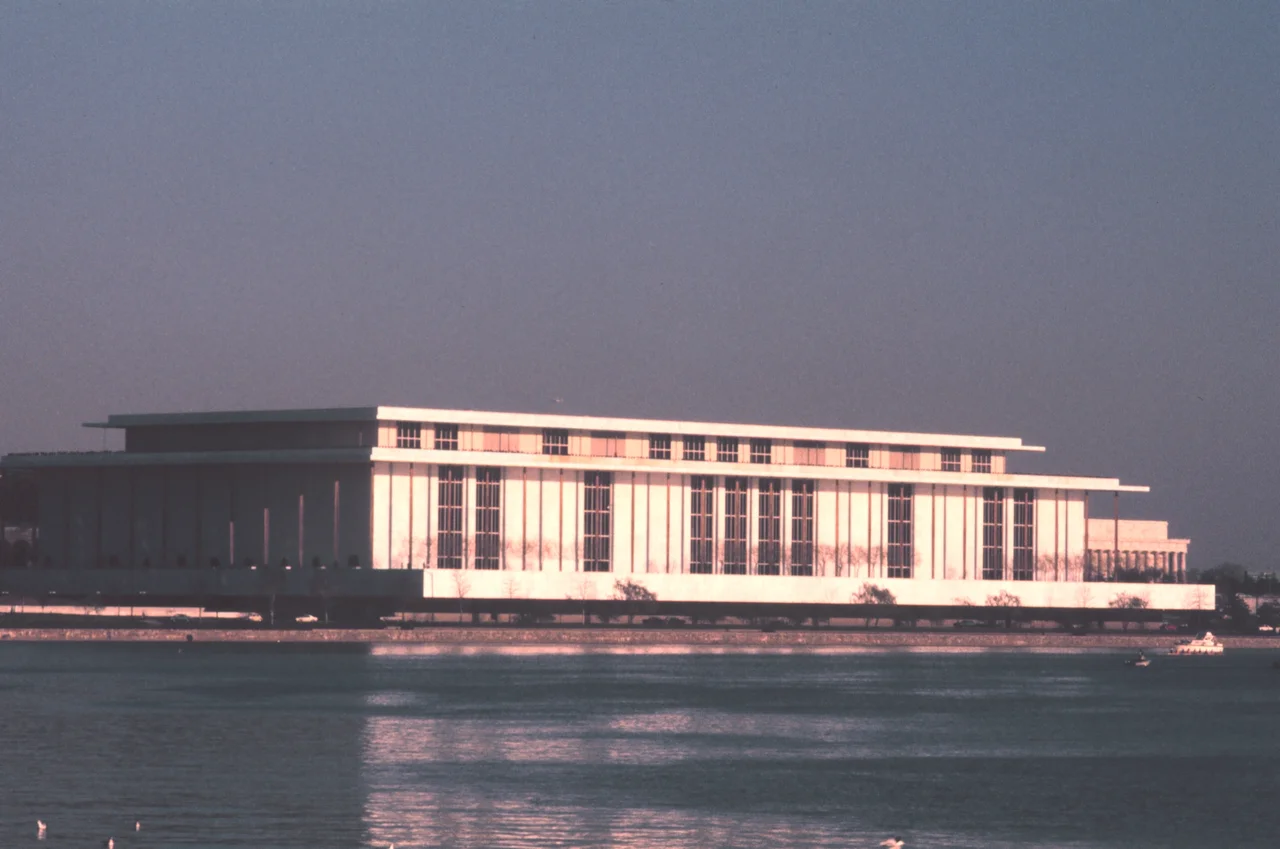
The John F. Kennedy Center for the Performing Arts was authorized by Congress as the National Cultural Center in 1958, then renamed and rededicated as a memorial to the assassinated president in 1964. The building, designed by Edward Durell Stone in a kind of restrained Neoclassical-Modern hybrid (all white marble pylons and gold-anodized aluminum), opened to the public on September 8, 1971. Bernstein's Mass received its world premiere at the opening, conducted by Maurice Peress. The Center now houses the National Symphony Orchestra, the Washington National Opera, the Suzanne Farrell Ballet, the National Symphony Pops, and a constellation of smaller resident companies. The Reach, a 4.6-acre cultural campus and pavilion complex designed by Steven Holl, opened on the Center's south lawn in 2019. The Kennedy Center Honors, awarded annually since 1978, are televised as part of a Christmas-week broadcast and remain the most prestigious lifetime achievement award in American performing arts. Honorees have included Tennessee Williams, Bob Hope, Aretha Franklin, Frank Sinatra, Stephen Sondheim, Meryl Streep, and the surviving members of Led Zeppelin.
Lafayette Square and Black Lives Matter Plaza
Lafayette Square, the seven-acre public park directly north of the White House across Pennsylvania Avenue, is technically not a square - it is a hexagon, designed as a presidential park in Pierre L'Enfant's 1791 plan. The equestrian statue of Andrew Jackson at its center, sculpted by Clark Mills and dedicated in 1853, was the first equestrian statue cast in the United States. The four corner statues depict foreign generals who fought for American independence: Lafayette (southeast), Rochambeau (southwest), Kosciuszko (northeast), and von Steuben (northwest). Pennsylvania Avenue itself, the block between Lafayette Square and the White House, was permanently closed to vehicle traffic in 1995 after the Oklahoma City bombing raised concerns about truck bombs. The closure converted the block into a pedestrian-only plaza popular with street hockey players, demonstrators, and tourists. In June 2020, Mayor Muriel Bowser had BLACK LIVES MATTER painted in 35-foot yellow letters running two blocks along 16th Street NW immediately north of Lafayette Square, in response to the federal response to the George Floyd protests. The street section was renamed Black Lives Matter Plaza in the same week. The yellow letters were repainted intermittently, contested, and partly painted over during subsequent administrations.
From the Air
The West End is roughly bounded by 15th Street NW on the east, Pennsylvania Avenue on the north, Rock Creek on the west, and Constitution Avenue on the south, centered near 38.9008 degrees N, 77.0497 degrees W. From the air the area's signature buildings - the White House complex, the State Department headquarters, the Watergate's curving facade, and the white marble Kennedy Center extending into the Potomac - are all easily identified. Best viewed at 1,500 to 3,000 feet AGL; the entire site lies within the Washington FRZ and the prohibited area P-56A, with the most restrictive airspace in the United States. Nearest airports are Ronald Reagan Washington National (KDCA) 3 nm south, College Park (KCGS) 7 nm northeast, and Washington Dulles (KIAD) 22 nm west.
Nearby Stories
- Gunston Hall 1.1 km away
- 2023 Baltimore Shooting 4.9 km away
- Battle of Middleburg 6.6 km away
- Crownsville Hospital Center 10 km away
- Battle of Loudoun Heights 13 km away
- First Battle of Rappahannock Station 20 km away
- Howard County, Maryland 21 km away
- Harriet Tubman Underground Railroad 50 km away