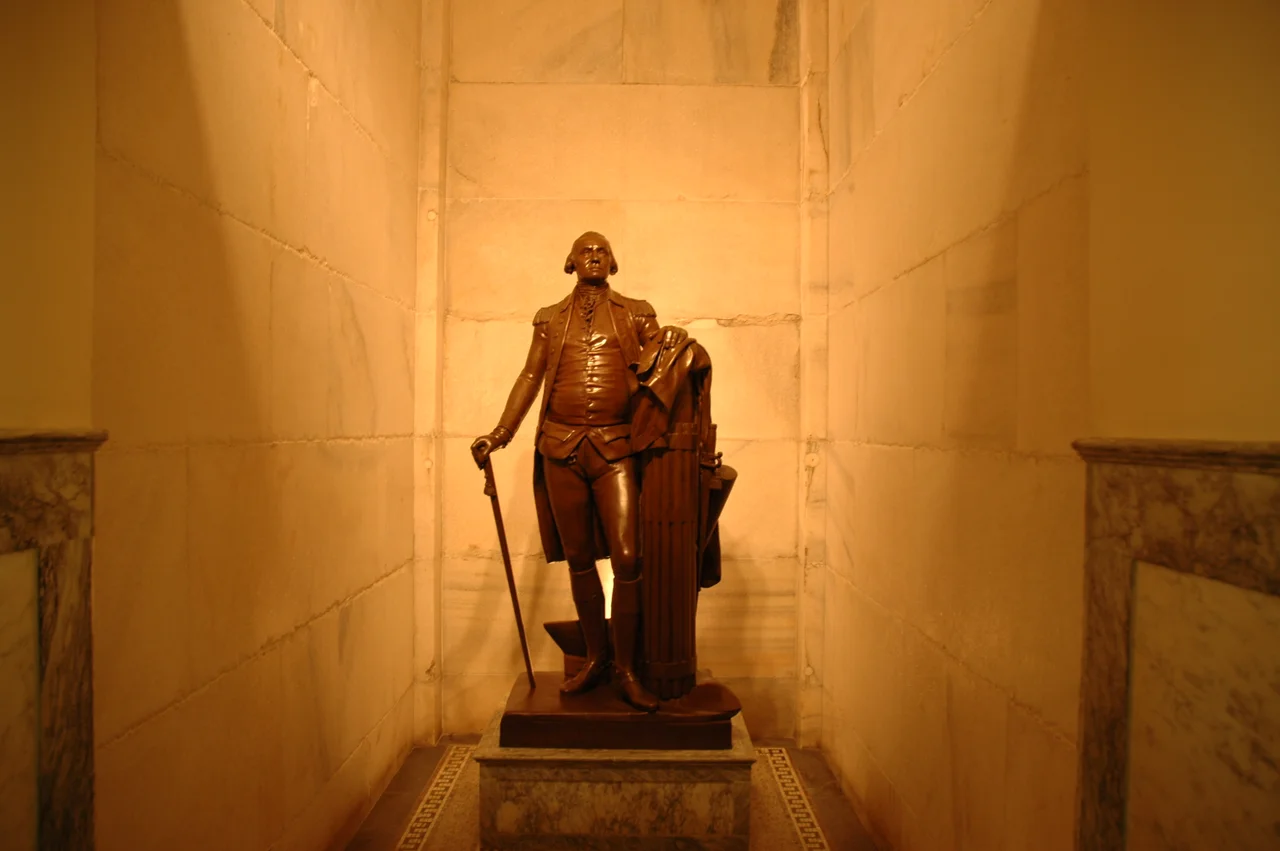

Washington Monument
Stand at the base of the obelisk and look up, and you can see the seam. About a third of the way up, the marble shifts color - lighter below, darker above - because the Washington Monument was built in two phases separated by almost a quarter century. Construction began in 1848 with white Cockeysville marble from the Texas Quarry in Maryland. Then the money ran out, the Civil War intervened, and the unfinished stump sat at 152 feet for nearly twenty years. When work resumed in 1879, the original quarry vein had shifted, and even the same source produced stone of a noticeably different shade. The monument carries the pause in its skin.
An Obelisk for a Republic
The design - a tapering shaft topped by a small pyramid - is the oldest monumental form on Earth, borrowed from ancient Egypt to honor the first president of a new republic. Architect Robert Mills drew up something more elaborate, ringed by columns and statuary. None of that ever got built. What rose instead is severe, almost stark: 554 feet of marble climbing into the sky with no ornament except the inscriptions cut into the aluminum apex. When that capstone was set on December 6, 1884, the monument briefly became the tallest structure in the world, a record held until the Eiffel Tower opened in 1889. The aluminum tip itself was a marvel - the metal was so rare and expensive in 1884 that the nine-inch pyramid was, briefly, one of the most valuable single objects in America.
Memorial Stones
Climb the stairs - all 897 risers - and you walk past one of the strangest archives in the country. Embedded in the interior walls are 193 memorial stones, contributed by states, cities, foreign governments, churches, fraternal orders, and Sunday schools. The Sabbath School children of the Methodist Episcopal Church in Philadelphia donated one with a quotation from Proverbs 10:7: "The memory of the just is blessed." Pope Pius IX sent a block of marble from the Temple of Concord in Rome in 1854. American nativists, suspicious of papal influence, stole and reportedly threw it into the Potomac. It never reached the monument; a replacement was finally installed in 1989, more than 130 years later. The stones inside the shaft are not just decoration. They are the country talking to itself, sometimes generously, sometimes meanly.
Engineering the Pyramidion
The cap of the monument - the pyramidion - is a feat of structural cleverness. Its marble panels are only seven inches thick, but they don't carry the weight above them. Instead, internal marble ribs transfer the load down to the shaft walls. Twelve courses of slabs, an inch overlap to keep water out, and the whole thing tops out at 300 long tons of stone held together by geometry. Lightning was the constant enemy. The original system used a single aluminum rod, then expanded to 200 gold-plated, platinum-tipped copper points strung in a net across the pyramidion after the marble was damaged. In 2013, the National Park Service stripped it all out and installed two simple aluminum rods. The earthquake that cracked the upper marble in August 2011 took years to repair; harnesses dangled climbers down the obelisk's faces while tourists watched from below.
The View from 500 Feet
The observation level sits at 499 feet above the entry lobby, behind small windows on each of the four cardinal sides. North looks up Sixteenth Street toward the White House and Lafayette Square. East stretches down the Mall to the Capitol dome. South looks across the Tidal Basin to the Jefferson Memorial. West follows the long reflecting pool to the Lincoln Memorial and, beyond it, the Potomac and Arlington. On a clear day the view extends thirty miles. The monument is the geometric center of L'Enfant's plan for the federal city - the point where the axes of the Capitol and the White House intersect - and from the top, you can finally see why the streets bend the way they do. Everything radiates from this point.
Closures and Returns
The monument has been closed for years at a stretch. The 2011 earthquake shuttered it from August of that year until May 2014. A faulty elevator and seismic monitor closed it again from 2016 to 2019. After September 11, 2001, a temporary security building - an unlovely wooden cube - was bolted onto the east entrance, eventually replaced by a low granite ha-ha wall designed by landscape architect Laurie Olin, who turned a hardened perimeter into something that doubles as a bench. The Washington Monument keeps closing and reopening, breaking and being repaired. It is the most visited memorial on the Mall, and the most maintained. From a quarter mile away across the grass, the seam in the marble is invisible. From its base, looking straight up, it is unmistakable.
From the Air
The Washington Monument stands at 38.8895 N, 77.0353 W, in the heart of the National Mall. At 554 feet 7 inches tall (per the 2014 NOAA survey that revised the historical 555-foot figure), it is by far the dominant vertical landmark in the Washington Flight Restricted Zone, which excludes general aviation traffic without prior authorization. Reagan National Airport (KDCA) is just two miles south; the monument's apex sits roughly 600 feet above sea level. From an arriving airliner over the Potomac approach, the obelisk is the white needle aligning with the Capitol dome to the east and the Lincoln Memorial to the west - the visual spine of L'Enfant's 1791 plan still legible from altitude.
Nearby Stories
- Gunston Hall 1.1 km away
- 2023 Baltimore Shooting 4.9 km away
- Battle of Middleburg 6.6 km away
- Crownsville Hospital Center 10 km away
- Battle of Loudoun Heights 13 km away
- First Battle of Rappahannock Station 20 km away
- Howard County, Maryland 21 km away
- Harriet Tubman Underground Railroad 50 km away