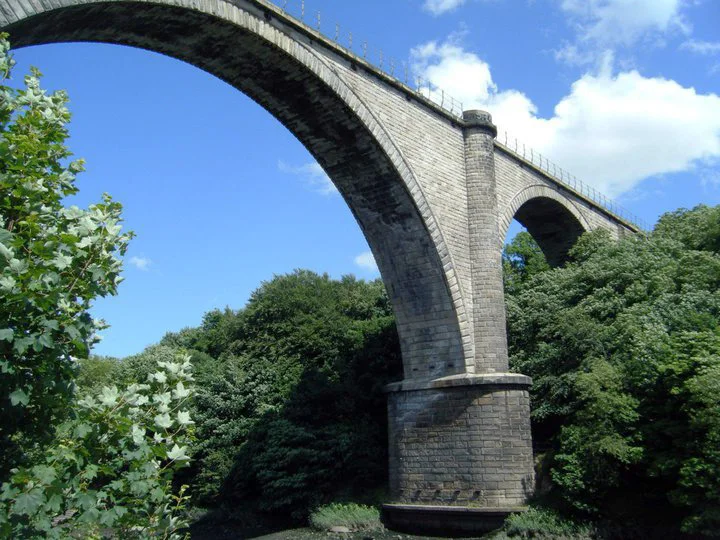

Washington, Tyne and Wear
For nearly two decades, the people of Washington, Tyne and Wear, lived inside a numbered system. Their town had been built without village names. Instead, planners assigned districts numbered one through fifteen, and that is what appeared on road signs, postal addresses, and the maps tourists tried in vain to follow. The numbers were finally abolished in 1983 after twenty years of confused visitors, though they lingered on signposts for years more. Washington has always been an experiment - in industry, in town planning, and in identity. The town that gave its name to a continent now builds Nissans for export to that continent.
Hwaesa's Estate
The name first surfaces in records around 1096, written in Old English as Wasindone. Local historians have argued over its origin ever since. The strongest theory derives it from Anglo-Saxon Hwaesingatun, meaning roughly the estate of the descendants of Hwaesa - Hwaesa being an Old English name that meant wheat sheaf. There is no surviving record of any chieftain or farmer called Hwaesa working this land in the 7th or 8th century, but such records would have been lost long before they could be copied. The other popular theory derives the name from Wascandun, washing hill - inspired by the River Wear that runs through Washington Old Hall's grounds. Linguists generally dismiss this as folk etymology. The wheat-sheaf farmer wins by default, his name carried by chance into the modern world and onto the lapels of American presidents.
Pit Country
Washington's industrial heart was coal. The Washington Colliery's shafts were named alphabetically from A to I; the F Pit alone now survives as a museum in the Albany district, its winding gear standing over a community that grew around the mine. Around the pits, settlements clustered: Little Usworth grew up beside Usworth Colliery before being renamed Sulgrave. Wagonways carried coal to staiths on the River Wear at Sunderland for loading onto seagoing vessels. Alongside the coal pits, the Washington Chemical Works employed thousands in the 19th century, eventually becoming the Cape/Newalls Works that produced insulation - giving Pattinson Town its identity. When the deep pits closed in the 1980s, Washington had already begun its reinvention. The Nissan plant, opened nearby in 1986, is now the largest car assembler in Britain and the largest private-sector employer in the City of Sunderland. The old Goodyear tyre factory site at Washington is now occupied by Rolls-Royce making aero engine blades, and by British Aerospace.
The Washington Family
Around 1183, William de Hertburn - born William Bayard - moved to the Wessyngton estate and took its name, becoming William de Wessyngton. The spelling drifted to Washington by 1539, when the family moved south to Sulgrave Manor in Northamptonshire. From Sulgrave, George Washington's great-grandfather John Washington sailed for Virginia. Washington Old Hall, in the centre of the modern town, was the family's ancestral home; the present structure incorporates parts of the medieval building they knew. Every American Independence Day, a ceremony is held there. Washington's other historical link to America runs through the village of Sulgrave - one of the eighteen residential villages that make up the modern town. The villages also include Albany, Ayton, Barmston, Biddick, Blackfell, Columbia, Concord, Donwell, Fatfield, Glebe, Harraton, Lambton, Mount Pleasant, Oxclose, Rickleton, Teal Farm, Usworth, and Washington Village itself.
Designed and Redesigned
Washington was designated a new town in 1964, joining Tyne and Wear in 1974, and the original five townships of Washington were stitched together with new residential villages on a grand plan. Land in the south west was bought from the Lambton family, the Earls of Durham, whose ancestral home is Lambton Castle. Population doubled from where it had been in the 1950s; at the 2011 census, Washington counted 67,085 residents. The town hosted the very first SavaCentre hypermarket on 15 November 1977 - a joint venture between Sainsbury's and British Home Stores that opened at The Galleries shopping centre. Washington's industrial estates take their names from northern engineers: Parsons, Armstrong, Stephenson, Phineas Crowther, Pattinson, Swan, and Emerson. The Wildfowl and Wetlands Trust runs a nature reserve here, the Washington F Pit Museum preserves the coal heritage, and Bryan Ferry - Roxy Music's frontman - grew up here and went to school at Washington Grammar. Sunderland's England goalkeeper Jordan Pickford was also raised in town.
From the Air
Washington, Tyne and Wear sits at 54.9 N, 1.52 W, between Sunderland and Gateshead. The Newcastle International Airport (EGNT) is about 7 nm north-west. The A1(M) motorway runs along the western boundary, with the Nissan plant visible just to the north-east of town - look for the large white industrial complex. The town's distinctive village-based layout makes it appear as clusters of housing around the central Galleries shopping centre. Best viewed at 2,000-4,000 feet AGL.
Nearby Stories
- Cresswell Lifeboat Station 5.2 km away
- Auckland Castle 5.7 km away
- Battle of Otterburn 7.1 km away
- Saltburn Pier 11 km away
- Hadrian's Wall Path 11 km away
- Battle of Stainmore 18 km away
- Saltburn-by-the-Sea 39 km away
- Alexander L. Kielland (Platform) 296 km away