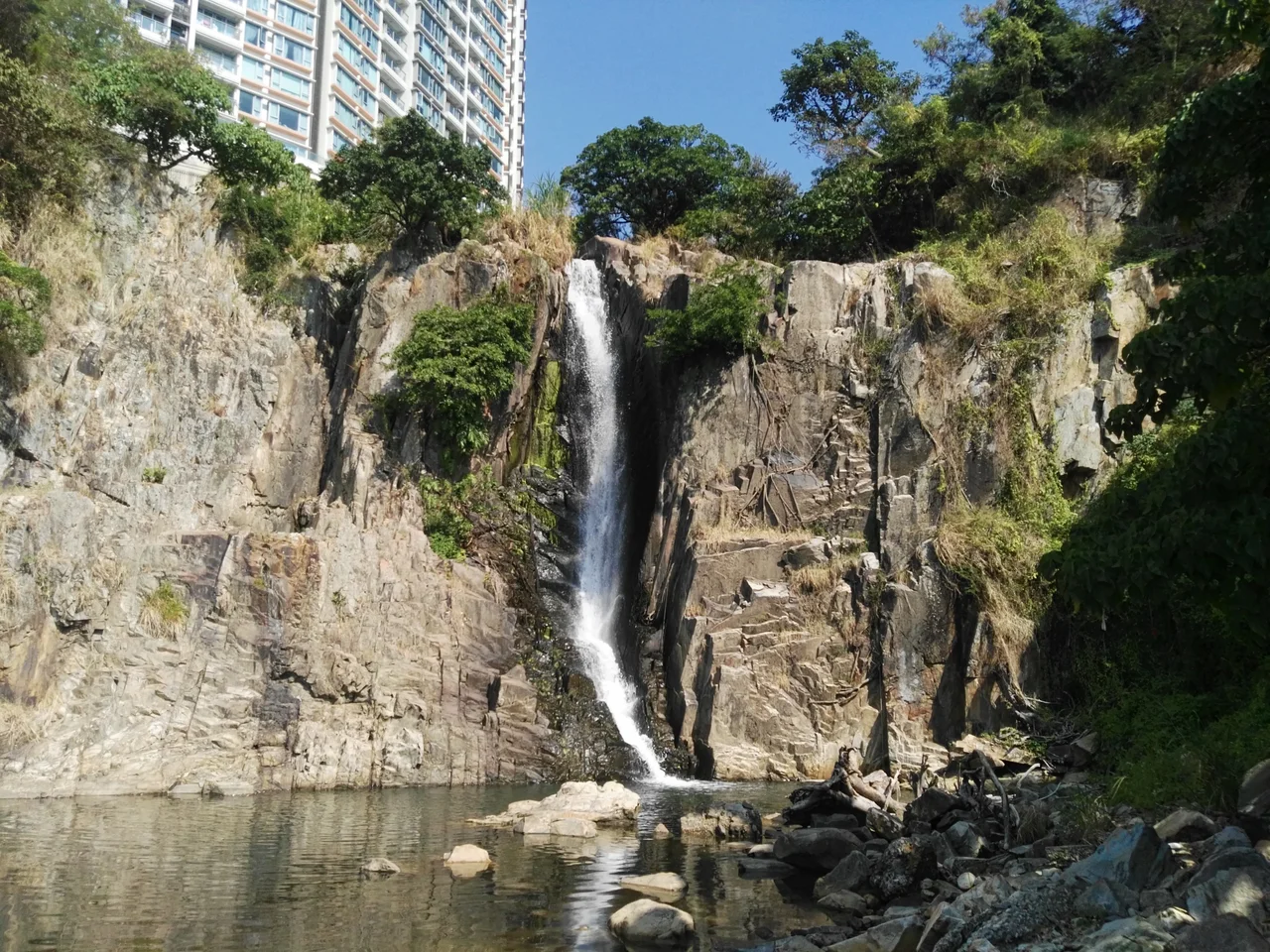

Waterfall Bay, Hong Kong
Hong Kong means 'fragrant harbour,' and scholars dispute where the fragrance came from. The most widely accepted explanation points to the agarwood trade: villages around Aberdeen Harbour processed and exported incense wood — heung (fragrant) gong (harbour) — giving the anchorage, and eventually the island, its name. A second theory, persistent among mariners, points here instead. Fishermen working the southern waters of Hong Kong Island called Aberdeen Harbour 'Hong Kong' because of the fresh water that tumbled into a small bay below Pok Fu Lam — water clean enough to drink, sweet enough to scent a name. British and European sailors learned of it. On voyages between Galle in Ceylon and Malacca in Malaya, they would put in at the bay and refill their casks directly from the falls. In a coastal China where reliable fresh water was scarce, this small waterfall gave the place a reputation that preceded the colony by decades. Whether the name spread from the incense trade or the freshwater falls — or both — remains contested.
The Fall That Named a City
The waterfall at Pok Po Wan — the Cantonese name for Waterfall Bay — drops from the hillside above Wah Fu Estate and the Cyberport residential development into a rocky bay on the East Lamma Channel. The etymology linking the falls to Hong Kong's name is attributed to the fresh water that flowed here: fishermen and sailors used 'Hong Kong' to identify Aberdeen Harbour and its surrounds, with the cascade as the anchor of the reference. Whether the name spread outward from this bay alone or from a broader pattern of clean water sources in the area is uncertain, but the falls were well enough known by the early 19th century to appear in a 1817 painting by William Harvell, making them one of the earliest-recorded natural features of the island.
The geography has not changed as dramatically here as in Wan Chai or Central. The bay still exists. The waterfall still falls.
A Wartime Shelter at the Tideline
By December 1941, Hong Kong was under Japanese assault. The Battle of Hong Kong lasted 17 days before the British garrison surrendered on Christmas Day. Waterfall Bay, already known for its secluded rocky shoreline, served a grim practical purpose during those weeks: the ruins near the falls served as a bunker for Allied soldiers. The structures — now in ruins and accessible at low tide — are among the quieter remnants of the battle scattered across Hong Kong Island. They lack the visibility of the pillboxes on the hilltops or the memorials in the city center, but at low tide, when the rocks are exposed and the falls are audible, the site carries the particular weight of a place where people took shelter and waited.
After the war ended, the bay returned to its long civilian life, far from the development corridors that remade the northern shore.
The Park Around the Falls
Waterfall Bay Park now surrounds the site, accessible from Waterfall Bay Road off Wah Fu Road. A trail descends a series of stairs to the rocky and sandy area below the falls, where the cascade can be seen dropping to the water's edge. The bay forms part of the East Lamma Channel, the strait separating Hong Kong Island from Lamma Island to the southwest.
The park sits between two very different neighbours: Wah Fu Estate, one of Hong Kong's early public housing developments, and Cyberport at Telegraph Bay, a commercial technology complex built in the 2000s. The juxtaposition — public housing, tech campus, colonial-era waterfall — is distinctly Hong Kong. The falls themselves remain indifferent to the company they keep, dropping as they always have into the same small bay where sailors once queued with empty barrels.
From the Air
Waterfall Bay lies at approximately 22.25°N, 114.13°E on the southwestern shore of Hong Kong Island, facing the East Lamma Channel. From the air at 2,000–4,000 feet southbound over the island, the bay appears as a small indentation below the Cyberport complex and the high-rise blocks of Wah Fu Estate. Lamma Island is visible to the southwest. Hong Kong International Airport (VHHH) is approximately 28 km to the west on Lantau Island. The southern coastline of Hong Kong Island is less built up than the northern shore, making Waterfall Bay relatively easy to identify from altitude by its forested hillside above the bay.
Nearby Stories
- Lok Ma Chau Loop 2.3 km away
- Portas do Cerco 2.3 km away
- Kweilin Incident 17 km away
- Wanshan Archipelago Campaign 34 km away
- Nanxiong Formation 115 km away
- Battle of Nanpeng Island 148 km away
- Heyuan 169 km away
- Cape Maobitou 632 km away