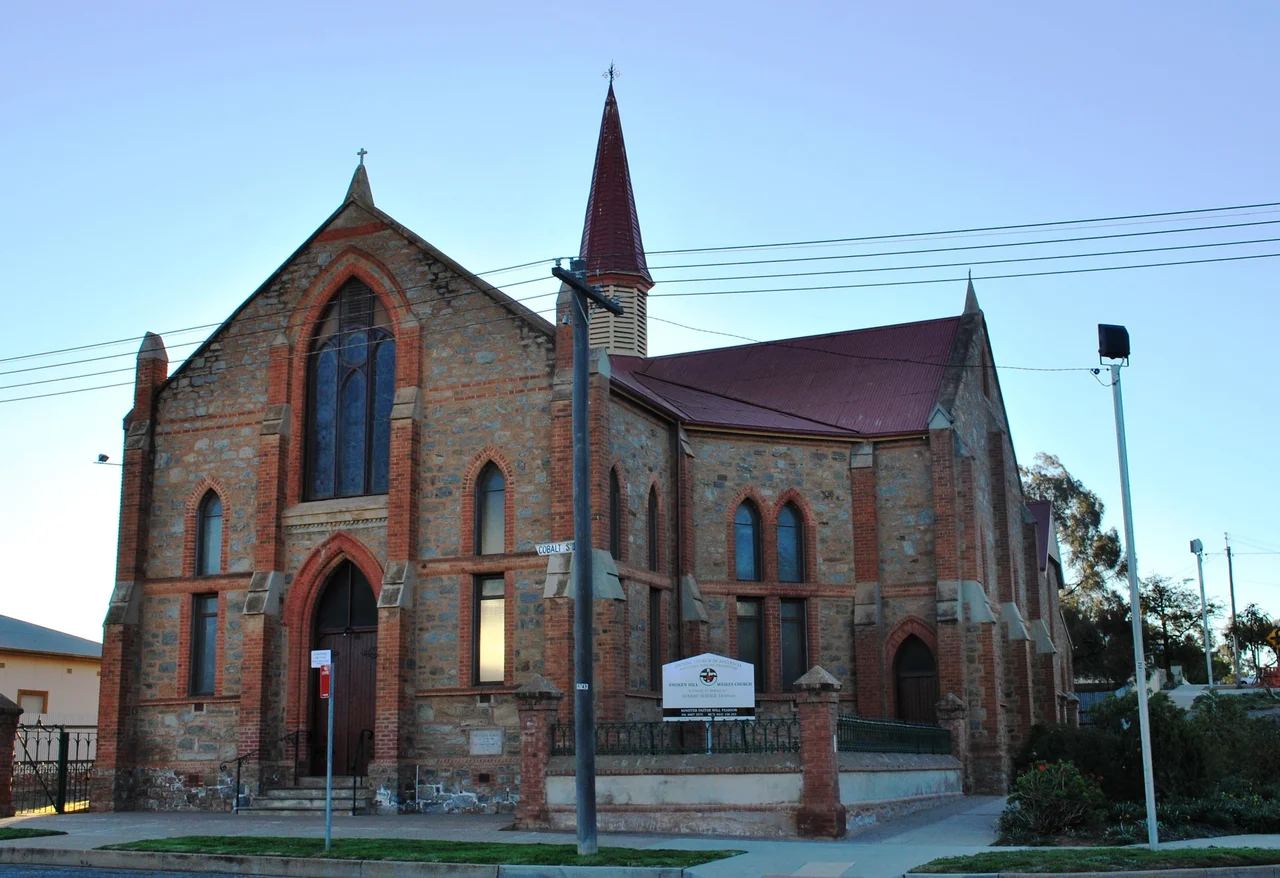

Wesley Uniting Church, Broken Hill
When the silver lode at Broken Hill opened in 1885, the settlement that sprang up to work it was mostly tents. One whole suburb was so flimsy it was simply called Canvas Town. And yet, within three years, a slender octagonal spire of rough-hewn stone was rising above the dust on the corner of Sulphide and Cobalt Streets. The Wesley Church went up almost as fast as the mine that paid for it, a statement that this raw frontier intended to become a real city, with real institutions and a real soul.
The Cornish Brought Their God
The spire is no accident of taste. The mines of Broken Hill pulled in thousands of Cornish miners, many of them from the older diggings of South Australia, and the Cornish carried Methodism the way they carried their tools. Wesleyan Methodism was the faith of the working underground man, plain, fervent and self-organising, and it arrived in the Barrier Ranges practically with the first pick stroke. The church demonstrates that early arrival in stone: built within three years of the start of mining, it marks the moment a mining camp decided it would also be a community. To this congregation, it was the seat of Methodism for the whole Barrier region.
Stone of the Desert
Designed by architect Frederick William Dancker and built between 1885 and 1888 by the firm of Walter and Morris, the church is a study in Victorian Gothic adapted to a harsh, dry place. Its walls are rough-hewn stone trimmed with brick, a method far more common in arid South Australia than in New South Wales, brought east by the same migration that brought the miners. The foundation stone was laid on 31 July 1888, with Mrs Charles Drew setting it in place. Beneath it, the trustees' secretary buried a glass jar of documents, a small time capsule sealed under the building's feet. The slender spire became a landmark on the skyline, looking out across the town's main park.
Older Than the Spire
The faith on this corner is recent; the human story of the land runs far deeper. The country around Broken Hill is that of the Wiljakali people, one of around fifteen Aboriginal groups whose lives were shaped by the great Darling River system to the east. Because water here is so scarce, European settlers were slow to come, and Wiljakali ways of life continued into the 1870s, longer than in much of New South Wales. But scarcity cut both ways. As drought tightened, Aboriginal people were forced onto stations and missions, and by the 1880s many were working in the very mining industry that built this church. The history that followed, including the forced removal of Aboriginal children from their families, is woven into the same decades as this congregation's hymns.
A Church for a Hard Town
Methodism flourished in Broken Hill because Broken Hill needed it. The Silver City grew up on the Line of Lode, the great boomerang-shaped ore body that runs beneath the town, and mining it was brutal and dangerous work. The Line of Lode Miner's Memorial today records the names of some 900 men who died underground over the decades. For families living with that risk, a church was not a luxury but a refuge: a place for funerals and weddings, for choirs and tea meetings, for the social and spiritual life that held a frontier community together. Broken Hill became famous for its fierce trade unionism and its proud working-class identity, and the chapels of the Cornish miners were part of the same fabric, faith and solidarity rising together out of the dust.
Oh, Mr Hart
The church has a lighter claim to fame too. In 1988 the adjoining Wesley Hall served as the set for one of the most beloved television commercials in Australian history, in which the Broken Hill artist Pro Hart flung food across a carpet to create a chaotic masterpiece while a horrified housekeeper cried, "Oh, Mr Hart, what a mess!" An entire generation of Australians can recite the line. That a heritage Gothic hall in a remote mining city should hold such a place in the national memory is exactly the kind of surprise Broken Hill specialises in. The church remains a working place of worship, still gathering its community more than 135 years on.
From the Air
Wesley Uniting Church stands at 31.9566 degrees south, 141.461 degrees east, on the corner of Cobalt and Sulphide Streets in central Broken Hill, far western New South Wales. From the air, Broken Hill is unmistakable: a grid-pattern city straddling a long dark line of mine headframes and tailings dumps that run through its centre. The slender octagonal church spire sits in the town grid opposite a green recreational park. The nearest airport is Broken Hill Airport (ICAO YBHI), about 5 km south-west of the city centre. Recommended viewing altitude is 1,500 to 3,000 feet AGL over the town. Visibility is generally excellent across this arid plateau, with the surrounding red gibber country providing high contrast against the built-up city.
Nearby Stories
- Mount Gipps Station 5.4 km away
- Radium Hill 33 km away
- Honeymoon Uranium Mine 35 km away
- Menindee, New South Wales 44 km away
- Mutawintji National Park 64 km away
- Kinchega Woolshed 70 km away
- Kinchega National Park 86 km away
- Mount Chambers Gorge 178 km away