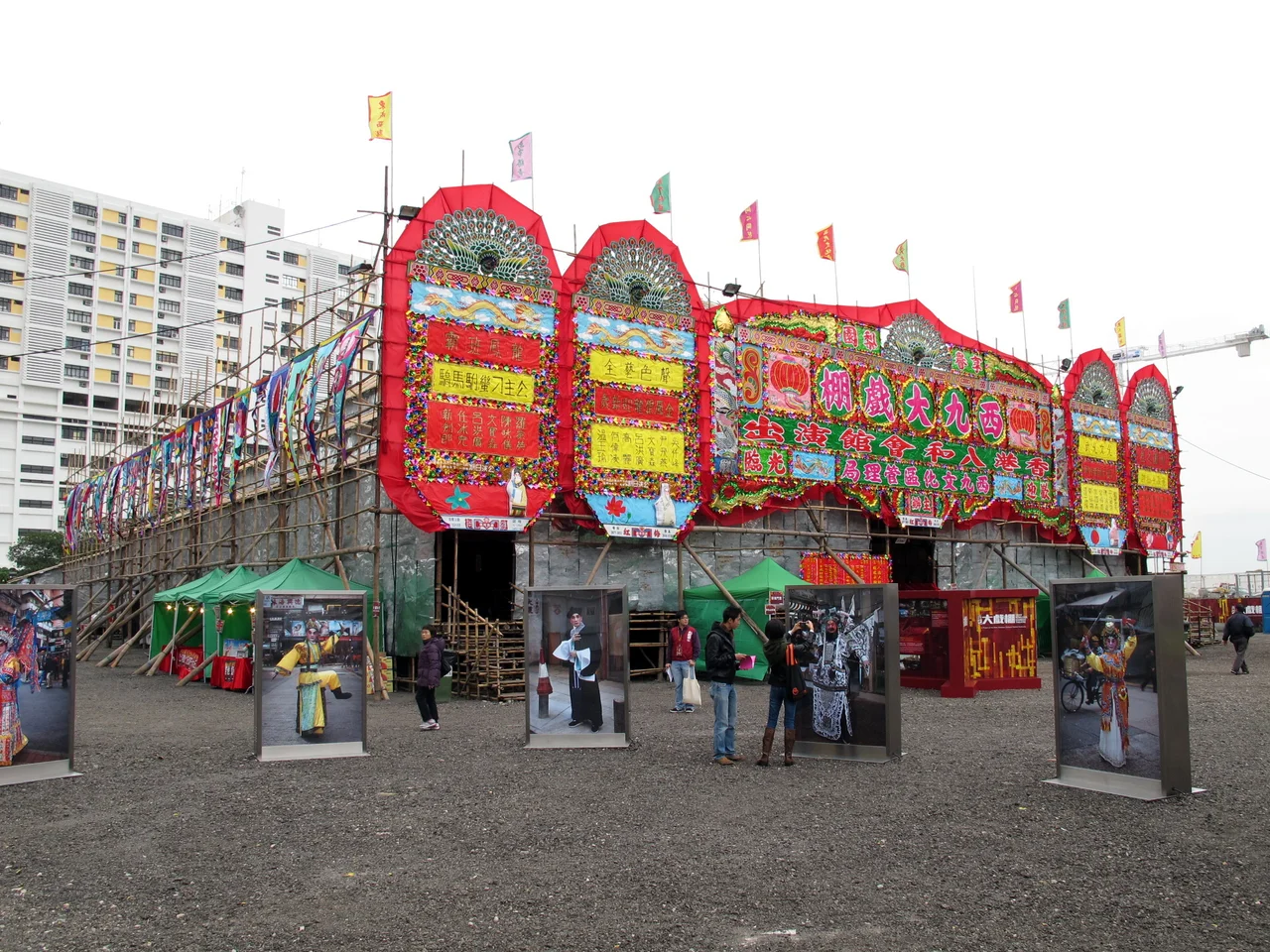

West Kowloon Bamboo Theatre
Ten bamboo scaffolders. Two weeks. More than 10,000 stalks of bamboo, lashed and braced without nails, rising into an 800-seat auditorium on the Kowloon waterfront. This was how the West Kowloon Cultural District Authority launched its cultural programme in January 2012 — not with a ribbon-cutting at a glass building, but with an ancient construction method and a tradition that Hong Kong had been quietly letting fade. The West Kowloon Bamboo Theatre was the first cultural event organised by the WKCDA, and it arrived as an argument: that the performing arts Hong Kong was about to invest billions in building should have roots, not just floors.
Bamboo and the Gods
Bamboo theatres have a long history in Hong Kong and southern China. They were once a staple for honoring Tin Hau, the Chinese sea goddess, and Zhen Jun, erected outside temples during festivals so that performances could be offered to the deities and their human worshippers simultaneously. The structures are temporary by design — raised for a festival, dismantled after. The construction method is entirely traditional: bamboo poles tied with strips of rattan, no screws or welding, the whole assembly relying on the tensile strength of the material and the scaffolders' knowledge of how to distribute load.
For the 2012 West Kowloon Bamboo Theatre, the structure covered 1,800 square metres and was built at the junction of Canton Road and Austin Road — the site later chosen for the permanent Xiqu Centre. The cost of land levelling and bamboo scaffolding was approximately HK$1,000,000. It was, at the time, the largest bamboo theatre built in Hong Kong.
The Night the Tickets Sold Out in Half an Hour
The Chinese Artists Association of Hong Kong performed 11 Cantonese operas from 20 to 23 January 2012. Tickets were priced at HK$10 each — deliberately low, to draw a broad audience rather than a specialist one. It worked. Six performances sold out within half an hour. The WKCDA added two extra shows. Estimates put the allowance paid to artists at around HK$1,000,000.
Around the performances, an exhibition of newly commissioned works by five contemporary artists — including Chu Hing-wah, Gaylord Chan, Michael Wolf, Samson Young, and Henry Chu — was held in what would become the M+ Museum of Visual Arts. Five rarely-seen opera-themed film classics were screened outdoors with English subtitles, including John Woo's Princess Chang Ping (1976) and Ann Hui's Spooky Bunch (1980). The bamboo theatre had become, briefly, a crossroads between the very old and the very new.
City Memories and Augmented Palaces
The 2013 edition, themed 'City Memories,' ran from 30 January to 16 February and drew a hundred thousand visitors over three weeks. That year, the bamboo exterior was draped in a golden orange nylon net to evoke an ancient palace. Fourteen Cantonese operas were staged, plus Chinese dance and two contemporary music concerts, with participation from seven local opera troupes including Law Ka-Ying's Golden Glory Cantonese Opera Troupe and Tse Suet-sum's Lung Fei Cantonese Opera Troupe.
The 2013 theatre also introduced augmented reality technology: the AR Xiqu Centre App allowed visitors to point their smartphones at AR codes and watch animations of the future Xiqu Centre building materialise on screen. The world's first AR Code Floral Panels were installed at the venue. It was a deliberate juxtaposition — bamboo scaffolding and opera traditions stretching back centuries, overlaid with technology that barely existed a decade earlier.
Ticket prices had risen from HK$10 in 2012 to HK$150 in 2013, reflecting both the theatre's established reputation and the growing ambition of its programming.
The Last Season
By 2014, the Xiqu Centre was under construction on the Canton Road site where the bamboo theatre had stood. The third edition moved to the West Kowloon Waterfront Promenade, and the venue grew to four times the size of the original 2012 structure. Kunqu and jingkunqu — forms of classical Chinese opera distinct from Cantonese opera — were added to the programme, offered free of charge. Classical Chinese films with opera themes were screened. Educational talks on the development of Chinese opera accompanied the performances.
The bamboo theatre had been planned as an annual event. As of 2021, it had not returned. The permanent Xiqu Centre opened in January 2019 on the ground where the first bamboo theatre rose from the waterfront, carrying forward the same mission in stone and glass rather than bamboo and rattan.
From the Air
The West Kowloon Bamboo Theatre's original site, now the Xiqu Centre, stands at approximately 22.30°N, 114.16°E at the junction of Canton Road and Austin Road on the Kowloon waterfront. From the air, the wedge-shaped West Kowloon Cultural District is clearly visible as a large reclaimed land development on the western side of Kowloon, bordered by Victoria Harbour to the south and west. The Xiqu Centre's lantern-inspired roof is identifiable on the eastern edge of the district. Hong Kong International Airport (VHHH) is approximately 30 km west on Lantau Island, visible on final approach from the east.
Nearby Stories
- Lok Ma Chau Loop 2.3 km away
- Portas do Cerco 2.3 km away
- Kweilin Incident 17 km away
- Wanshan Archipelago Campaign 34 km away
- Nanxiong Formation 115 km away
- Battle of Nanpeng Island 148 km away
- Heyuan 169 km away
- Cape Maobitou 632 km away