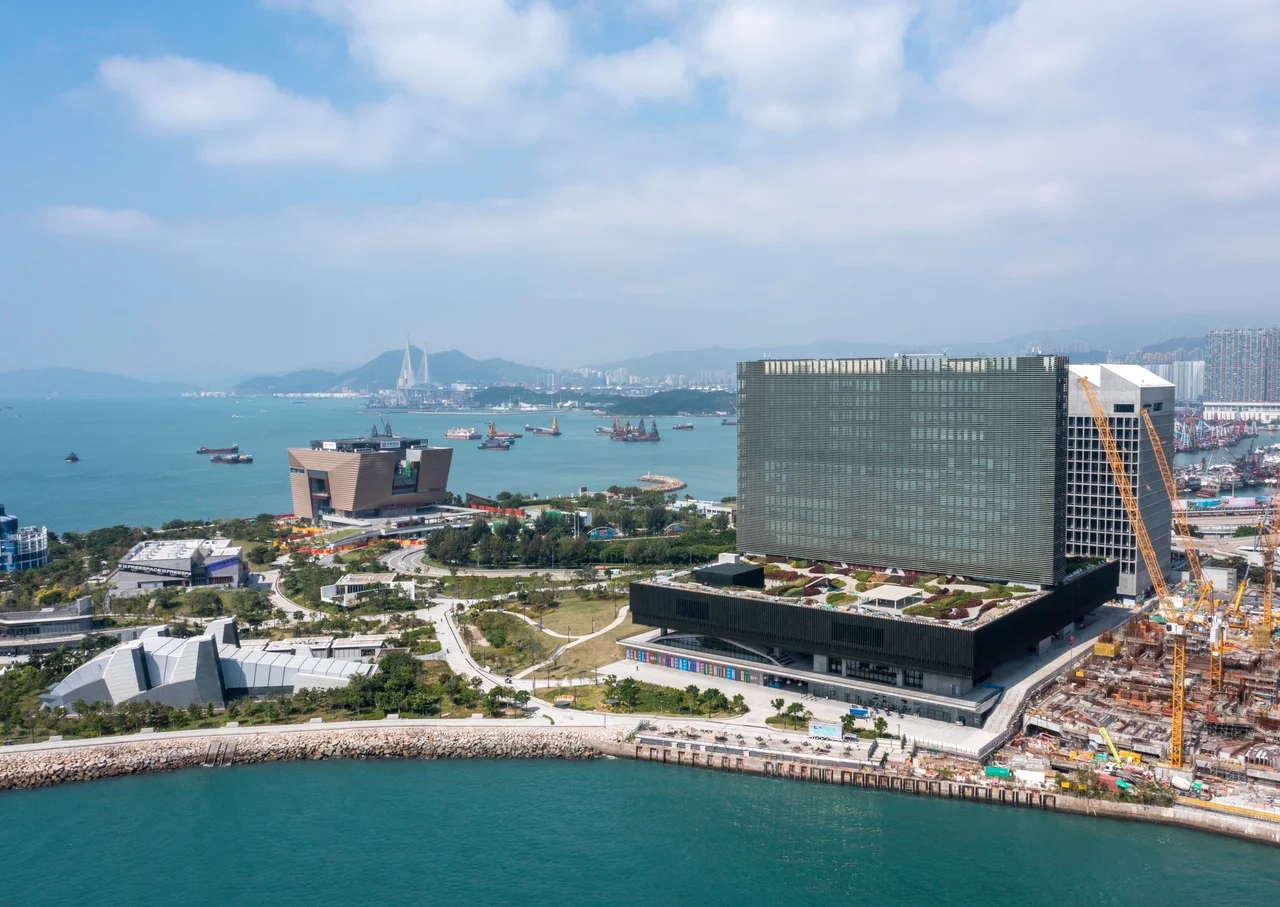

West Kowloon Cultural District
In 1996, Hong Kong Tourism Board surveyors asked visiting tourists what was missing. The answer, repeated often enough to generate policy, was cultural attractions. Two years later, Chief Executive Tung Chee-hwa stood up in his Policy Address and proposed a solution: a new cultural district on the western Kowloon waterfront, built from scratch on reclaimed land, designed to make Hong Kong a cultural hub for Asia. What followed was nearly two decades of cancelled designs, resigned CEOs, cost overruns, and public argument. What emerged — the Xiqu Centre, M+ Museum, Hong Kong Palace Museum, and Freespace, spread across 40 hectares of harbour-front — is among the most densely programmed cultural precincts built anywhere in the 21st century.
Land Made for Culture
The site has no ancient claims on the city's memory. The wedge-shaped waterfront plot was created from reclaimed land in the 1990s as part of the Airport Core Programme — infrastructure works that also produced Chek Lap Kok airport. By the time the cultural district was proposed, the land was simply there: flat, empty, bounded by Canton Road to the east, Austin Road West to the north, and Victoria Harbour to the south and west.
The proximity matters. The West Kowloon Cultural District is within walking distance of Tsim Sha Tsui, one of the most visited tourist areas in Hong Kong. The Kowloon MTR Station and West Kowloon Terminus — the Hong Kong entry point for high-speed rail connections to mainland China — are adjacent. Whatever the district becomes, it will be found.
The Canopy That Divided a City
In April 2001, the government launched an international design competition. Ten judges selected a submission from Foster and Partners as the winner: a vast canopy stretching over much of the development, shading public space below and providing a visual signature for the whole precinct. Critics immediately questioned the financing model, the role of property developers, and the design's suitability for Hong Kong's climate and density. Public opposition mounted. By 2005, the canopy design was scrapped entirely.
Three new proposals were considered through 2004 and 2005, then shelved as the government reset its consultative process. A Consultative Committee was established in 2006. Stage 1, Stage 2, and Stage 3 public engagement exercises followed — 66 separate events in the first stage alone. On 4 March 2011, Foster and Partners won again with a revised plan called 'City Park,' this time without the canopy. Construction cost estimates had grown from an initial HK$21.6 billion to over HK$29 billion.
The Buildings That Finally Arrived
The Xiqu Centre opened in January 2019 on the eastern edge of the district. Its design — by Revery Architecture and Ronald Lu and Partners — draws from traditional Chinese lanterns; the main entrance is shaped to resemble parted stage curtains. Inside, the 1,075-seat Grand Theatre sits at the top of the eight-storey building, with an open atrium below. A Tea House Theatre seats up to 200 for more intimate performances. The centre is dedicated to xiqu: the family of Chinese classical theatre traditions that includes Cantonese opera, Peking opera, and other regional forms.
Freespace, a centre for contemporary performance designed by Dennis Lau and Ng Chun Man Architects, opened in 2019 with the largest blackbox theatre in Hong Kong, accommodating up to 900 people.
The M+ Museum — designed by Herzog and de Meuron, focused on visual art, design and architecture, and the moving image — opened in November 2021. The Hong Kong Palace Museum, funded by a HK$3.5 billion donation from the Hong Kong Jockey Club Charities Trust and designed by Rocco Design Architects, opened on 2 July 2022 to mark the 25th anniversary of Hong Kong's handover to China.
The People Who Tried to Run It
The West Kowloon Cultural District Authority was established by ordinance and came into operation on 11 July 2008. Its governance history mirrors the project's broader turbulence. The Authority's first executive director, Angus Cheng Siu-chuen — formerly at Hong Kong Disneyland — resigned for personal reasons less than two weeks after taking the post in June 2009. Graham Sheffield, formerly artistic director of the Barbican Centre in London, was appointed CEO in March 2010 on a three-year, HK$3.5 million-a-year contract. He resigned for 'health reasons' in January 2011, five months in.
Subsequent leaders lasted longer. Michael Lynch served until 2015. Duncan Pescod, appointed in 2015 and described as popular within the authority, was forced to resign in 2020 before his term ended. Betty Fung Ching Suk-yee assumed the post in October 2021. Through all of it, construction continued.
A Promenade While the Cranes Work
While the district was being built out in phases, the West Kowloon Waterfront Promenade opened in 2005 and remained in use as a temporary public space: open lawns, bicycles for hire, harbour views. AXA x WONDERLAND — the successor to the site's nursery park — provides outdoor music and arts events. The promenade will be incorporated into the permanent design as construction progresses.
The second phase of the district is expected to be completed in 2026, adding the Lyric Theatre Complex (a 1,450-seat main theatre, 600-seat medium theatre, and 250-seat studio theatre) and additional venues. The project that a 1998 policy address proposed as a cultural hub for Asia is still, after nearly three decades, arriving — building by building, stage by stage.
From the Air
The West Kowloon Cultural District occupies the southwestern tip of the Kowloon peninsula at approximately 22.31°N, 114.16°E. From the air at 3,000–5,000 feet, the 40-hectare wedge of reclaimed land is clearly distinct from the surrounding urban grid, bordered on three sides by water. The M+ Museum's dark horizontal facade and the Xiqu Centre's lantern-shaped roof are identifiable from altitude. Hong Kong International Airport (VHHH) is approximately 30 km to the west on Lantau Island, with West Kowloon visible during approach from the northeast.
Nearby Stories
- Lok Ma Chau Loop 2.3 km away
- Portas do Cerco 2.3 km away
- Kweilin Incident 17 km away
- Wanshan Archipelago Campaign 34 km away
- Nanxiong Formation 115 km away
- Battle of Nanpeng Island 148 km away
- Heyuan 169 km away
- Cape Maobitou 632 km away