
West Kowloon
The land did not exist here forty years ago. Where the International Commerce Centre now pierces the sky at 484 metres — currently the tallest building in Hong Kong — there was only the grey chop of Victoria Harbour. West Kowloon is a district built from nothing, or rather from everything dredged from the harbour floor and sculpted into a new coastline. Beginning in the mid-1990s and finishing around 2003, the West Kowloon Reclamation Project added kilometres of waterfront to the Kowloon Peninsula as part of a broader Airport Core Programme that reshaped Hong Kong's geography in a single generation. The result is a place that feels both unfinished and inevitable — a city still deciding what it wants to be.
Land Risen from the Harbour
Reclamation has always been Hong Kong's sleight of hand: the city has been filling in its own harbour for well over a century, shaving cliffs and dumping the rubble into the sea. West Kowloon is the grandest chapter in that long story. Engineers and construction crews spent the better part of a decade pouring concrete, driving piles, and laying roads across what had been open water. When the work was done, the new shoreline stretched from Yau Ma Tei southward past what would become Austin and Kowloon stations, all the way to where the Western Harbour Crossing — Hong Kong's third harbour tunnel — plunges beneath the surface. The scale is staggering to contemplate standing at the water's edge, watching container ships glide past buildings whose foundations rest on the former harbour bed.
Towers Over the Tung Chung Line
Kowloon MTR Station sits at the heart of the new district, threading together the Tung Chung line and the Airport Express — and above it, developers stacked an entire skyline. The Waterfront, Sorrento, The Harbourside, The Arch, and The Cullinan rose in a cascade between 2000 and 2008, the tallest residential towers in Hong Kong clustered above a single underground platform. The shopping mall Elements opened alongside them in October 2007, sealing the relationship between rail, retail, and residence that defines this part of the city. The International Commerce Centre followed, its 108 floors of glass giving Kowloon, for the first time, a vertical statement that rivalled anything across the harbour on Hong Kong Island.
The Gateway to Everywhere
Hong Kong West Kowloon Station is something apart from the surrounding development — quieter, more ceremonial, its underground concourse designed with the drama of a major international terminus. From here the Guangzhou-Shenzhen-Hong Kong Express Rail Link carries passengers northward at high speed, tunnelling under the harbour and into mainland China. The journey from this station to Guangzhou South takes as little as 47 minutes on the fastest services, though typical journey times run closer to an hour. What that means for this corner of Kowloon is a constant movement of cross-border travellers: families with overstuffed luggage, businesspeople moving between two economies, tourists arriving with fresh eyes. The station pulls the rest of the district — the waterfront promenade, the nearby Austin station, the Cultural District beyond — into the orbit of the wider Pearl River Delta.
A Cultural District on the Edge
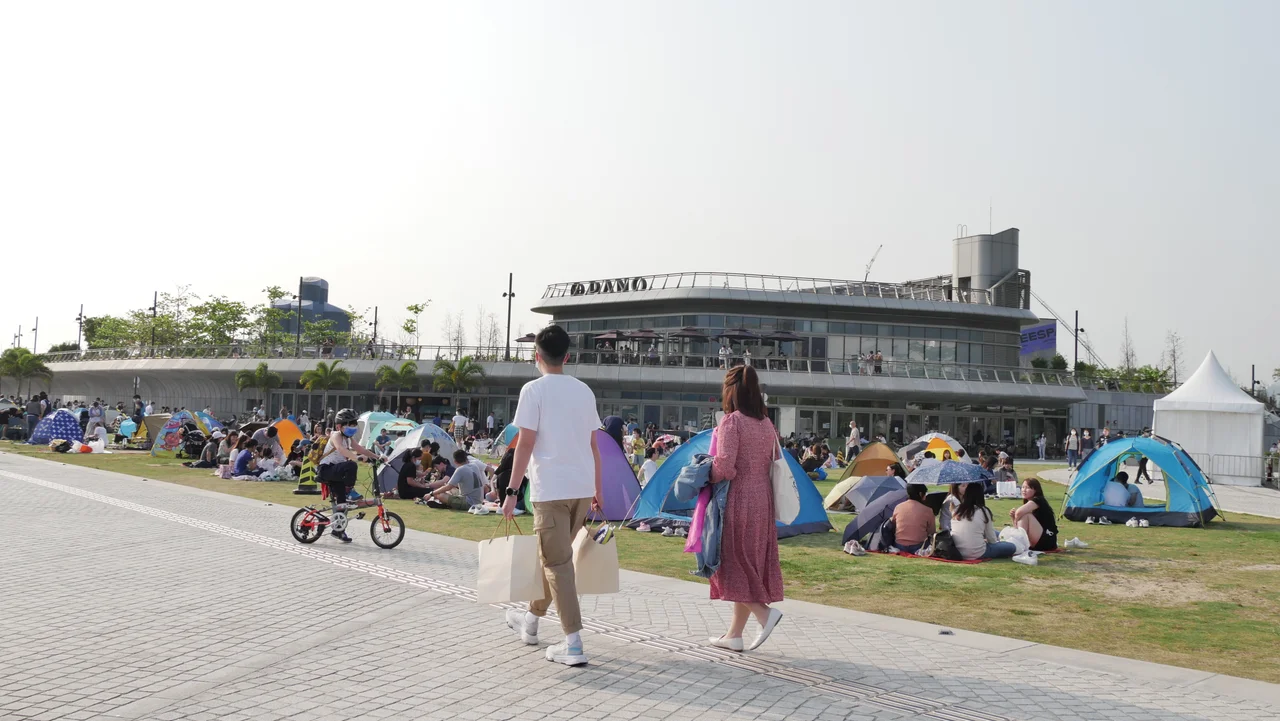
At the southern tip of the reclaimed land, the West Kowloon Cultural District has been the district's most watched and debated project. Conceived as a world-class arts hub facing Victoria Harbour, it was years in the planning before ground broke, and the construction timeline stretched across decades. The waterfront promenade it anchors is already popular — a flat, breezy stretch of pavement where locals jog in the evenings and visitors photograph the island skyline going amber in the late afternoon. Whether the Cultural District becomes the creative engine its planners envisioned or merely another luxury precinct along the water is a question West Kowloon is still living out. The answer, like the district itself, feels perpetually close but not quite arrived.
Old Names, New Maps
The name West Kowloon is simultaneously precise and slippery. The reclaimed strip near the Cultural District is West Kowloon in its narrowest sense. But the name also sprawls north through Yau Ma Tei, Mong Kok, Sham Shui Po, and Cheung Sha Wan — older, denser neighbourhoods that predate the reclamation by generations. Property developers branded four housing estates in Cheung Sha Wan as the West Kowloon Four Little Dragons (西九四小龍), borrowing the district's new glamour and attaching it to places that had nothing to do with the harbour fill. It is a very Hong Kong kind of geography: a name that means different things depending on who is using it, the new city overlapping imperfectly with the old one it was built beside.
From the Air
West Kowloon lies at approximately 22.30°N, 114.16°E on the western edge of the Kowloon Peninsula, directly across Victoria Harbour from Hong Kong Island. From the air at 3,000-5,000 feet, the reclaimed land is instantly identifiable: a broad, flat apron of development jutting into the harbour, crowned by the needle-like International Commerce Centre. The nearby airport is VHHH (Hong Kong International Airport), approximately 25 km to the west on Lantau Island. The Western Harbour Crossing toll plaza and the sweeping arc of the West Kowloon Corridor are useful navigation landmarks. In clear weather, the contrast between the raw geometry of the reclaimed district and the older, more organically developed neighbourhoods immediately to the north is visible in a single glance.
Nearby Stories
- Lok Ma Chau Loop 2.3 km away
- Portas do Cerco 2.3 km away
- Kweilin Incident 17 km away
- Wanshan Archipelago Campaign 34 km away
- Nanxiong Formation 115 km away
- Battle of Nanpeng Island 148 km away
- Heyuan 169 km away
- Cape Maobitou 632 km away