
West Somerset Railway
On a March morning in 1964, Ringo Starr and George Harrison cycled along a platform at a small Somerset station while cameras rolled for A Hard Day's Night. The branch line they filmed on was, even then, considered a relic. Seven years later, British Rail closed it. Yet the rails never came up, the stations never went derelict, and within five years volunteers were running steam trains again. Today the West Somerset Railway stretches 22.75 miles from Minehead to Bishops Lydeard, the longest standard-gauge independent heritage line in the United Kingdom, threading the Quantock foothills and the Somerset coast on a route the great Isambard Kingdom Brunel himself once surveyed.
Brunel's Brook
The line owes its existence to a meeting at the Egremont Hotel in Williton on 9 July 1856. Sir Peregrine Acland of Fairfield House had gathered local landowners to discuss connecting the iron-rich West Somerset coast to the Bristol and Exeter Railway, and they had already engaged Brunel to scout the routes. The great engineer, who had only just finished his Bristol-to-Exeter mainline, came back with a clear answer. The little watercourse he called Donniford Brook would carry the rails. Other proposals favoured a long tunnel under the Quantock Hills toward Bridgwater, drawn by the ironstone seams that promised coal of South Wales quality, but Brunel saw the cost: seventy chains of bore, fifty shafts, gradients of 1 in 50. He recommended the gentler route via Williton to Taunton, and the meeting agreed. The first trains rolled in 1862, broad-gauge, on a single track. Minehead joined the network in 1874.
From Butlins to Beeching
For a century the branch worked steadily, carrying iron ore out and seaside trippers in. The Great Western absorbed it in 1876 and added flourishes the line had never seen: the chairman himself opened a £20,000 open-air swimming pool at Minehead in 1936. After nationalisation in 1948, camping coaches reappeared at Stogumber and Blue Anchor, families spending fortnights in converted carriages beside the sea. Then came Butlins, opening at Minehead in 1962 and bringing thirty thousand holidaymakers in a single summer. It was not enough. Dr Beeching's 1963 Reshaping of British Railways report marked the line for closure, and goods traffic was withdrawn from the lesser stations the following year. Despite the Beatles' brief visit, despite the Butlins crowds, the last British Rail train ran in January 1971. The signal boxes fell silent. The chocolate-and-cream carriages were taken away.
A Working Party of Volunteers
On 5 February 1971, less than a month after closure, a local businessman named Douglas Fear chaired a working party in Taunton. Within months a new West Somerset Railway Company had been formed, and by 1973 Somerset County Council had purchased the line outright, wary of letting the lucrative Minehead site fall into private hands. The county leased the tracks back to the volunteers, and on 28 March 1976 the first steam train ran. The dream of a year-round commuter service to Taunton faded quickly. What emerged instead was something purer: a seasonal heritage line where the locomotives matter as much as the destinations. The West Somerset Railway Association at Bishops Lydeard maintains its own engines, the Diesel and Electric Preservation Group keeps a fleet of Western Region diesels at Williton, and the Heritage Trust runs a museum at Blue Anchor. In 2008 a new turntable came into use at Minehead; in 2009 a four-carriage platform opened at Norton Fitzwarren.
The Quantock Belle
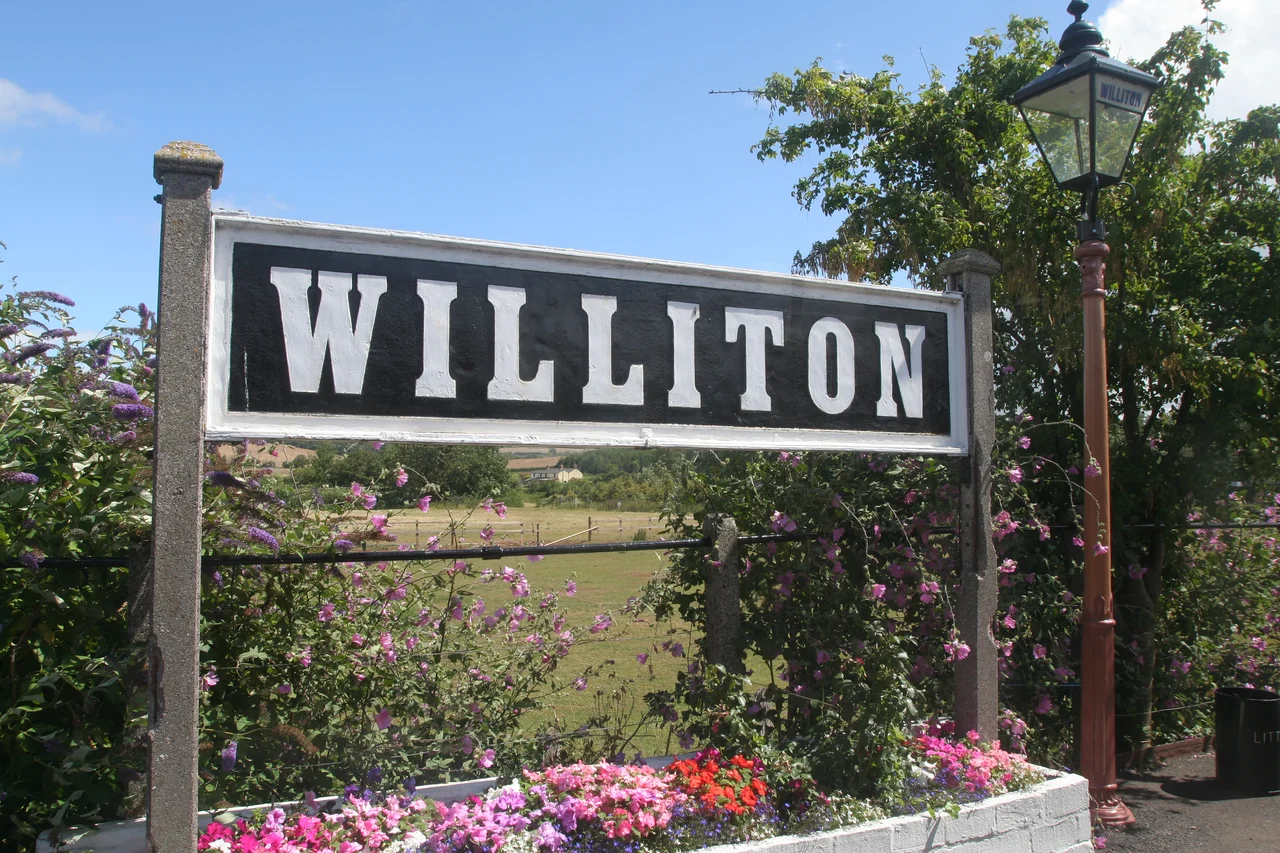
Most of what you see today rides on British Rail Mark 1 coaches painted in the chocolate-and-cream livery the GWR made famous, with West Somerset crests on the doors. The Quantock Belle, the WSRA's fine-dining train, wears a Pullman-inspired scheme, each carriage named. Williton station, near the midpoint of the line, holds the oldest signal box on the route, perched above a level crossing that sees little road traffic. From there the rails climb the eastern side of a steep valley at gradients of 1 in 92, past the Royal Marines camp at Norton Manor, past the new Allerford Junction with its ballast reclamation depot, until they meet the Bristol-to-Exeter line and the modern network begins again. During special events some trains continue all the way to Taunton's Fairwater Yard, twenty-four and three-quarter miles from the sea.
A Screen Star
Cameras keep returning to this line. The Beatles came in 1964. The Belstone Fox was filmed near Crowcombe in 1973. The 1977 children's series The Flockton Flyer used the railway shortly after it reopened. The BBC shot The Lion, the Witch and the Wardrobe at Crowcombe Heathfield in 1988, and The Land Girls turned the same station into 'Bamford' in 1997. Most recently, Agatha Christie's Seven Dials sent a Netflix crew to Blue Anchor in 2026. The reason is straightforward: very few places in Britain still look this much like 1937. The semaphore signals, the gas lamps, the signal-box clocks, the volunteers in waistcoats - all of it survives because a working party in Taunton in 1971 decided it should.
What the Council Decided
In 2014 Somerset County Council declined to sell the freehold; the line remains publicly owned, privately operated. In 2018 an Office of Rail and Road inspection forced a three-month closure for safety upgrades. In May 2025 the Department for Transport rejected a joint Somerset Council and WSR business case to re-establish regular through-running to Taunton on the national network. The Campaign for Better Transport still lists the line as a priority-two reopening candidate. For now, the daily reality is volunteers in greasy overalls, steam in the morning air at Minehead, and 22.75 miles of railway preserved by the affection of the people who refused to let it die.
From the Air
Located at 51.21°N, 3.47°W along the Somerset coast and into the Quantock foothills. The line runs roughly southeast from Minehead on Bridgwater Bay to Bishops Lydeard near Taunton. Recommended viewing altitude is 3,000-5,000 feet to follow the route between coast and hills. Look for the heritage station at Watchet (8 miles from Minehead) and the steep wooded valley descending toward Williton. Nearest airfields: Dunkeswell (EGTU) to the south, Bristol (EGGD) to the northeast, Exeter (EGTE) to the southwest. The Bristol Channel coast provides clear orientation; visibility is best on still mornings before sea breezes develop.
Nearby Stories
- Cheddar Gorge 5.7 km away
- Royal Mint 6.6 km away
- Montacute Castle 7 km away
- Coldharbour Mill Working Wool Museum 8.3 km away
- Tidal Lagoon Swansea Bay 10 km away
- Caerwent 12 km away
- Ilfracombe Lifeboat Station 18 km away
- Okehampton Castle 29 km away