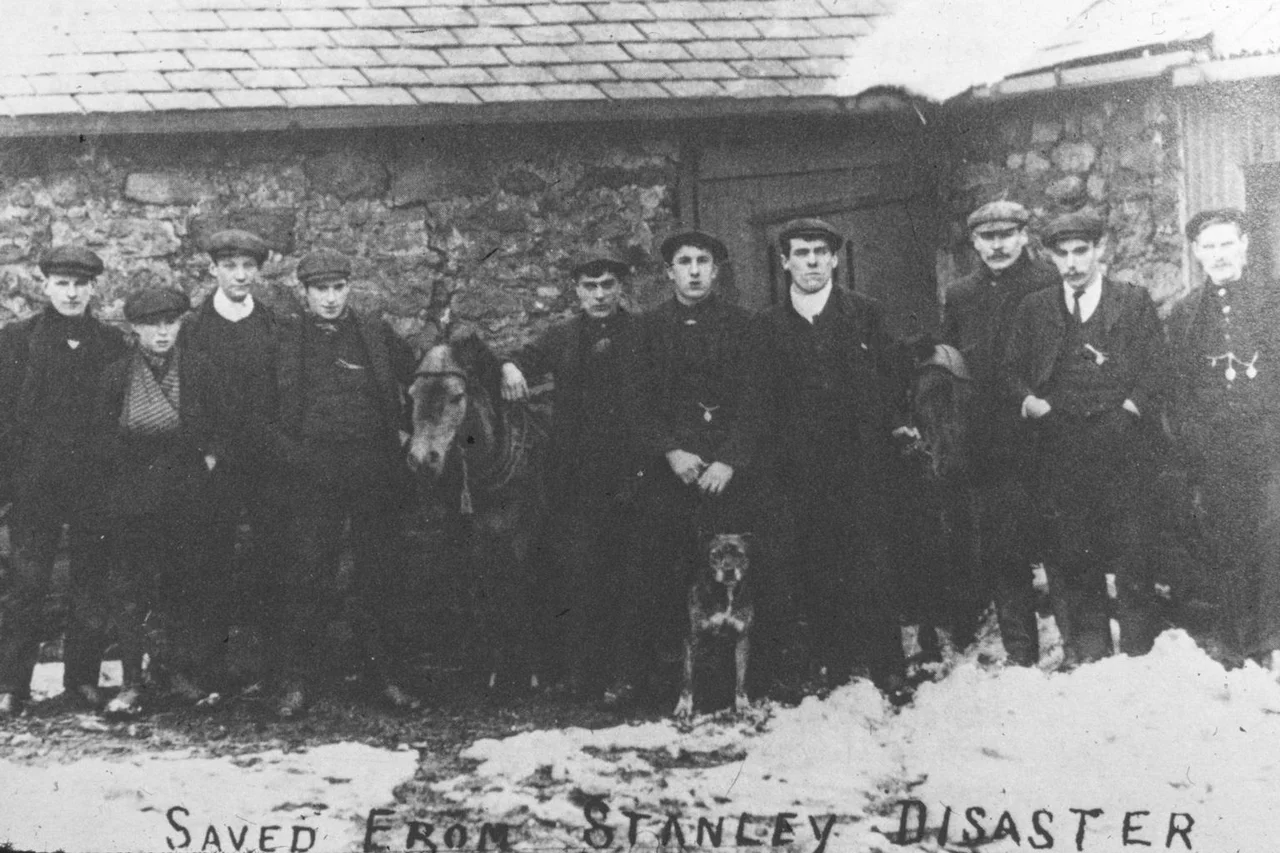

West Stanley Pit Disasters
At 3:45 in the afternoon of 16 February 1909, smoke began rising the wrong way out of the Busty shaft at West Stanley colliery in County Durham. Air should have been flowing down that shaft, not coming up it. Fifty seconds later, a fireball followed the smoke into the sky, and a cloud of debris rolled out over the pit yard. One hundred and ninety-eight men and boys were trapped underground. Only twenty-nine would come back alive. It was the second time the West Stanley pit had killed its workers in living memory - in 1882, thirteen men had died in the same colliery. The Tanfield songwriter Tommy Armstrong, who knew the Durham coalfield as well as anyone, sat down afterwards and wrote a five-verse poem to the lost men, sold as a one-penny broadsheet sung to the tune of Cassells in the Air.
The First Disaster
The 1882 explosion came at one in the morning on 19 April, in the Busty seam. Two men were taking a food break in the north cross-cut district when a great stone - some four metres long, sixty centimetres wide, perhaps thirty thick - fell from the roof above them. The stone had been concealing a cavity rising at least fifteen feet into the rock above, packed with firedamp under pressure. The released gas met the flame of one of their Clanny safety lamps, and the gas ignited. Thirteen men died. The official inspector's report later catalogued failures in the mine's management - no certified copy of the rules could be found, one deputy was illiterate and could not have enforced them, licenses for shotfirers were not properly issued. The mine's manager, William Johnson, had refused to acknowledge West Stanley as a fiery mine, though gas had been reported repeatedly in the months before. The inspector accepted that, in this specific case, the management failures had not directly caused the disaster. But they had built the conditions that made it possible.
An Electric Mine
By 1909, electricity had reached underground. Two electrically driven coal-cutting machines worked the Townley seam, with one each in the Tilley and Brockwell. The largest motors were a 100-horsepower pump and a 100-horsepower haulage motor, fed by a 550-volt three-phase generator on the surface that delivered power through insulated but unarmoured cables down the Busty shaft. Five minutes before the explosion, the man working the big Busty pump told the generator house he was about to start it. Five minutes later came a burring noise from the generators - the sound of an electrical overload - and two of the three fuses blew. Then came the smoke, and the fireball. The inquiry, led by Redmayne and Bain, called West Stanley one of the most perplexing investigations they had ever conducted. They settled finally on the Busty seam as the source, and on electricity as the likely ignition. Dr W. M. Thornton, Professor of Electrical Engineering at Armstrong College in Newcastle, testified that a train of coal dust drifting between the terminals of a junction box could have arced, ignited the dust, and triggered the catastrophic chain reaction that swept the mine.
Recovery and Loss
The rescue began before the official inspector could arrive. The shaftmen at the pit head began clearing debris from the damaged downcast shaft within an hour, working in the cold February darkness. By two the next morning, the cages could be lowered. Rescue parties descended into the Townley and Busty seams, then pushed through into the Tilley, where they found and brought out 26 men alive. From the Townley they recovered four more, though one died of afterdamp after thirty hours. Over the next six days, 165 more bodies were brought to the surface. Two men were never found, the search abandoned because the recovery parties themselves were now in danger. In 1933, twenty-four years later, miners cutting into the Busty seam broke through into a forgotten gallery and found two skeletons. They were identified as the missing men. A coroner's inquest convened that same year, with a jury, to consider whether the new evidence changed anything. The retired mines inspector J. B. Atkinson tried to argue that an unsafe lamp type called the Howart's Patent Deflector had been in use. The coroner allowed Atkinson to read his statement, but directed the jury to disregard it. The dead remained dead. The cause stayed officially unchanged.
Remembering
Two memorials to the 1909 disaster stand in Stanley today. The first, an ornate pedestal and urn, was unveiled in 1913, four years after the explosion - dedicated when the wound was still fresh, when widows still came to leave flowers. The second was unveiled in 1995, eighty-six years afterwards, when the children of the dead were themselves gone. It features a former colliery winding wheel. In 2005, a memorial headstone was finally dedicated to mark the mass graves where the unidentified and unreturned dead had been buried. The centenary in 2009 brought a memorial service, drawing descendants and historians and the families of mining communities all along the Great Northern Coalfield. The colliery itself opened in 1832 and closed in 1936, twenty-seven years after the disaster that defined it. The investigation's recommendations - better mechanical protection of electrical equipment, trip coils in place of fuses, better cleaning of coal dust - became part of the foundation of modern mining safety in Britain. The 168 men and boys did not get to see it.
From the Air
The West Stanley colliery site sits at approximately 54.872 N, 1.684 W, in the town of Stanley, County Durham, west of the A1(M) motorway. Newcastle International Airport (EGNT) lies roughly 8 nm north-east. The town of Stanley sits on a low ridge in the eastern Pennine foothills, with Beamish Museum (the open-air industrial heritage site) just 2 nm north-east of the town. The memorials and former pit site are within Stanley town centre. Best viewed at 2,000-3,500 feet AGL; expect frequent low cloud and rain across the Durham coalfield.
Nearby Stories
- Cresswell Lifeboat Station 5.2 km away
- Auckland Castle 5.7 km away
- Battle of Otterburn 7.1 km away
- Saltburn Pier 11 km away
- Hadrian's Wall Path 11 km away
- Battle of Stainmore 18 km away
- Saltburn-by-the-Sea 39 km away
- Alexander L. Kielland (Platform) 296 km away