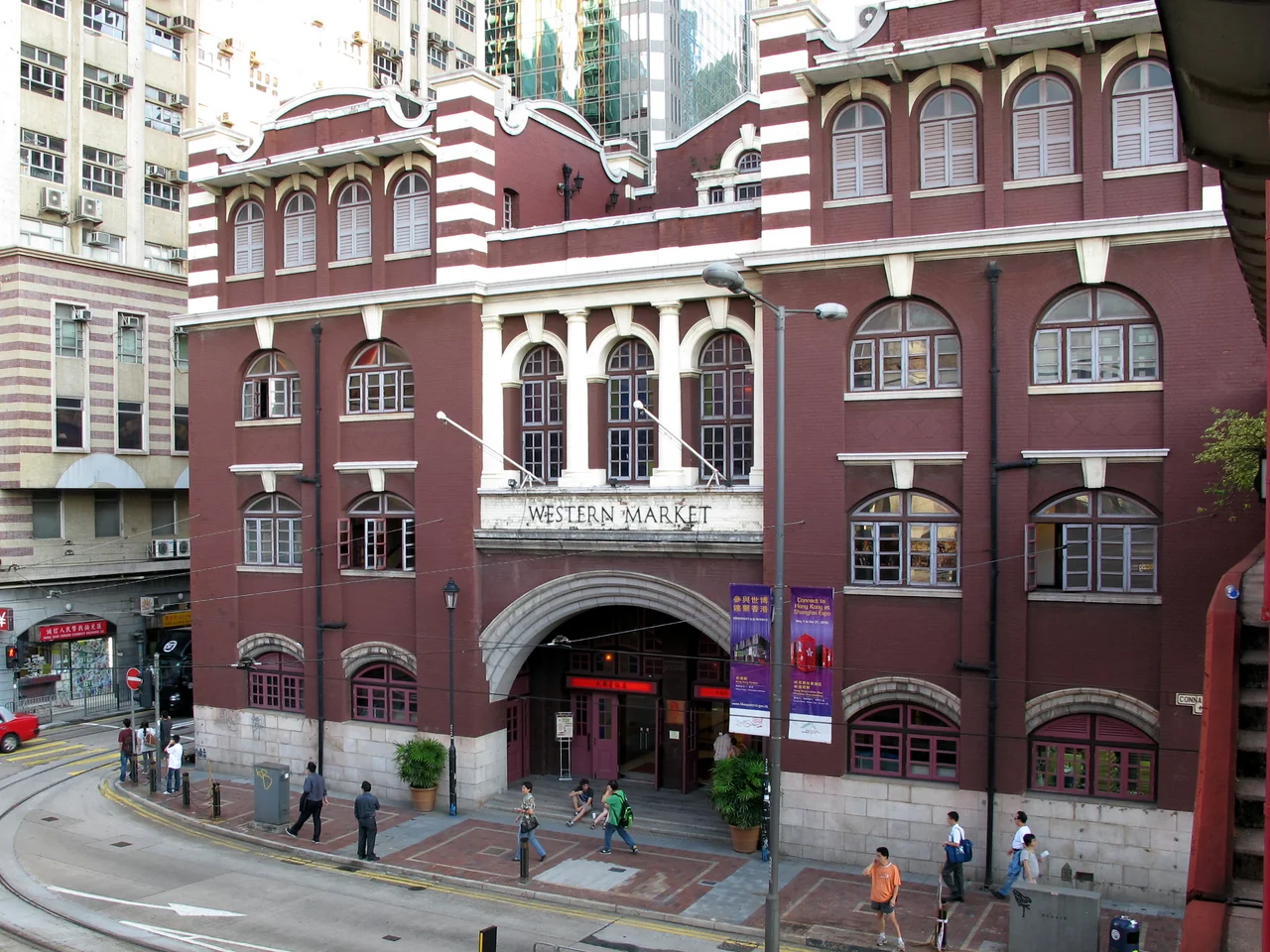

Western Market
Hong Kong came into business in September 1844, and so did Western Market. The same month British colonial administration was establishing itself on this rocky, malarial island, a market opened in Sheung Wan to supply the traders and labourers and soldiers who had arrived to build a city. The building standing at 323 Des Voeux Road Central today is not that original structure — it dates from 1906, constructed in Edwardian style — but the continuity of purpose across nearly two centuries is striking. Other cities preserve their oldest buildings as museums. Western Market has simply kept trading, kept changing hands, kept absorbing whatever the neighbourhood needed from it.
The North Block Survives
Western Market originally consisted of two blocks: a North Block and a South Block, facing each other across an interior space. The South Block was demolished in 1981, replaced by what is now the Sheung Wan Municipal Services Building at 345 Queen's Road Central. The North Block — smaller, more compact in its design — survived. This is the building visitors see today: a handsome redbrick structure occupying an entire city block, bounded by Des Voeux Road Central to the south, Connaught Road Central to the north, Morrison Street to the east, and On Tai Street to the west. Its arched windows and terracotta detailing belong to a school of colonial tropical architecture that once defined Hong Kong's commercial streets; almost all of the other examples are gone.
One Hundred and Forty-Four Years of Food
For 144 years — from 1844 to 1988 — Western Market operated as a food market. Generations of Sheung Wan residents bought their vegetables, fish, and meat inside its walls. The building survived the Second World War, the turbulent postwar decades, and the rapid modernization that erased most of nineteenth-century Hong Kong. Then the nearby MTR construction work damaged the structure, and the repair effort coincided with a broader reassessment of what to do with a building that was no longer needed as a wet market. Half the site was earmarked for a proposed widening of Morrison Street that would have required demolition. That widening never happened. The Land Development Corporation — later the Urban Renewal Authority — stepped in to preserve and renovate the North Block.
Redbrick in a Glass City
Walk through Sheung Wan today and Western Market stands out like a deliberate anachronism: a low, solid, elaborately ornamented building in a street canyon of glass curtain walls and concrete towers. Its four corner turrets and ornate parapet give it a grandeur that the surrounding blocks, many of them ten times its height, cannot match on their own terms. The building is now a declared monument of Hong Kong, recognized under the Antiquities and Monuments Ordinance, and a UNESCO Asia-Pacific Heritage Award winner. On the footbridge running alongside it, a series of old photographs offers fragmentary views of the neighbourhood as it once was: the market in operation, the streets narrower, the harbour closer, the hill behind Sheung Wan before the buildings climbed it.
The Grand Stage
After its conversion from food market to heritage site, Western Market found a new use as a centre for fabric merchants and specialty vendors — and as an event venue. The interior's central atrium, with its ironwork gallery and high ceiling, became known as the Grand Stage, a space used for exhibitions, performances, and weddings. There is something appealing about the transformation: a building that fed a neighbourhood for a century and a half becoming the place where people celebrate. The cloth dealers who set up on the lower floors carry on the trading tradition in reduced form, their bolts of silk and linen stacked against walls that once held fishmongers' slabs. It is a different kind of market, but a market still.
From the Air
Western Market sits at approximately 22.287°N, 114.150°E in Sheung Wan on Hong Kong Island's northern shore. From the air at 2,000-3,000 feet, the redbrick building is visible as a low, square structure standing apart from the surrounding high-rises, occupying its own complete city block near the waterfront. The Sheung Wan MTR station is directly adjacent, and the busy Des Voeux Road Central runs along the building's southern face. The nearest airport is VHHH (Hong Kong International Airport), approximately 25 km to the west. Victoria Harbour is visible to the north; the steep green hillside of Victoria Peak rises immediately to the south. The building's distinctive terracotta colour and its compact form amid taller neighbours make it a useful visual reference point when approaching Hong Kong Island from the harbour.
Nearby Stories
- Lok Ma Chau Loop 2.3 km away
- Portas do Cerco 2.3 km away
- Kweilin Incident 17 km away
- Wanshan Archipelago Campaign 34 km away
- Nanxiong Formation 115 km away
- Battle of Nanpeng Island 148 km away
- Heyuan 169 km away
- Cape Maobitou 632 km away