.jpg)
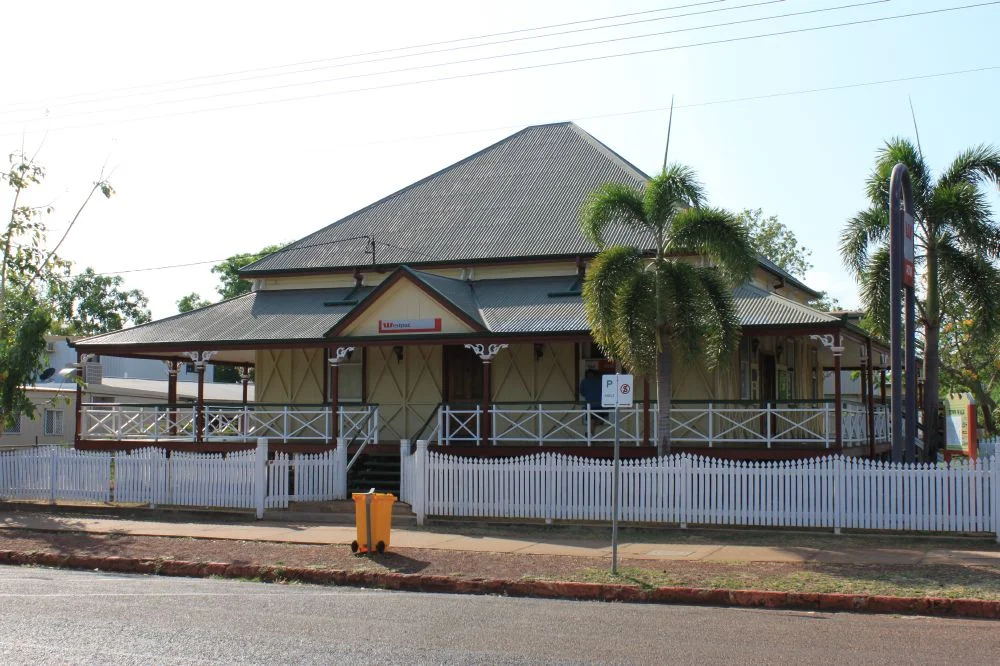
Westpac Bank building, Normanton
Inside, the gold scales are still there. So are the manager's old safes, heavy and immovable, set into a single-storey timber building that has weighed and stored the wealth of the Gulf since 1886. Most country banks of that era were built of brick or stone, statements of permanence in the centre of town. This one is timber - exposed framing, tongue-and-groove boards, a pyramid roof of corrugated iron, and wide verandahs wrapping three sides against the heat. It looks more like a grand Queensland homestead than a financial institution, and that is precisely what makes it rare. The Bank of New South Wales built it to serve a boom. It is the only bank still left in Normanton, and the boom it was built for has not returned.
Banking the Boom
By the mid-1880s, Normanton had become the port for an enormous spread of country - the Cloncurry gold and copper fields, the Etheridge, and the rich new goldfields at Croydon all funnelled their trade down to the Norman River. Where gold and cattle money flowed, banks followed. The Bank of New South Wales began trading in rented rooms in Normanton in 1884, acquired this corner site in 1885, and raised its permanent premises the following year, just as the town was constituted a municipality. The building did double duty from the start: a banking chamber up front, and the manager's residence attached behind. For decades the manager and his family simply lived inside the bank, a single roof covering both the business of the Gulf and the domestic life of the man who ran it.
The Architect of the Frontier Bank
The design came from Richard Gailey, a Brisbane architect who made something of a specialty of rural Queensland bank buildings in the late nineteenth century. Working in timber rather than masonry was a practical choice for a remote, flood-prone, termite-ridden place where heavy materials were costly to ship and slow to assemble - but Gailey gave the building real dignity all the same. Paired shaped brackets sit under the eaves; the verandah carries square posts and a braced balustrade; a small timber pediment crowns the central stair on the Landsborough Street front. It is modest detailing, but confident, the work of an architect who understood that a bank in a frontier town still needed to project trust. Gailey's other commissions stand in towns across Queensland, but few survive as large, intact timber banks like this one.
What the Building Outlived
Time reshaped the place slowly. The manager moved to a separate house in the late 1960s, and the old residential wing served as staff quarters until 1971. In 1978 the interior was overhauled to modernise the banking floor, and the verandahs - boxed in during the 1960s - were reopened to the air. Then, in October 1982, the institution itself transformed: the Bank of New South Wales absorbed the Commercial Bank of Australia and renamed itself Westpac, and the old sign came down for a new one. Through every change, the original fabric of the place persisted - the framing, the verandahs, the safes - and the Landsborough and Little Brown Street faces remain intact, anchoring the streetscape of the town. The gold scales that once weighed a prospector's luck still sit in their place, relics of the trade that built the walls around them.
The Last One Standing
Normanton in its heyday was thick with commerce - banks, agents, merchants and hotels crowding a main street fat on gold and cattle. The Gulf's fortunes thinned as the goldfields gave out and the population drained away, and one by one the institutions of the boom closed their doors or fell down. The bank held on. It has operated as a banking premises in Normanton continuously since 1886, and today it is the only one left - the sole survivor of the town's financial life, still doing the job it was built for nearly a century and a half ago. A short stroll up Landsborough Street stands its old neighbour and rival in trade, the great Burns Philp warehouse; together the timber bank and the iron merchant's store bookend the surviving heart of a frontier port. To walk between them is to read the whole arc of the Gulf gold rush in two intact buildings.
From the Air
The former Bank of New South Wales, now Westpac, stands at 17.671°S, 141.079°E, on the corner of Landsborough and Little Brown Streets in central Normanton. A low timber building with a corrugated-iron pyramid roof and wrap-around verandahs, it is difficult to single out from altitude amid the town's similar rooflines - navigate instead by the larger Burns Philp warehouse a short way north-east along Landsborough Street, then look toward the town centre. Best appreciated low and slow, 1,000-2,000 ft AGL. Normanton Airport (ICAO YNTN) lies about 3 km north. Karumba (YKMB) is roughly 70 km north-west on the Gulf coast; Mount Isa (YBMA), the nearest major airport, is about 370 km south. The dry season (May-October) gives clear, steady light over the flat savannah town.
Nearby Stories
- Flinders River 7.8 km away
- Delta Downs Station 49 km away
- Normanton to Croydon Railway Line 53 km away
- Golden Gate: The Richest Reef on the Field, Now a Field Again 61 km away
- 2000 Australia Beechcraft King Air Crash 65 km away
- Croydon Station: End of the Line That Floods on Purpose 84 km away
- Sweers Island 112 km away
- Aboriginal Shire of Kowanyama 214 km away