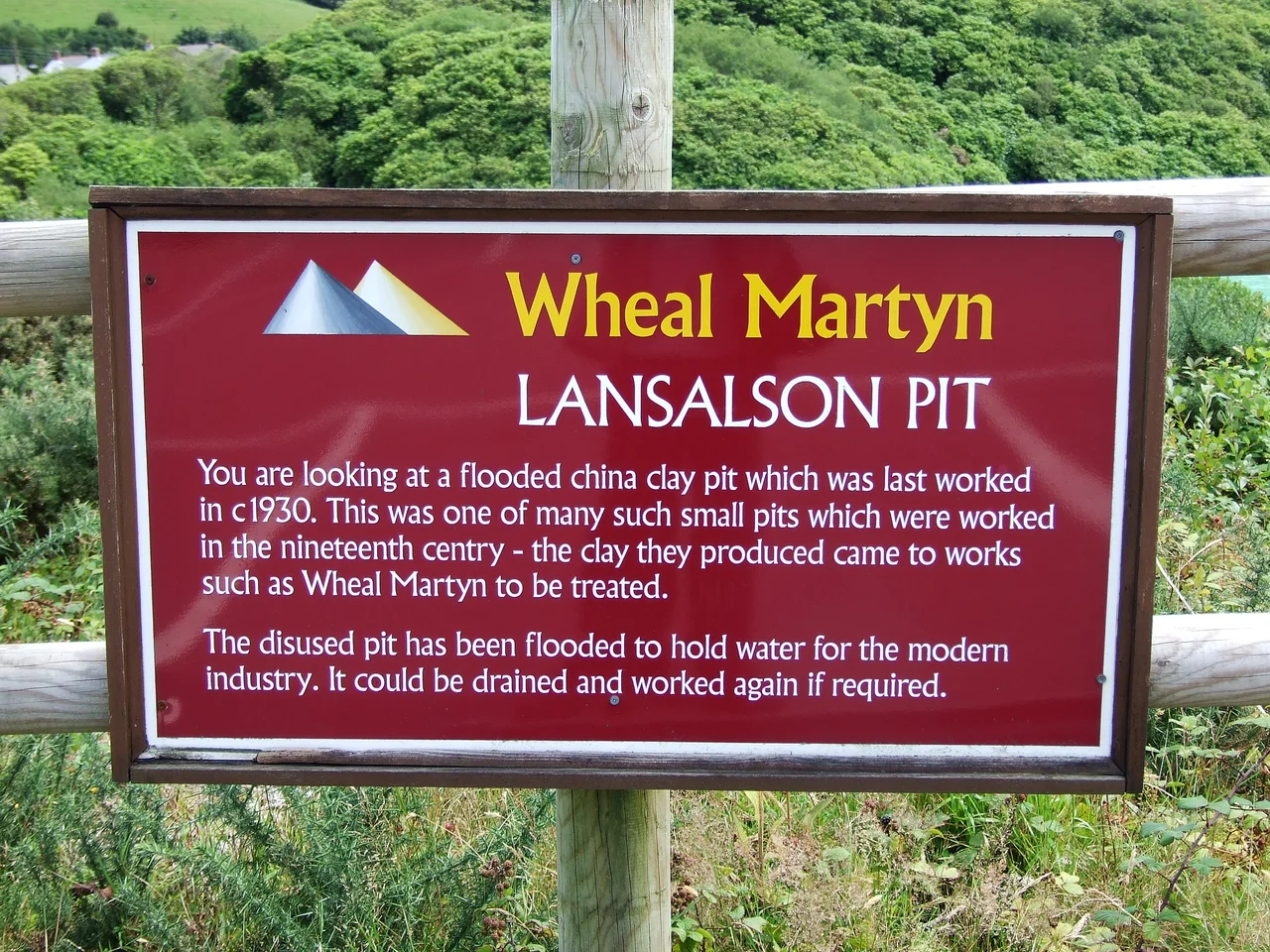

Wheal Martyn
Two days for the slurry to thicken to twelve percent solids in the settling pits. Two or three months in the larger tanks before the clay reached thirty percent. Then heat from below in the pan kiln, coal fires running through underground flues, drying the cake in one to three days depending on how close it sat to the firebox. A china clay works was a machine for separating fine white kaolin from the granite sand it weathered out of, and the machinery ran on patience as much as power. At Wheal Martyn, two miles north of St Austell, the whole apparatus survives almost intact, the only complete Victorian clay works left standing in the world.
The Martyn Brothers
Richard Martyn bought the Carthew Estate in 1790, when china clay was still a new industry in Cornwall. His son Elias started the Wheal Martyn works on the family land in the 1820s, expanding into a serious operation by the 1840s with five pits in production. By 1869 Wheal Martyn was producing 2,000 tons of clay a year, a respectable output for a single works. The Cornish word wheal simply means mine, and the family's name became attached to the works in the regional convention. After Elias died in 1872, his son Richard inherited the operation but lacked his father's appetite for it; he closed some pits and leased others to outside operators. John Lovering took on the lease of Wheal Martyn in the 1880s and made the modifications that defined the site as visitors see it today. The pit at Wheal Martyn itself closed in 1931. The pan kiln stayed in service until 1969, drying clay from neighbouring works long after its own pit had been exhausted.
The Eighteen-Foot Wheel
The most impressive surviving machine on the site is a waterwheel of 18 feet in diameter, built around 1902, still in place and turning when the museum operators choose to set water on it. Its job was to drive a slurry pump that moved liquid clay around the site between settling pits, settling tanks, and kilns. Before electricity reached the Cornish clay country, water provided the steady mechanical energy that pottery porcelain making required. The wheel is overshot, fed by a leat from upstream, and rebuilt rather than original in its surviving form, but the geometry and the slow mechanical advantage are exactly as they were. Adjacent to the wheel sits the linhay, the storage shed where about 1,000 tons of dried clay could be held before being loaded for shipment. Three horses pulled each loaded wagon. From here the clay went down to St Austell railway sidings and on to the potteries of Stoke-on-Trent or the harbours at Charlestown and Par for export.
The Pan Kiln
Walk into the pan kiln and the scale of the operation becomes obvious. A long, low building floored with iron plates, with flues running underneath that carried hot gases from coal-fired furnaces at one end. Workers raked dewatered clay across the heated plates in shallow layers, watching for it to crack into transportable cakes as the moisture evaporated. The clay closest to the firebox dried fastest, in about a day. Clay at the far end took up to three days. Skilled workers learned to read the colour and texture of the surface to decide when to turn each batch. The dust was constant, the heat severe, the work physical, and the wages low. China clay was a poor man's industry in Cornwall, but it employed whole families, with children doing the lighter tasks of sorting and bagging. The museum's reconstructions of a clay worker's kitchen and a cooper's workshop give the lives some shape: a hearth, a kettle, a chair, a place where casks were assembled to hold the finest grades of clay for the porcelain trade.
Preserved by Charity
Wheal Martyn became a museum in 1975, established as a charity with John Stengelhofen as its first director. The 26-acre grounds include not just the preserved works but a Site of Special Scientific Interest, designated for the geological exposures that show how kaolinization actually works in Cornish granite. In 2010 the South West Lakes Trust took over as the charity operator. The transport section preserves a Pecketts locomotive built in 1899 that worked at Lee Moor Pit in Devon, a 19th-century clay wagon designed for a three-horse team, a 1934 ERF lorry, and a First World War Peerless lorry that hauled clay during the war years. The Gomm china clay works, also on the site, was leased by the Martyn brothers from the Mount Edgcumbe Estate around 1878 and worked until the 1920s, providing a second complete set of features alongside the main works. Walking the site today gives a clear picture of an industry that built and reshaped Cornwall, and that still operates in modified form at Imerys pits a few miles north.
From the Air
Wheal Martyn lies at 50.37 N, 4.81 W on the B3274 road at Carthew, two miles north of St Austell in mid-Cornwall. Approach from Newquay (EGHQ) about 13 nautical miles northwest, or Exeter (EGTE) roughly 53 nautical miles east-northeast. From 1,500 feet AGL the site is set among the white china clay tips and exhausted pits of the Hensbarrow Downs, the so-called Cornish Alps. The cleaner ground around the museum contrasts with the working Imerys clay operations to the north and west. St Austell town centre lies south, with the geodesic biomes of the Eden Project five nautical miles east-southeast. Clear flying year-round; the white clay landscape is dramatic in any light but particularly in low sun when the tips throw long shadows.
Nearby Stories
- Mount Edgcumbe Country Park 2.6 km away
- Tintagel 4.2 km away
- Wheal Trewavas 6.1 km away
- Tehidy Country Park 14 km away
- Battle of Plymouth (1652) 15 km away
- Okehampton Castle 19 km away
- Goonhilly Satellite Earth Station 32 km away
- Action of 17 November 1917 101 km away