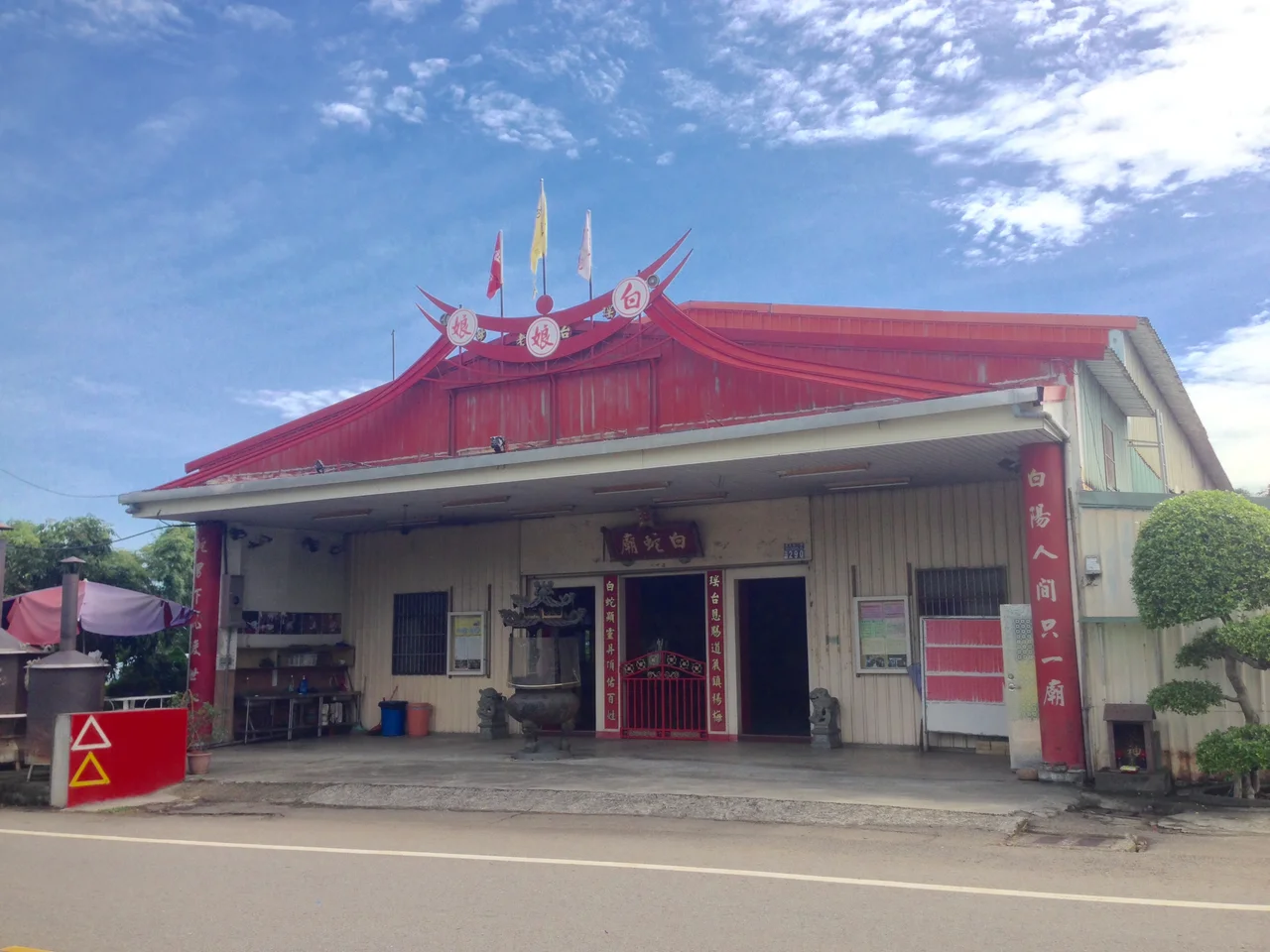

White Snake Temple
It began with a dream. In the 1990s, a man named Luo Shifu (羅士富) in Fangliao Township in southern Taiwan's Pingtung County dreamed of a woman who identified herself as Bai Suzhen — the White Snake Lady, one of the most beloved figures in Chinese folklore. She told him she had been practicing asceticism for a long time and wished for him to build a temple in her honor. Many people have dreams. Luo did something about his. The temple he built has become one of Taiwan's most unusual spiritual destinations, a place where a story that began as literature became a living faith — and where hundreds of live snakes move through the incense-scented air as sacred beings.
The Legend That Became a Deity
The Legend of the White Snake is one of the great Chinese folktales: a story of Bai Suzhen, a white snake spirit who transforms herself into a beautiful woman, falls in love with a mortal man named Xu Xian, and battles the forces that would tear them apart. Over centuries of retelling — through opera, fiction, and film — Bai Suzhen became an enduring symbol of love, loyalty, and the power of transformation. What makes the White Snake Temple unusual is that it takes this literary figure and elevates her to the status of a genuine deity, to be worshipped rather than merely admired. The temple's formal name, Fangliao Ditang Temple (枋寮地龍殿), reflects this elevation. Ditang translates as 'Hall of the Earth Dragon' — a title that transforms the snake from animal to cosmic power. Accompanying Bai Suzhen in the temple is her sworn sister from the legend, Xiaoqing, the Green Snake, revered as a loyal companion and protector.
From Dream to Shrine to Temple
After his dream, Luo Shifu established a small shrine in his own home. Word spread. People came to pray. Belief in the deity grew in ways that surprised even Luo, and he raised funds to construct a proper temple. The current building opened in 2002. It has since become a major tourist attraction in Pingtung County, drawing visitors who come for the spiritual experience, the spectacle, and something harder to name — the pull of a place where the boundaries between story and reality have been genuinely, deliberately dissolved. The temple houses not only Bai Suzhen and Xiaoqing but a full complement of deities from the Taiwanese folk religion tradition: Guanyin, Guan Yu, Tianshang Shengmu, Tudigong, and others. Bai Suzhen presides, but she presides in company, woven into the broader fabric of Taiwanese spiritual life.
The Sacred Snakes
What no photograph fully prepares visitors for is the snakes. The temple houses live snakes — pythons and others — treated not as exotic pets or theatrical props but as manifestations of the divine. Devotees who handle them do so with reverence. The most famous ritual is called 'Crossing Under the Snake' (鑽蛇底): temple staff and handlers hold a large python aloft while devotees walk or crawl beneath it, an act believed to bring great fortune and dispel misfortune. On Bai Suzhen's birthday, celebrated during the Dragon Boat Festival, the temple hosts Taoist scripture-chanting ceremonies, group worship services, and egg-balancing rituals. Devotees can take home symbolic objects: 'dragon robes,' the shed skin of the temple's snakes, and 'treasure basins,' both believed to carry the goddess's blessings into the home. The snakes are cared for attentively; their welfare is understood as inseparable from the spiritual health of the temple community.
Offerings and Intentions
What do people pray for at the White Snake Temple? According to the temple, wealth tops the list — a practical aspiration in any community. But the romantic core of Bai Suzhen's legend draws a significant number of visitors who come seeking blessings for love and marriage. The offerings reflect this dual nature. Standard temple gifts — incense, flowers, fruit — are supplemented here by items associated with femininity and beauty: cosmetics, perfume, things that honor the goddess's graceful human form in the legend. There is something touching in this logic. The worshippers bring what they would offer to a person they admire and hope to please. They bring gifts, and they bring hope. Visiting the temple is less a purely solemn experience than a vividly human one: people arriving with specific needs, addressing a deity who was herself once a creature trying to become something more.
Southern Taiwan from the Sky
Fangliao Township sits in the southern stretch of Pingtung County, where the Central Mountain Range descends toward the southern tip of the island and the coast swings around toward the Pacific. It is a different Taiwan from the urban north — quieter, more agricultural, the landscape opening out toward ocean on both sides. The nearest major international airport is Kaohsiung International Airport (IATA: KHH / ICAO: RCKH), roughly 50 kilometers to the north. Pilots descending into Kaohsiung on clear days see the Pingtung Plain spread below: one of Taiwan's most fertile agricultural zones, the flat land between the mountains and the southern coast. The White Snake Temple is not visible from altitude, but the landscape around Fangliao — paddy fields, coastal wetlands, the hazy blue of the Taiwan Strait to the west — gives a sense of the rooted, particular place where this unusual faith took hold.
From the Air
The White Snake Temple (Fangliao Ditang Temple) is located in Fangliao Township, Pingtung County, southern Taiwan, at approximately 22.37°N, 120.59°E. Nearest major international airport for southern Taiwan: Kaohsiung International (RCKH). The Pingtung coastal plain south of Kaohsiung is visible on clear approach days; Fangliao is approximately 50 km south of Kaohsiung city.
Nearby Stories
- Former Residence of Chang Hsueh-liang (Hsinchu County) 3.8 km away
- Dawulun Fort 7.3 km away
- Cherry Orchard Cemetery 8.4 km away
- 2022 Chinese Military Exercises Around Taiwan 17 km away
- Suao 21 km away
- 2015 New Taipei Water Park Fire 28 km away
- Gaomei Lighthouse 33 km away
- Gaomei Wetlands 63 km away