
Whitegate Refinery
Forty percent of every litre of petrol burned in Ireland passes through one place: a sprawl of distillation columns and storage tanks at the eastern edge of Cork Harbour. Whitegate is the country's only oil refinery, a fact that makes its existence feel both precarious and indispensable. When you stand on the shore of Cork Harbour and look across to Corkbeg Island, you see the silver cylinders glinting between trees - seven floating-roof tanks holding crude pumped in by tankers up to 160,000 tonnes. The scale is industrial, but the setting is unmistakably Irish: green fields, grey water, a stone village nearby that the refinery was built to support.
An Industry for a New Republic
In the late 1950s, the Irish government wanted heavy industry the way young countries want symphony orchestras - as proof of arrival. A consortium of three oil majors agreed to build it. Esso took 40 percent of the Irish Refining Company Limited, Shell-Mex and BP took another 40, and Caltex held the remaining 20. The site they chose was a quiet peninsula at Whitegate in East Cork, 330 acres of farmland and shore where the harbour ran deep enough for tankers. Construction took two years and cost roughly twelve and a half million pounds. In April 1959 the refinery was commissioned, with Esso running the operation. For a country still building its industrial base, the refinery was something more than a chemical plant - it was infrastructure that made the rest of the economy possible.
Almost Lost
By 1981 the math had stopped working. Margins were thin, the global refining business was consolidating around larger and more complex plants, and the original consortium walked away. Whitegate closed. For a country that had spent two decades using its own refinery, the closure was a national problem - one solved when the Irish government took over operations to keep the lights on. The refinery has changed hands several times since, passing eventually to Phillips 66 and then to Irving Oil of New Brunswick, which acquired it in 2016. Each transition brought new investment but also new questions about whether a small, simple refinery on the edge of Europe could survive the next decade of energy transition.
How a Refinery Breathes
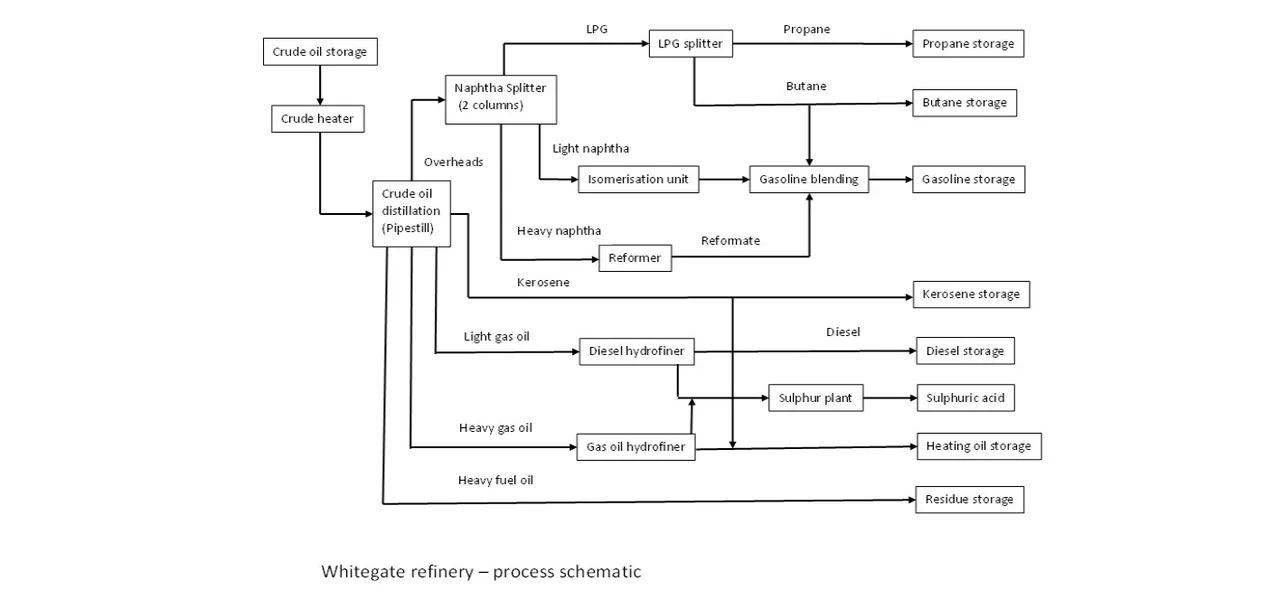
Whitegate is what engineers call a simple refinery - its Nelson complexity index of 3.8 places it well below the heavy conversion plants that turn the worst crude into the most valuable fuels. The work happens in stages. Crude arrives at the Marine Terminal in two berths and travels by pipeline to those seven storage tanks on Corkbeg Island. From there it flows into the atmospheric distillation column, where heat separates the oil into fractions - light gases, naphtha, kerosene, gas oil, residue. Each stream goes on to further processing before becoming the petrol, jet fuel, diesel, kerosene and bitumen that flow back out to Irish forecourts. The plant produces around three million barrels of product in a typical year. It's a fraction of what bigger refineries handle, but it's enough.
The Power Station Next Door
Just south of the refinery, almost touching it, sits the 435-megawatt Whitegate power station at Glanagow. The two are siblings of a kind. The station runs primarily on natural gas, but it's designed to switch to distillate oil produced next door if needed - a combined-cycle gas turbine that can burn either fuel and feed electricity into the national grid. Together, refinery and power station form one of the more concentrated pieces of energy infrastructure in Ireland: fuel for cars, jets and homes coming out of one set of stacks, electrons for the grid coming out of the other. It is the kind of industrial pairing that the planners of the 1950s might have imagined as the future, and that the planners of the 2050s are now trying to imagine without.
From the Air
Located at 51.82°N, 8.25°W on the south-east shore of Cork Harbour. The refinery and adjacent Whitegate power station form a distinctive industrial complex of silver storage tanks, distillation columns and stacks, easily visible from cruising altitude in clear weather - look for the cluster of tanks on Corkbeg Island and the marine terminal berths. Cork Airport (EICK) lies roughly 14 km west. Best viewed in clear morning light when the tank tops catch the sun.
Nearby Stories
- Walter Siepmann 6.3 km away
- Gaeltacht na nDéise 11 km away
- Fermoy 12 km away
- Canovee 14 km away
- Rathcoole Ambush 16 km away
- SS Folia (1907) 20 km away
- Cloghan Castle, Lough Hyne 35 km away
- SM U-27 91 km away