
Wik-Ngathan language
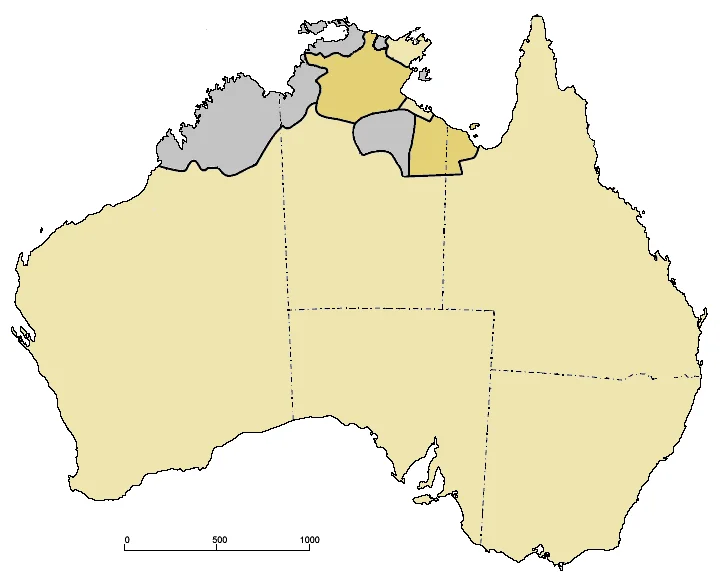
A language is a map of a place drawn in sound. Wik-Ngathan - also called Wik-Iinjtjenj - maps a stretch of the western Cape York Peninsula where the rivers run brown to the Gulf of Carpentaria and the saltwater country gives way to wetland and scrub. It belongs to the Wik-Ngathan people, one clan-grouping within the broader Wik nation, and to the human ear it carries sounds that English speakers rarely make: nasals that can be pre-stopped under emphasis, high front vowels that slide across the mouth, consonants that turn syllabic when they stack together. This is not a relic. Most of its speakers live today in Aurukun, the Wik community on the coast, where Wik languages remain part of daily life.
A Family of Tongues
Wik-Ngathan is one of the Paman languages, a vast family that blankets Cape York Peninsula. Within that family it sits among the Wik languages - a closely related cluster spoken by the clans of the western Cape. Its nearest relative is Wik-Ngatharr, so close that the two are sometimes treated as a pair; more distantly it connects to the other Wik tongues across the region. This is the ordinary texture of Aboriginal Australia, where a single area can hold many languages, each tied to particular country and particular families. The names themselves often encode meaning: 'Wik' is the word for speech or language in several of these tongues, so that to speak of the Wik nation is, quite literally, to speak of the people of the word.
Five Languages, Many Voices
The Wik languages are best understood not as a single speech but as a closely knit group - commonly counted as five core languages, among them Wik-Ngathan, Wik-Mungkan, Wik-Ep, Kugu, and Pakanh, each branching further into named dialects. They share grammar and vocabulary while diverging enough that a speaker can place a person by the way they talk. This density is not unusual for Cape York, one of the most linguistically rich regions on the continent, but it makes each individual tongue precious and distinct. Wik-Ngathan holds its own place in that constellation. Of the cluster it is among the more resilient varieties, and the work of recording it - the dictionary, the dialect surveys, the archives - exists precisely because such a small language, in such a remote place, deserves the same care as any of the world's great tongues.
The Language That Binds
In and around Aurukun, the everyday lingua franca is a sibling language, Wik-Mungkan, spoken by roughly a thousand people and still learned by children as a first language - a genuine rarity among Aboriginal languages, so many of which were broken by the mission and removal era. Wik-Mungkan serves as common ground among related groups, the Wik-Ngathan among them. This matters because the Aurukun community was assembled, over the mission decades from 1904 onward, from clans and language groups that had not always lived together. A shared tongue let distinct peoples hold a single community without dissolving their differences. Wik-Ngathan persists within that web - its own thread, woven beside the others.
Written Down, Spoken On
In 1976 the anthropologist and linguist Peter Sutton began detailed work on the Wik languages, mapping how they varied from clan to clan and place to place. From that long study came the Wik-Ngathan Dictionary, published in 1995 - a record of a language that had, until then, lived almost entirely in speech. A dictionary cannot capture everything: the rhythm of a story told around a fire, the way a word for country carries obligation as well as meaning. But it anchors the language against forgetting, and it puts a tool in the hands of the people who own it. A census in 1981 counted around 130 Wik-Ngathan speakers. The figure is small, and the language is listed as endangered. But endangered is not extinct, and on the western Cape the words are still being spoken.
From the Air
The Wik-Ngathan language belongs to the country around 13.87°S, 141.52°E on the western Cape York Peninsula, inland and slightly south of the coastal community of Aurukun. This is flat tropical savanna laced with seasonal wetlands, draining westward to the Gulf of Carpentaria. From the air the landmark is the Archer River system and its estuary at Archer Bay to the north. Aurukun Airport (ICAO: YAUR, IATA: AUU) is the nearest strip; Weipa (ICAO: YBWP) lies about 100 km north. Best overflown at 3,000-6,000 ft in the dry season (May-October); wet-season flooding (November-April) reshapes the wetlands and limits visibility.
Nearby Stories
- Archer River 24 km away
- Aboriginal Shire of Pormpuraaw 94 km away
- RAAF Base Scherger 102 km away
- Wenlock Goldfield 126 km away
- Cape York Peninsula 147 km away
- Gulf of Carpentaria 214 km away
- Bountiful Islands 313 km away
- Australia–Indonesia Border 357 km away