
Wildlife of Brazil
The heaviest spider in the world is the Goliath birdeater, and it lives in the Amazon. Its body can span a dinner plate. It does not, in fact, often eat birds, despite the name - it prefers earthworms and insects - but it will tackle a small bird or a bat if the chance presents itself. The Goliath is one animal among an estimated 70,000 insect species and 1,107 non-marine mollusc species and more than 500 mammal species and a thousand-plus bird species that together make Brazil the most biodiverse country on the planet. No other country has more recorded plants, freshwater fish, amphibians, snakes, or mammals. Brazil holds roughly one-tenth of every species living on Earth.
The Numbers That Do Not Settle
Counting Brazilian wildlife is a task with no bottom. Scientists have described somewhere between 96,660 and 128,843 species of invertebrates within the country's borders, and the estimate may still be low. Brazil has 60,000 recorded plant species and 55,000 confirmed ones - more than any other country. The world's researchers identify about 775 mammal species in Brazil, 1,622 or more bird species, 848 reptile species, 1,188 amphibian species, 3,000 freshwater fish species. Ranked by total species, Brazil is first in mammals and amphibians and snakes and insects. It sits behind Colombia and Peru on birds. It trails Indonesia only on the count of endemic species - animals found nowhere else on Earth. According to the biologists Lewinsohn and Prado, Brazil holds about 9.5 percent of all the species on the planet. They suspect the real figure is higher.
The Predators
The jaguar is Brazil's great cat. It slips through the floodplains of the Pantanal and the rainforest canopy of the Amazon, the apex predator of both biomes. Alongside it move five other wild felines: the puma, the smaller margay and ocelot, the rare oncilla, and the long-legged jaguarundi. Among the canids - the dogs - six species share the landscape: the maned wolf that looks like a red fox on stilts and trots across the cerrado at dusk; the bush dog that hunts in packs along rainforest streams; the short-eared dog of the deep Amazon, one of the least-studied mammals in South America; the hoary, crab-eating, and pampas foxes that work the edges where forest meets grassland. The giant anteater ambles through the same country, with its tubular snout and shaggy tail, eating ants a tongueful at a time.
Water, and What Lives in It
The pink river dolphin - the boto - is the world's largest river dolphin, and it surfaces in the muddy water of the Amazon and its tributaries, flushing pink when excited and fading to gray when at rest. Indigenous mythology across the basin turns the boto into a shapeshifter who emerges from the river to seduce humans on moonlit nights. The Amazonian manatee, a smaller relative of the Atlantic manatees, grazes on aquatic grasses and migrates between seasonal flooded forests. The pirarucu - one of the largest freshwater fish on Earth, sometimes exceeding two meters - breathes air at the surface of Amazonian lakes. Below it swim piranhas, caimans including the huge black caiman, and thousands of other fish. The anaconda, often described controversially as the largest snake on the planet, has been measured up to nine meters long, though historical claims from early European explorers of snakes twice or three times that length have never been confirmed.
The Rhea and the Toucan and the Frog
The largest bird in Brazil is the rhea - a flightless ratite, a cousin of the emu and the ostrich, running on long legs across the grasslands of the cerrado and the pampas. Gauchos herded cattle through rhea country for centuries; the bird is on the national emblem of several interior states. High in the Amazon canopy, the toco toucan balances its enormous orange bill. On the rainforest floor, the yellow-banded poison dart frog flashes a warning: do not eat me, because the alkaloids in my skin will kill anything your size. Indigenous peoples of the Chocó and western Amazon once rubbed blowgun darts on the backs of these frogs to arm their hunting darts. Most poison frogs in Brazil are less toxic than their Andean cousins, but the color codes are universal: yellow, blue, red on black. Bright is dangerous.
What Is Being Lost
More than one-fifth of Brazil's Amazon rainforest has been cleared. Of 202 animals officially listed as endangered in Brazil, 171 live in the Atlantic Forest - the band of coastal rainforest that once covered a million square kilometers and has been reduced to scattered fragments. Sugarcane plantations for ethanol have eliminated 15.8 million acres of tropical ecosystem. More than 70 mammal species are currently endangered. The scale of the threat matches the scale of the abundance: the country whose naturalists still describe new species every year is also the country whose farmers, loggers, and miners clear habitat at industrial pace. Along the border with Venezuela, on the sandstone tabletop of Monte Roraima, carnivorous plants evolved to digest insects because the soil has no nutrients. They survive on what Brazil's biodiversity does best: finding a way to live in the smallest margins, and finding many different ways at once.
From the Air
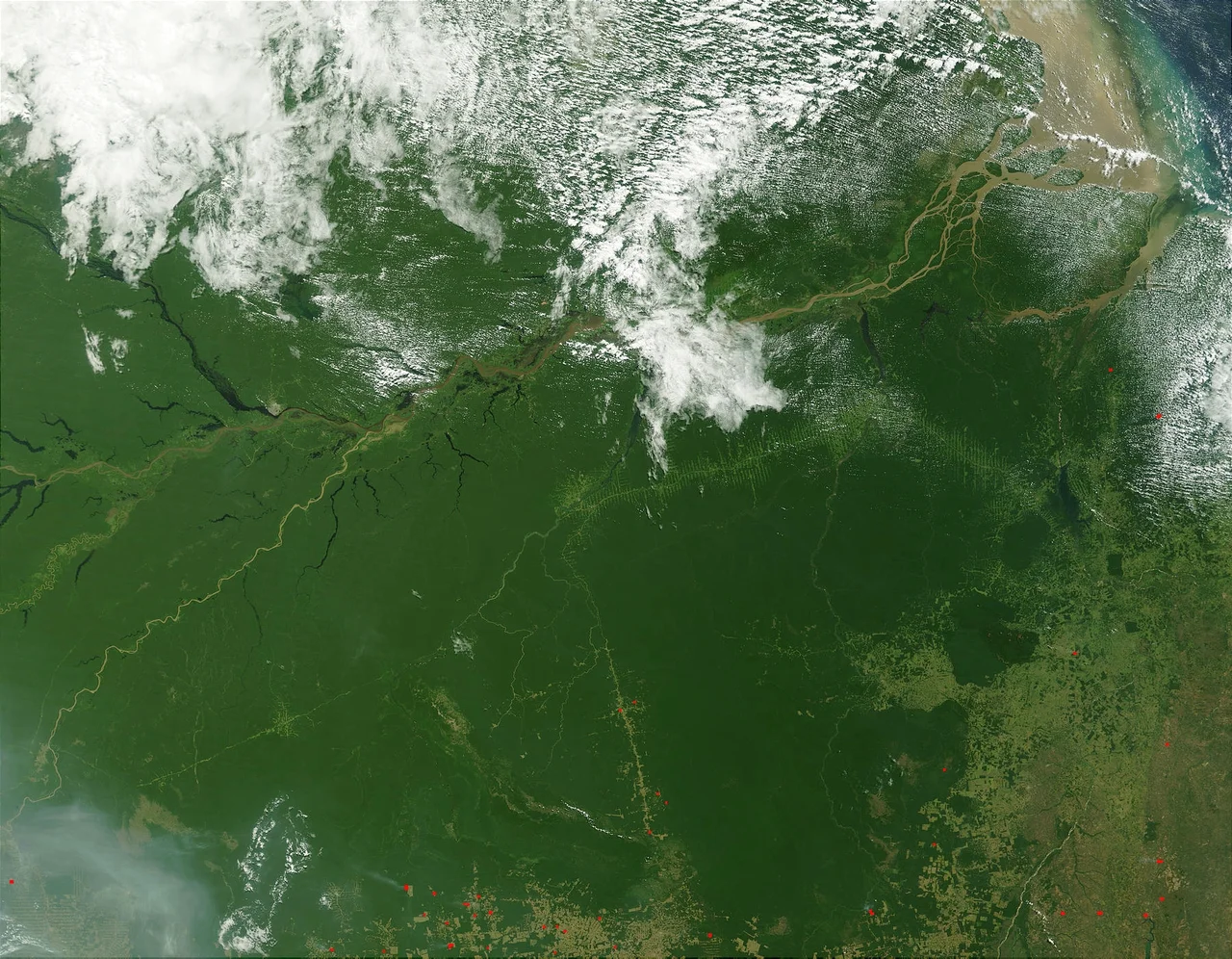
This is a national biome overview rather than a single location. The nominal coordinates in the record (15.61 degrees south, 56.06 degrees west) fall near Cuiabá and the edge of the Pantanal wetlands in central-western Brazil - a spot close to where three great biomes meet: the Amazon rainforest to the north, the Pantanal wetlands to the south, and the cerrado savanna to the east. Nearest airport is Marechal Rondon International (SBCY) near Cuiabá. From cruising altitude over central Brazil, the clearest view of Brazilian biodiversity is the visible difference between the dark green unbroken Amazon canopy north of the Mato Grosso line, the paler cerrado savanna mosaic south of it, and the seasonal wetlands of the Pantanal in southwestern Mato Grosso do Sul.
Nearby Stories
- Guiratinga 200 km away
- Central-West Region, Brazil 225 km away
- Pantanal Matogrossense National Park 226 km away
- Guaporé River 264 km away
- Araguainha Crater 306 km away
- Vila Bela da Santíssima Trindade 364 km away
- Serra Azul State Park 413 km away