
Willie Smits: The Dutchman Who Regrew a Rainforest
When Willie Smits proposed to his first wife in Tomohon, North Sulawesi, in 1980, the dowry surprised him: six sugar palms. A mature sugar palm ready for tapping cost about as much as a chicken. Smits, a young Dutchman who had arrived in Indonesia with little more than a forestry degree and an obsessive curiosity about trees, could not understand why the locals prized these particular trees so highly -- or why they were so cheap. Decades later, having founded the world's largest orangutan conservation organization, regrown 2,000 hectares of dead forest, and built a palm sugar factory powered by geothermal steam, he would look back at that dowry and call the sugar palm a magic tree. The answer to the mystery had been there all along. Smits just needed thirty years of work in Borneo to understand it.
Hungry Boy, Wounded Owl
Smits was born on February 22, 1957, in Weurt, a small village in the Gelderland province of the Netherlands. His father was a farm worker, his mother a dressmaker, and the family of five shared a space of roughly two by two meters. They often went hungry. Smits struggled with autism until the age of five, a challenge that made his early years more isolated but may have deepened his capacity for intense, sustained observation. Growing up on a farm, he found in animals the companionship that human society did not always offer. By six he was birdwatching. By twelve he had written his first article on barn owl behavior. Before long he had established a small rescue center for injured owls and falcons -- a teenager running a wildlife rehabilitation clinic from a Dutch farmyard. The pattern of his life was already forming: find something broken, study it closely, and figure out how to fix it.
A Dying Orangutan in a Market
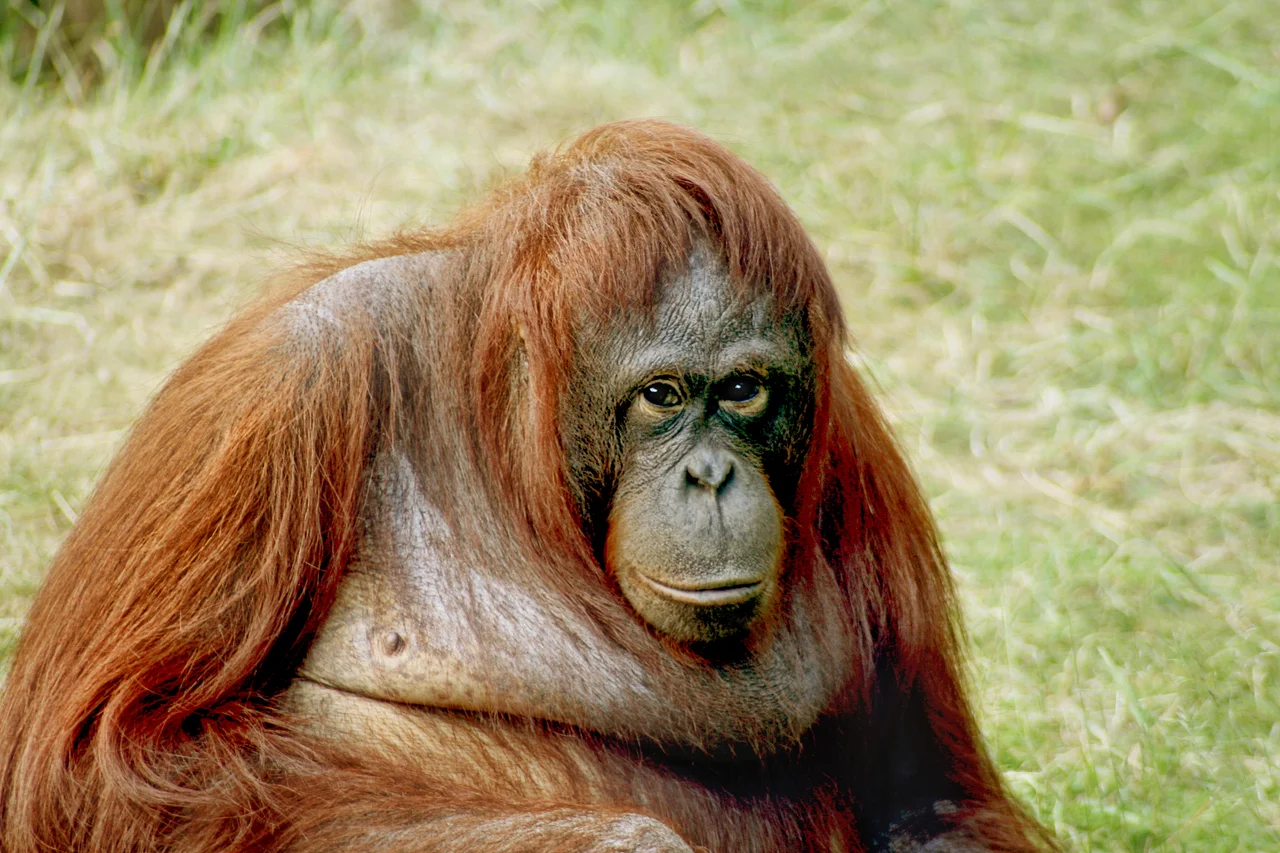
In 1985, Smits arrived at the Wanariset Tropical Forest Research Station near Balikpapan in East Kalimantan. He was there to study mycorrhizal fungi -- the underground networks that connect tree roots to nutrients in the soil -- and completed a PhD on the symbiosis between these fungi and the roots of dipterocarp rainforest trees. Then, in 1989, an encounter in a local market changed everything. A dying baby orangutan, skeletal and gasping, was being sold among the stalls. Smits nursed her back to health and named her Uce -- pronounced Ootcha -- for the labored sound of her breathing. A few weeks later, another sick orangutan arrived. He named this one Dodoy. By 1991, with the help of thousands of schoolchildren in Balikpapan contributing small donations, Smits had founded what would become the Borneo Orangutan Survival Foundation, now the world's largest organization dedicated to protecting the endangered Bornean orangutan. Wanariset became home to hundreds of confiscated orangutans rescued from smuggling, pet ownership, and exploitation. Dutch orangutan scientist Herman Rijksen remembered watching Smits build the quarantine facility: "In no time he set up the most fantastic oversized quarantine facility, better than any hospital in the whole area, because that's typical of Willie. He wants to do it very, very good."
Growing Forest from Nothing
In 2001, the BOS Foundation began buying degraded land near Samboja -- 2,000 hectares of clay soil covered in alang-alang grass, with underground coal seams that spontaneously combusted in dry weather. This was the land nobody wanted, and Smits could afford it precisely because it was considered worthless. He applied what he knew about mycorrhizal fungi to create compost systems that could jumpstart soil biology, planting tree seedlings inoculated with the fungal networks his doctoral research had documented. By 2006, more than 740 tree species had been planted. By 2009, there were 1,200 species of trees, 137 species of birds, and six species of non-human primates living in what had been a wasteland less than a decade earlier. In his 2009 TED talk, Smits reported that reforestation at Samboja Lestari had increased local cloud cover and boosted rainfall by 30%. The claim was challenged, and TED published a detailed response. But the forest itself was undeniable -- growing, populated, and functioning as an ecosystem where orangutans could learn to be wild again through forest schools and graduated release programs.
The Magic Tree
Smits' work extended far beyond orangutans. Through the Masarang Foundation, which he co-founded and chairs, he attacked the economic pressures driving deforestation by offering communities alternatives. His answer was the sugar palm -- the tree that had appeared in his wedding dowry decades earlier. In 2007, Masarang opened a palm sugar factory in Tomohon that uses waste steam from a Pertamina geothermal power station to process nira, the white sap tapped daily from sugar palms. The factory employs roughly 6,200 farmers. The sugar is sold locally and exported to Hong Kong, Australia, Singapore, and Europe. Smits estimates that the factory saves 200,000 trees per year from being cut down as fuel wood. The sugar palm, he discovered, prevents landslides on steep terrain, produces fibers used in European luxury car bodies, and yields sap that can be processed into ethanol. "From the roots to the leaves, every bit is beneficial for people," he has said. He designed and patented what he calls the Village Hub -- a decentralized processing unit he believes could be replicated across Indonesia's eight sugar-palm-rich provinces.
Death Threats and Dedication
The work has never been safe. Confiscating illegally held orangutans from homes is inherently confrontational, and Smits has received numerous death threats. He once spent three days in a hospital on chemotherapy to fight lungworms and other parasites contracted from the animals he was trying to save. He became an Indonesian citizen. He was knighted in the Netherlands and served as a senior advisor to Indonesia's Ministry of Forests. He designed the Schmutzer Primate Centre at Jakarta's Ragunan Zoo, where thick dark glass allows visitors to observe orangutans while remaining invisible to them -- a design that puts the animals' comfort above spectacle. By 2018, Smits had facilitated the rescue of 1,300 orangutans and established 114 conservation projects across Indonesia, including sanctuaries in twenty-eight locations. He is not without critics. Some conservation scientists argue that protecting existing forest is far more cost-effective than regrowing lost forest. But Smits' response has always been the same: the existing forest is almost gone. Somebody has to start growing it back.
From the Air
Smits' primary base of operations is at Samboja Lestari, located at 1.05S, 116.99E in East Kalimantan, approximately 38 km northeast of Balikpapan. Nearest major airport is Sultan Aji Muhammad Sulaiman Sepinggan International Airport (WALL/BPN). His Masarang Foundation palm sugar factory is located in Tomohon, North Sulawesi (WAMM). The Schmutzer Primate Centre is at Ragunan Zoo in Jakarta (WIII). From the air, the contrast between the Samboja Lestari reforestation block and surrounding degraded land is visible at medium altitude.
Nearby Stories
- The Last Beach 6.9 km away
- The Mahakam: Borneo's River of Kingdoms and Dolphins 20 km away
- The Bridge That Tried to Be Golden 31 km away
- Badak LNG: Borneo's Gas Giant 91 km away
- Sixty Seconds Over Banjarmasin 171 km away
- The Ground Beneath Mamuju 258 km away
- Oil, Empire, and the Fight for Borneo 275 km away
- The Million-Hectare Mistake 282 km away