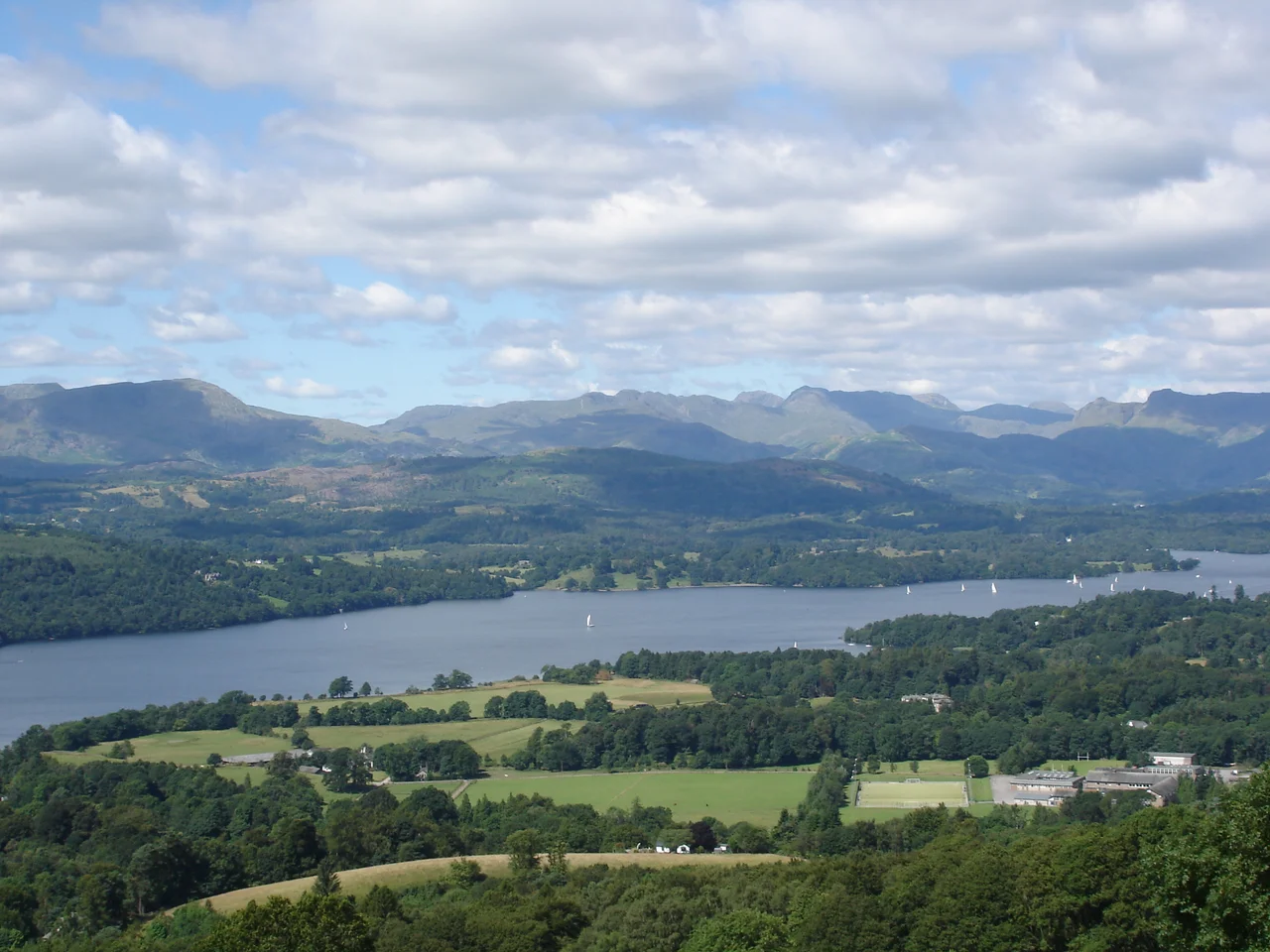

Windermere
On Saturday 13 September 2008, two thousand two hundred people put on wetsuits, walked into Windermere, and swam a mile. It was the inaugural Great North Swim. The following year, six thousand people did the same. England's largest lake is also, by some measures, its most public - eleven miles long and a mile across at its widest, eleven kilometres of shoreline lined with hotels, slipways, sailing clubs, ferry stops, hire boats, jetties, and conservation workshops. Some lakes are remote. Windermere is the opposite. Every era of British public life in the last two hundred years has somehow ended up here.
A Ribbon Drawn by Ice
Windermere lies in a steep-sided pre-glacial river valley, deepened by successive glaciations. The current lake formed between roughly 17,000 and 14,700 years ago, during the retreat of the British and Irish Ice Sheet, just before the period known as the Windermere Interstadial. Meltwater from retreating ice in the Troutbeck, Rothay, and Brathay catchments filled the valley. The lake is up to 66.7 metres deep and sits 39 metres above sea level. Geologists count at least nine ice retreat phases recorded in buried recessional moraines under the lake bed. Its outflow is the River Leven, which drains south to Morecambe Bay. The name itself is Old English-Norse hybrid: probably 'Winand's lake', combining a personal name with the Old English 'mere'. Despite the name, Windermere is not a true mere - it has a distinct thermocline, distinguishing it from typical shallow lakes.
Steamers, Yachts, and the Crowded Surface
The lake has been a tourist destination since the Kendal and Windermere Railway's branch line opened in 1847. Three of the original four large railway-built motor vessels still operate under Windermere Lake Cruises Ltd: MV Tern of 1891, MV Teal of 1936, and MV Swan of 1938. The fourth, MV Swift of 1900, was broken up in 1998. Often called steamers, they are now all diesel. The Windermere Ferry, a cable ferry, has crossed from Ferry Nab to Far Sawrey since long before the road system caught up. Five large boating clubs share the water - the Royal Windermere Yacht Club, South Windermere Sailing Club, Windermere Motor Boat Racing Club, Lake District Boat Club, and Windermere Cruising Association. Belle Isle, the largest island, sits opposite Bowness and is privately owned. The lake gave its name to the Windermere kettle, a steam-powered tea urn now considered a museum piece.
Records, Wars, and a Refugee Rescue
On Friday 13 June 1930, Sir Henry Segrave broke the world water speed record on Windermere in Miss England II at 158.94 km/h. On the third run, off Belle Grange, the boat capsized. His mechanic Victor Halliwell drowned. Segrave was rescued, but died soon after of his injuries. He remains one of the few people in history to have held the world land speed record and water speed record simultaneously. Norman Buckley set several further records here in the 1950s before the lake imposed a 10-knot speed limit in 2005, which sent the record-chasing community south to Coniston Water. In 1945, three hundred Jewish children who had survived Auschwitz were brought to Troutbeck Bridge near Windermere, helped to recover by Leonard G. Montefiore. They became known as the Windermere Boys; their story was dramatised by the BBC for the 75th anniversary of the camps' liberation in 2020. William Wordsworth had described the view of Windermere from a hilltop in The Prelude more than a century earlier. Stan Laurel - born in Ulverston in 1890 - came here as a child on day trips. Oscar Wilde began Lady Windermere's Fan during a Lake District summer in 1891. Taylor Swift sang about Windermere peaks on her 2020 album Folklore.
The Water Quality Fight
Beneath all this surface life, Windermere has been in serious environmental trouble. In 2021 it emerged that the sewage-treatment plant at Ambleside had discharged untreated sewage for 1,719 hours during 2020 alone, the equivalent of 71 days. Local zoologist Matthew Staniek founded the campaign group Save Windermere to push back. The Big Windermere Survey - run by the Freshwater Biological Association (established on the shore of Windermere in 1929) and Lancaster University between 2022 and 2024 - sampled more than a hundred sites and found widespread bacterial contamination and elevated phosphorus, with results released in September 2025. Environment Agency modelling suggests about 52% of the phosphorus in the north basin comes from sewage; in the south basin, about 59%. In 2024, United Utilities fought in court to keep its monitoring data secret. The Information Commissioner's Office ruled the data must be disclosed, and the company eventually dropped its appeals in January 2025. The Big Windermere Survey was prompted in part by years of algal blooms and visible turning of the water. On 9 March 2025, the UK Government pledged to end all sewage discharges into the lake. A feasibility study, due to report in summer 2026, is now under way. England's most loved lake is also, in 2026, its most carefully argued over.
From the Air
Windermere is England's largest lake - 11 miles long, oriented roughly NNW-SSE, centred at 54.36 N, 2.94 W in the southern Lake District. From altitude it is unmistakable: the longest body of fresh water in England. The town of Windermere and Bowness sit on the eastern shore at the lake's widest point. Belle Isle is the large island opposite Bowness. Major inflows are the Rothay and Brathay at the north end; the River Leven flows south from the lake's southern tip. Nearest airfield is Carlisle Lake District (EGNC), about 60 km north; Walney Island (EGNL) lies 35 km south-west. Recommended viewing altitude 3,000-5,000 ft AGL. Strong south-westerly winds funnel up the lake; expect turbulence and rapid weather change at lower altitudes.
Nearby Stories
- Morecambe Bay 4.1 km away
- Caldbeck 8 km away
- Pendragon Castle 8.1 km away
- Egremont Castle 8.5 km away
- Upper Teesdale 13 km away
- Solway Firth 13 km away
- Malham Cove 21 km away
- Santon Railway Station 70 km away