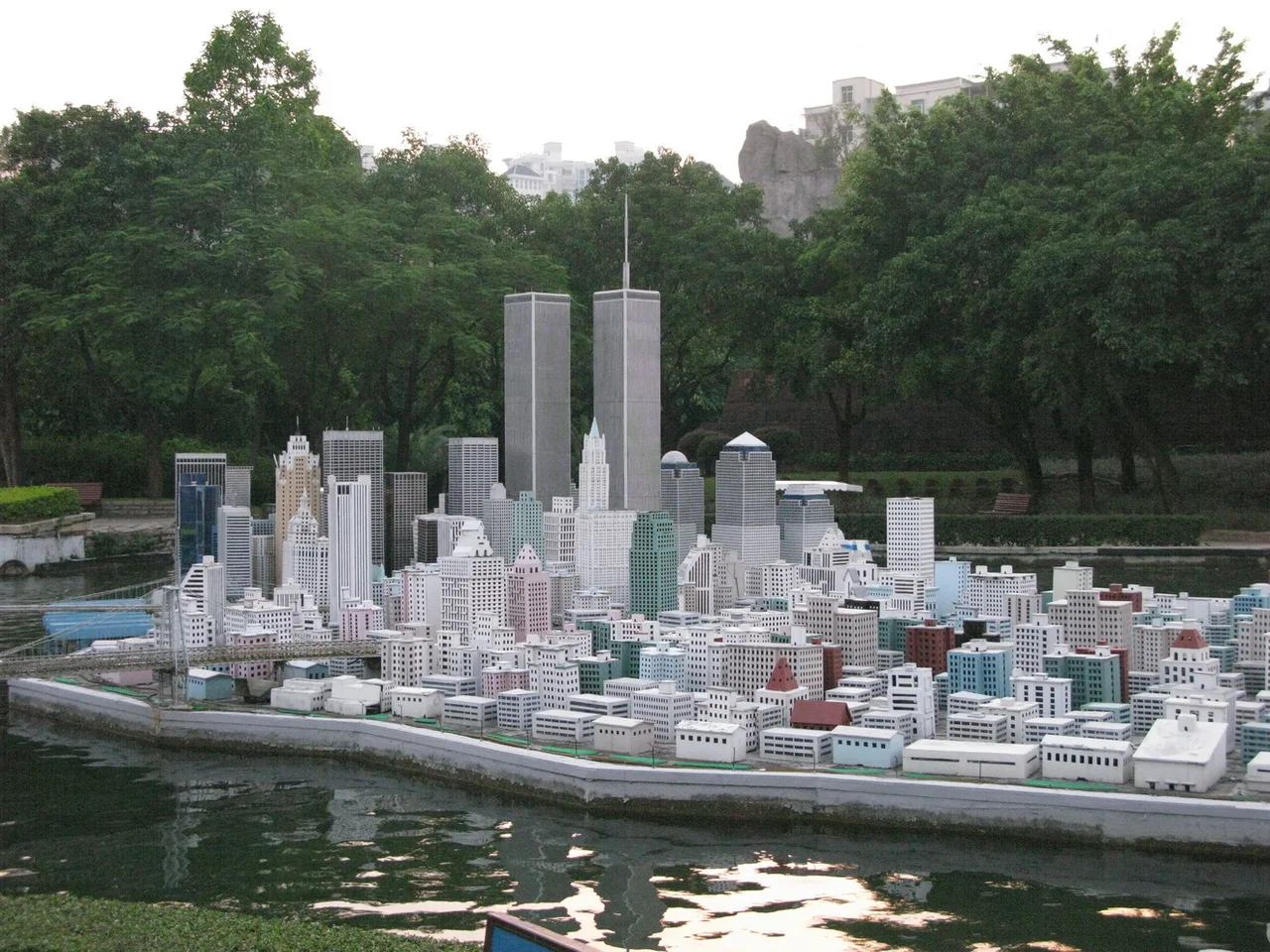

Window of the World
Stand in one spot at Window of the World in Shenzhen and you can see the Egyptian Pyramids, the Taj Mahal, and Angkor Wat simultaneously. Turn around and there is a 108-metre Eiffel Tower — one-third the height of the Paris original, but tall enough to dominate the entire park. The premise sounds absurd: 130 of the world's most famous monuments, crammed into 48 hectares in the western part of a Chinese Special Economic Zone city. In practice, it is something stranger than absurd. It is genuinely disorienting, and genuinely appealing.
The World in 48 Hectares
The park opened in 1993 and has drawn over 3.25 million visitors per year as of 2025. Its 130 reproductions span every inhabited continent, arranged by region: European landmarks cluster in one area, Asian monuments in another, the Americas and Oceania and Africa each given their own territory. The organizing logic mirrors atlas geography, letting visitors navigate from Stonehenge to Mount Fuji to Machu Picchu in the course of an afternoon.
Most landmarks have been reproduced at 1:15 scale, though the Eiffel Tower — at 108 metres (354 feet) — occupies a special place. It functions as the park's visual anchor: visible from across the grounds, it orients visitors the way the real tower orients Paris. Around it stand the Arc de Triomphe, the Notre Dame Cathedral, the Louvre Pyramid. A miniature Paris in a miniature world.
From Pyramids to the Pacific Northwest
The sheer inventory of what Window of the World contains is staggering. In Europe: the Acropolis, the Colosseum, Venice's canals, Neuschwanstein Castle, the Kremlin, the Winter Palace, Buckingham Palace, the Uffington White Horse. In Asia: Angkor Wat, the Taj Mahal, Borobudur, Persepolis, Mount Fuji, Himeji Castle, Hagia Sophia. In Africa: the Pyramids of Giza, Abu Simbel, the Lighthouse of Alexandria. In the Americas: Niagara Falls, Machu Picchu, Christ the Redeemer, Mount Rushmore, the Statue of Liberty, the Grand Canyon.
The totem poles and longhouses of the Indigenous peoples of the Pacific Northwest stand near Moai statues from Easter Island. Uluru rises beside the Sydney Opera House. The breadth is the point: the park aspires to nothing less than a comprehensive portrait of human civilization, pressed into the space of a Shenzhen district.
Shenzhen's Particular Ambition
Window of the World opened when Shenzhen was still proving itself — a city barely a decade old as a formal Special Economic Zone, growing at a pace that felt more like invention than development. Building a park that claimed to contain the whole world was consistent with the energy of the place: large, self-confident, and fundamentally optimistic about what could be accomplished quickly.
The park sits in western Shenzhen, accessible by metro and bus from the city center. It occupies the same Nanshan District as Splendid China, the park that miniaturizes China's own landmarks — a street apart, the two parks bracket an unusual experiment in cultural compression. Together, they present both Chinese heritage and world heritage at walkable scale, a vision of accessibility that the city of Shenzhen seemed particularly eager to build.
What the Reproductions Reveal
A faithful reproduction of a famous landmark involves choices. How do you represent the Great Wall without the landscape it traverses? How do you convey Machu Picchu's verticality at 1:15 scale? The answers at Window of the World are often clever, sometimes imperfect, occasionally surprising. The park does not pretend the originals are unnecessary — it works better as a prompt than as a substitute, sparking curiosity about the actual places.
One curiosity: the park's reproduction of the Ruwanwelisaya in Sri Lanka is mislabeled as the neighboring Jetavanaramaya. Such small errors are almost inevitable at this scale of ambition. Three million visitors a year seem undeterred. The park's entry sign — a soaring archway past which a miniature planet Earth rotates — announces exactly what awaits inside: the whole world, compressed, available, and ready for an afternoon.
From the Air
Window of the World is located at approximately 22.538°N, 113.970°E in the Nanshan District of Shenzhen. Nearest major airport is Shenzhen Bao'an International Airport (ZGSZ), approximately 26 km to the northwest. The 108-metre replica Eiffel Tower is the park's most recognizable feature from the air and serves as a visual landmark for the western Shenzhen Bay area. Recommended viewing altitude 2,000–4,000 feet. The park is part of the Overseas Chinese Town development cluster visible along the western Shenzhen waterfront.
Nearby Stories
- Hong Kong Disneyland 4.1 km away
- Mount Guanyin (Dongguan) 7 km away
- 2024 Lixinsha Bridge Collapse 7.4 km away
- Portas do Cerco 12 km away
- Lotus Hill 15 km away
- Nanxiong Formation 78 km away
- Heyuan 130 km away
- Checheng Fu'an Temple 629 km away