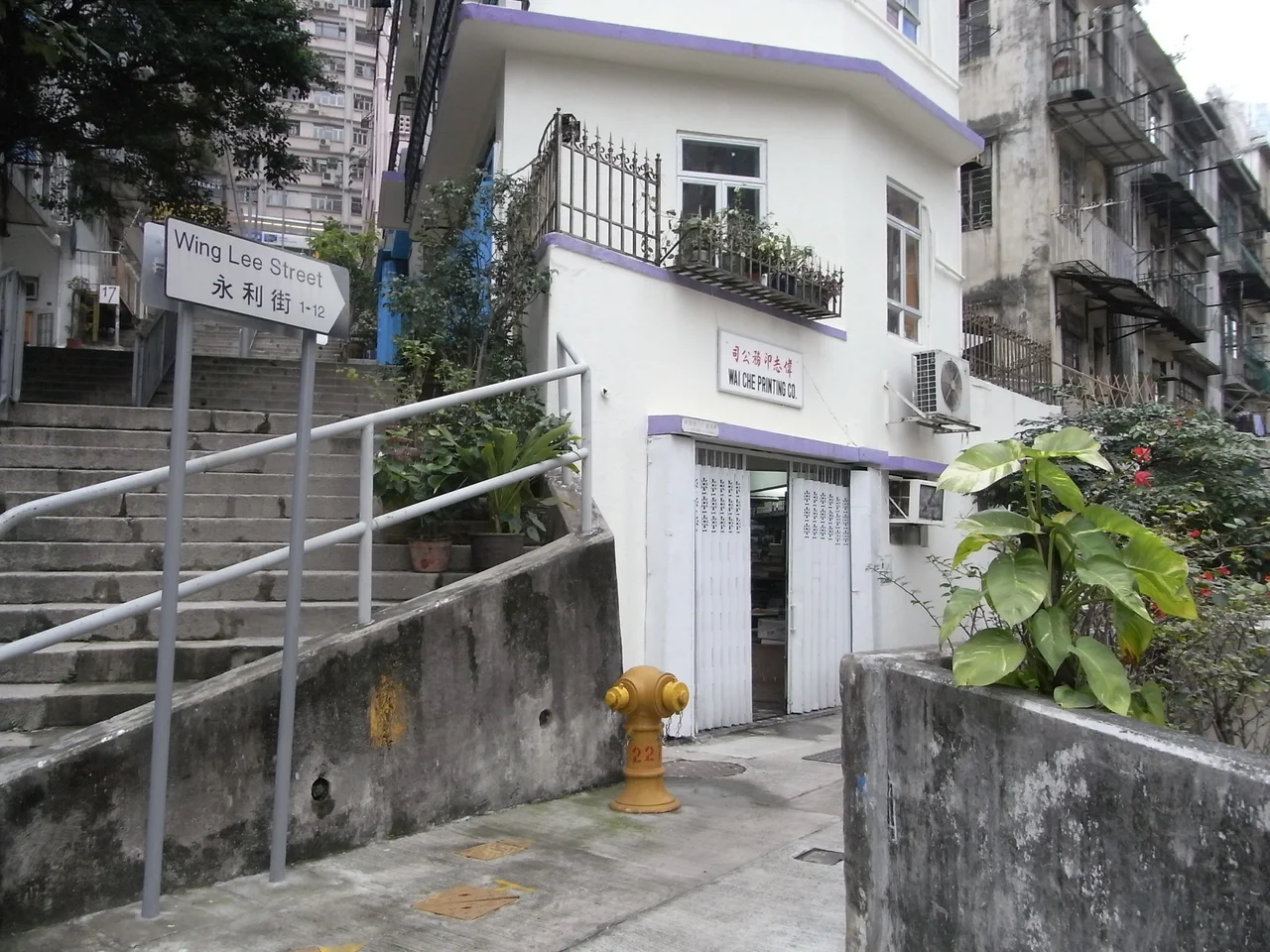

Wing Lee Street
A film saved Wing Lee Street. Without *Echoes of the Rainbow* — a Hong Kong movie about childhood memory and loss, shot partly on this narrow Sheung Wan slope — the Urban Renewal Authority's H19 project would have proceeded, and the old tenement blocks would be gone. Instead the film won the Crystal Bear for Best Film in the Children's Jury Generation Kplus category at the 2010 Berlin International Film Festival. The award generated attention, and the attention generated enough public pressure that the redevelopment plan was scrapped. Wing Lee Street survived its scheduled death, though the aftermath was messy, and the street today exists in the complicated limbo of a place that was saved but not quite saved.
The Seediest Street in Hong Kong
Someone, at some point, called Wing Lee Street the seediest street in Hong Kong. The description stuck, and it is not entirely unfair. The buildings along it — unremarkable 1960s-era tenement blocks, five or six storeys of rendered concrete with metal grilles on the windows and air conditioning units bristling from every facade — are old by Hong Kong standards, which is to say they are about sixty years old, a span of time that in other cities might qualify as recent history. In Hong Kong, where the pace of demolition and reconstruction has been ferocious, they are antiques. The street itself is a short, steep lane in Sheung Wan's tangle of old roads, running near Shing Wong Street, Bridges Street, and Ladder Street, just below the Former Hollywood Road Police Married Quarters. Nothing about it is conventionally picturesque.
The Crystal Bear Intervention
The Urban Renewal Authority had assembled the wing Lee Street blocks into its H19 project, packaged with adjacent properties on Staunton Street, and was preparing to redevelop. Residents whose flats had been acquired by the URA had already lost their right to compensation and resettlement by the time the film brought international attention to the street. The Berlin win in February 2010 changed the calculation. The URA, responding to public sentiment that had suddenly coalesced around a place that had previously been invisible to most Hong Kong residents, cancelled the project. It was a rare reversal — the URA tends not to change direction once redevelopment machinery is in motion — and it happened fast.
Saved, But Imperfectly
The aftermath revealed the limits of what a film festival award can achieve. Residents whose flats had already been acquired by the URA were no longer eligible for the standard compensation and resettlement packages, because the project cancellation left them outside the redevelopment area. The URA offered renovation subsidies and resettlement assistance instead, but the situation for many tenants remained difficult. Owners of blocks the URA had not managed to acquire were invited to renovate their properties, with the authority offering subsidies to support preservation. None of them responded. Those blocks were left unmaintained, their owners apparently unwilling to spend on properties they could no longer easily sell or demolish.
What a University Does With a Tenement
The URA renovated four blocks it had acquired and handed them to institutions: the University of Hong Kong, the Hong Kong Youth Federation, and the Hong Kong Arts Centre were invited to make use of the spaces. What those partnerships produced is a modest form of adaptive reuse — not the gleaming heritage centre or boutique hotel that such conversions often become, but something more functional and less spectacular. The blocks remained recognizably what they were: narrow floors, low ceilings, the bones of domestic Hong Kong from sixty years ago. Wing Lee Street did not become a tourist attraction in the conventional sense. It became, instead, a place that people visit because they know its story: the tenements that a film held together by winning a prize in Berlin.
From the Air
Wing Lee Street sits at approximately 22.283°N, 114.150°E in Sheung Wan, on the northern slope of Hong Kong Island's central ridge. From the air, the area is densely built — a tight grid of mid-rise residential and commercial blocks rising from the waterfront toward Victoria Peak. Wing Lee Street itself is too narrow to distinguish from altitude, but the broader Sheung Wan neighbourhood is identifiable by the Western Market's distinctive redbrick form a few blocks to the north, and by the green spine of the Bonham Road ridge rising sharply to the south. The nearest airport is VHHH (Hong Kong International Airport), approximately 25 km to the west. Sheung Wan MTR station is the closest rail access, and Hollywood Road — the antiques district above the street — is a useful landmark for ground-level orientation.
Nearby Stories
- Lok Ma Chau Loop 2.3 km away
- Portas do Cerco 2.3 km away
- Kweilin Incident 17 km away
- Wanshan Archipelago Campaign 34 km away
- Nanxiong Formation 115 km away
- Battle of Nanpeng Island 148 km away
- Heyuan 169 km away
- Cape Maobitou 632 km away