
Woodrow Wilson Presidential Library
Twelve rooms. Twelve fireplaces. The First Presbyterian Church of Staunton built the house in 1846 for its minister, and on December 28, 1856, the minister's wife gave birth in an upstairs bedroom to a son named Thomas Woodrow Wilson. The family stayed only a year or two before the father took a different pulpit further south, and the boy who would become the 28th president of the United States grew up mostly in Augusta, Georgia, and Columbia, South Carolina. But Wilson never forgot the Manse. He returned several times - including a two-night stay just after his 1912 election - and called Staunton home. The house at 18 North Coalter Street is, in the technical sense, the place he came from.
The Manse
A manse is a Presbyterian minister's residence, and this one cost about $4,000 to build - serious money in 1846. The Greek Revival house has porches on multiple levels and views across the small valley that runs through downtown Staunton. The Wilson family - Joseph Ruggles Wilson, the minister; his wife Jessie Woodrow Wilson; and their two young daughters, Marion and Annie - moved in during 1855 when Joseph took the Staunton pulpit. Their son Tommy, as the family called him, was born the following winter. The Wilsons left Staunton in 1857. Wilson would later move with his family across the South as his father served different congregations, including in Augusta during the Civil War, where the boy saw Union soldiers march through his streets - experiences that shaped him for life.
Wilson Returns
Wilson visited Staunton repeatedly as an adult. In December 1912, just weeks after winning the presidential election, he and his first wife Ellen came to Staunton for his 56th birthday. They stayed two nights in the Manse as guests of Reverend Frazier, who was then minister of the First Presbyterian Church. Photographs from that visit show the president-elect on the porch he had not lived behind since infancy. The house itself remained the Presbyterian minister's home until the 1920s. After Wilson died in 1924, his widow Edith Bolling Galt Wilson - herself a Virginia native who had effectively run the executive branch during her husband's incapacitating 1919 stroke - led the effort with former cabinet members and Staunton residents to convert the Manse into a memorial.
The Library Complex
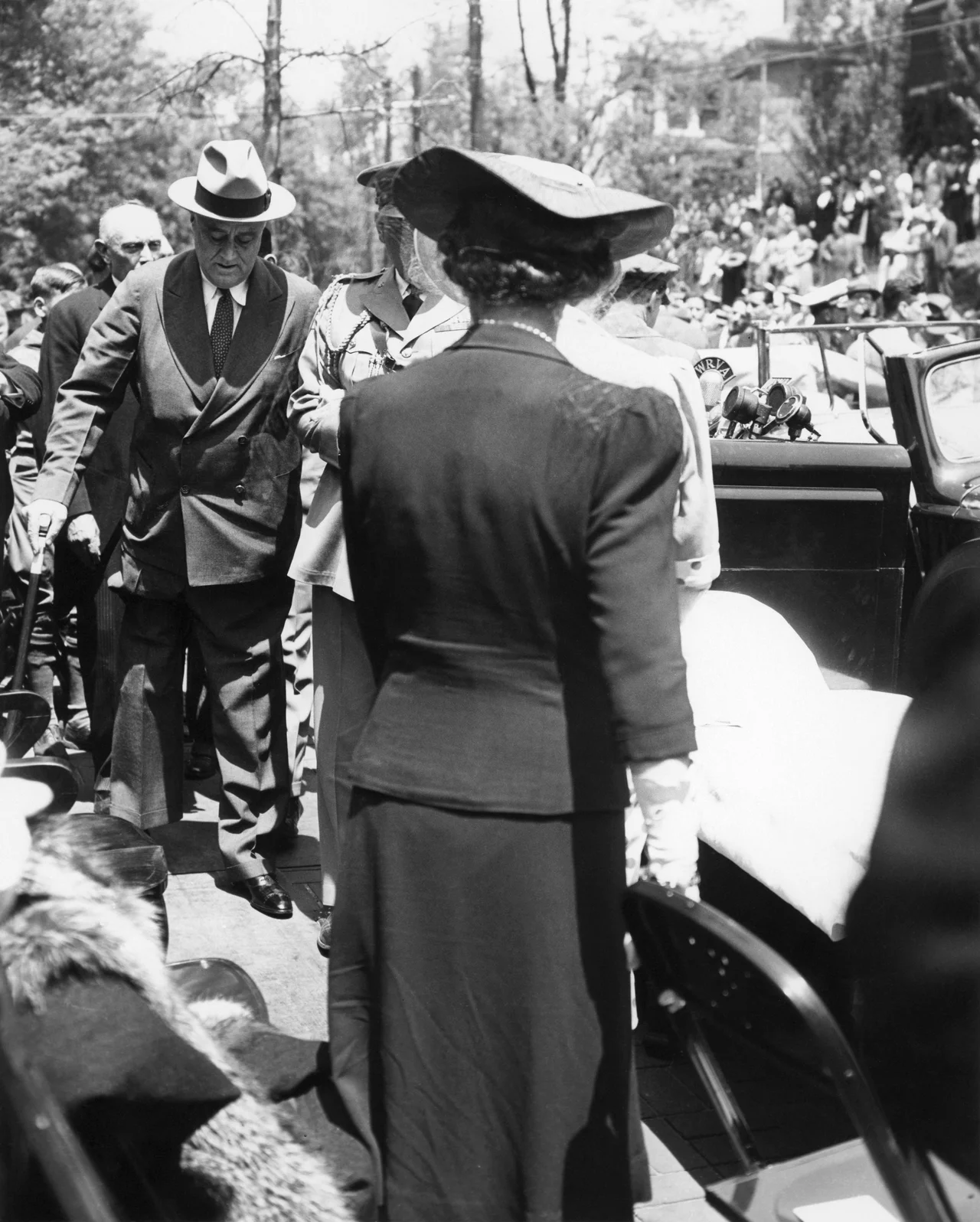
The Woodrow Wilson Birthplace Foundation incorporated in 1938. The house was restored to its 1850s appearance - which meant removing later additions like bathrooms and changing fixtures back to the kerosene and oil lamps of Wilson's birth year. President Franklin D. Roosevelt formally dedicated the museum on May 4, 1941, just months before the United States entered the war that would test the international institutions Wilson had championed. The site became a National Historic Landmark in 1964 and joined the National Register of Historic Places in 1966. Today the complex includes the Manse itself, a museum opened in 1990 with eight galleries on Wilson's life and presidency, and a research library that holds the third-largest collection of Wilson papers. The largest is at the Library of Congress; Princeton holds Wilson's academic papers from his presidency of that university.
What's in the Museum
The 8,000-square-foot museum two doors down from the Manse focuses on the Wilson presidency and the world it tried to shape. The signature artifact is Wilson's 1919 Pierce-Arrow limousine, the car that carried him through the post-war negotiations and his ill-fated cross-country tour to promote the League of Nations - the tour that ended with his stroke. An interactive World War I trench exhibit lets visitors stand inside a recreation of the conditions that shaped Wilson's generation's diplomacy. The museum confronts the more difficult parts of Wilson's record honestly: his role in re-segregating the federal civil service, his hostility to Black Americans' civil rights, his repression of dissent during World War I. A presidential birthplace is rarely a tidy story. Wilson's, in particular, is not.
From the Air
Located at 38.1501N, 79.0688W on North Coalter Street in downtown Staunton, Virginia, in the Shenandoah Valley. The Manse, museum, and library complex sits on a hilltop a few blocks east of downtown's commercial core. Recommended viewing altitude is 3,500 to 5,500 feet for views of the complex in context with the surrounding city. Nearest airport is Shenandoah Valley Regional (KSHD) about 4 nm north; Charlottesville-Albemarle (KCHO) is 30 nm east. Watch for valley haze in summer.
Nearby Stories
- Rockingham County 4.8 km away
- Shenandoah: The Skyline Drive Through America's Oldest Mountains 5.6 km away
- 2023 Virginia Cessna Citation Crash 16 km away
- Highland County, Virginia 16 km away
- Montpelier 20 km away
- Fork Union Military Academy 26 km away
- Battle of Greenbrier River 28 km away
- Alleghany County, Virginia 53 km away