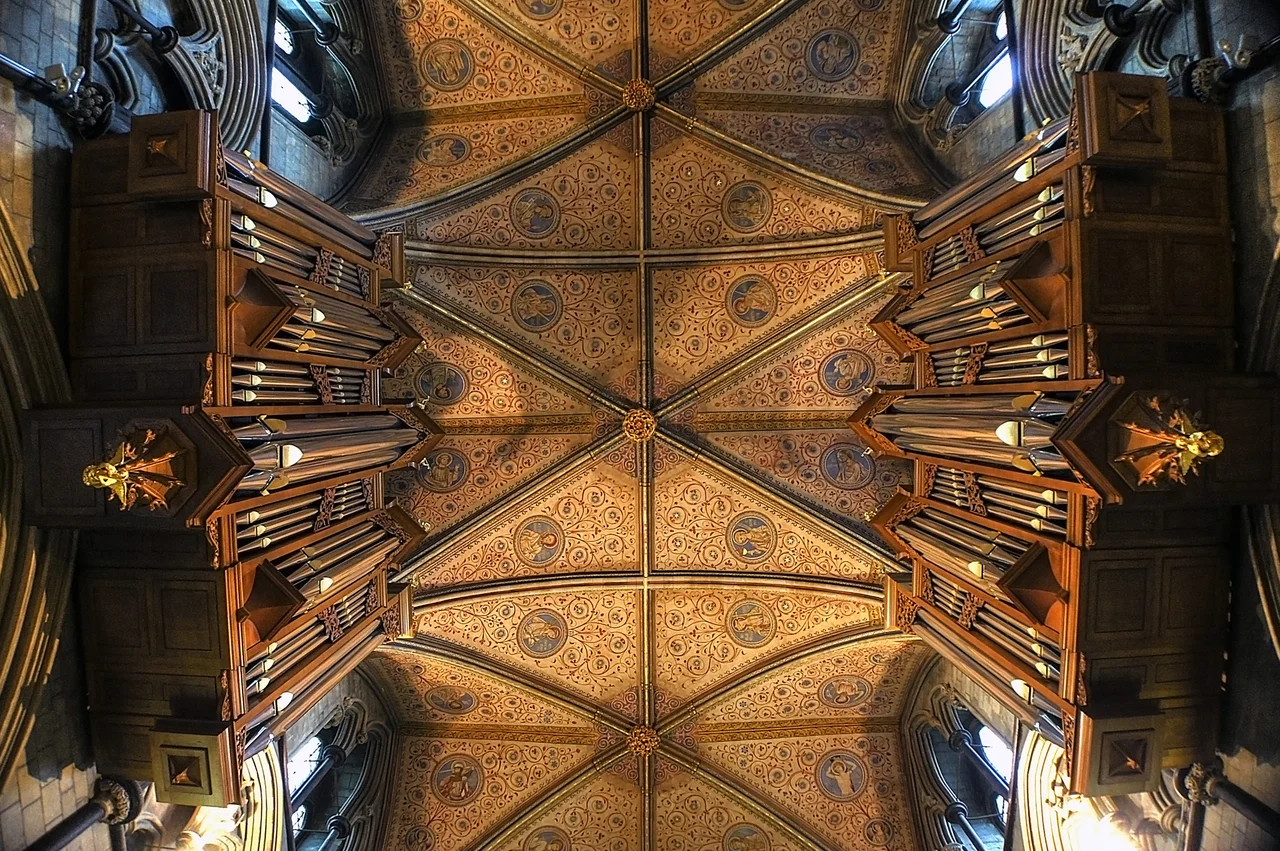

Worcester Cathedral
King John asked to be buried at Worcester before he died at Newark in 1216. He chose his spot carefully: between the shrines of two Anglo-Saxon saints, Wulfstan and Oswald, where he hoped their reputation for holiness might offset his own for tyranny. The shrines are gone now, smashed at the Reformation. The tomb of John remains - the oldest royal effigy in England, his stone face still wearing the crown that lost him most of his French possessions and almost all his English allies. Worcester Cathedral has accumulated this kind of irony for over thirteen centuries. Founded in 680 AD, rebuilt by a Saxon saint, spared at the Dissolution because of an elder brother who died too young to be king, looted in the Civil War, and revered today as one of the most musically distinguished cathedrals in England.
Saint Wulfstan's Crypt
Go down the steps beneath the chancel into a forest of stone. The crypt of Worcester Cathedral is the oldest fabric in the building, begun in 1084 by Wulfstan - the last Anglo-Saxon bishop, who survived the Norman Conquest and would still be bishop of Worcester when he died in 1095, aged about 87. He was made a saint in 1203. His crypt is a multi-columned hall in the pure Norman Romanesque style, the cushion capitals still recognisably the work of carvers trained before 1066. Above it the rest of the cathedral was built and rebuilt over three centuries: the round chapter house from 1120 (the walls were thickened in the 14th century, which turned the outside octagonal); the nave from the 1170s, in alternating bands of green Highley sandstone and yellow Cotswold limestone; the East End rebuilt in the Early English Gothic style from 1224 to 1269 by Alexander Mason, in deliberate harmony with what was being built at the same time at Salisbury. The central tower - what the architectural historian Alec Clifton-Taylor calls "exquisite" - was finished by John Clyve in 1374.
The Brother Who Saved a Cathedral
Henry VIII's Dissolution of the Monasteries should have ended Worcester Cathedral. It was a Benedictine priory church; 35 monks worked here at the dissolution in January 1540 (eleven were pensioned off immediately, the rest were converted into secular canons of a new Royal College). What spared the building - what stopped Henry from doing to Worcester what was done to so many great abbeys - was a chantry chapel on the south side of the choir. Inside it lies Arthur Tudor, Prince of Wales, who died at Ludlow in 1502 at the age of fifteen, four months after marrying Catherine of Aragon. Had he lived, he would have been King Arthur of England; his younger brother Henry would have remained a duke. His chantry was built between 1502 and 1504 in dazzling late-perpendicular stone, and it sits in Worcester Cathedral as both monument and warning. The English Reformation made an exception for it because Henry VIII could not be seen to desecrate his own brother's tomb. Worcester suffered badly from iconoclasm under the new dispensation, but it was not levelled.
The Cathedral in the Civil War
What Henry's commissioners spared, Cromwell's soldiers ransacked. Worcester declared for the King in 1642 and was used to store munitions; when the Earl of Essex briefly retook the city after the Battle of Powick Bridge that September, Parliamentary troops vented their frustration on the cathedral. Stained glass was smashed. The organ was destroyed. Library books and monuments were broken up for the sheer pleasure of breaking them. The diocese itself was abolished from 1646 to 1660. In 1647 the bell tower (a separate detached structure) was pulled down. After the Battle of Worcester in September 1651, the building was used as a prison for the Scottish soldiers Cromwell had captured - 10,000 of them, packed into Worcester's churches and warehouses, many of them eventually shipped to New England as indentured servants. The cathedral has, in its way, never quite recovered: of the medieval glass that once filled its windows, very little is now original.
Libraries and Ledgers
Two treasures survive that the iconoclasts somehow missed. The cathedral library, tucked since the 19th century in a loft above the south nave, holds 289 medieval manuscripts, 55 incunabula (books printed before 1501), and 6,600 post-medieval printed volumes. The collection also includes the original 1215 will of King John - a single sheet of vellum, signed by the man whose tomb lies a few hundred feet below - and a 1225 copy of Magna Carta, one of only four reissues of that year. The Worcester Antiphoner survives too, the only complete medieval music book of its kind in England. The cathedral's scriptorium produced manuscripts of the highest quality: John of Worcester, the great early-12th-century chronicler, worked here, and so did the unnamed monk whose distinctive shaky handwriting earned him the nickname "The Tremulous Hand of Worcester" - he was probably copying texts late in life with Parkinson's or essential tremor, and his hand can still be identified across multiple surviving books.
Elgar's Cathedral
Edward Elgar grew up here. His father William ran a music shop in Worcester High Street; the boy studied scores in the cathedral's music library, which still holds the original manuscripts of his early works alongside those of the 17th-century composer Thomas Tomkins (organist here from 1596). Elgar's *Enigma Variations* received their definitive performance in this cathedral at the 1899 Three Choirs Festival - the oldest classical music festival in the world, founded in the early 1700s and rotating between Worcester, Hereford, and Gloucester cathedrals. A stained-glass window in the cathedral commemorates Elgar with his portrait. His image once also appeared on the reverse of the Series E £20 note, issued from 1999 to 2010, with the west front of Worcester Cathedral behind him. Look up at the cathedral's tower of fifteen ringing bells, the sixth heaviest ring of twelve in the world - cast in 1928 by John Taylor of Loughborough from the metal of an earlier 1869 set - and you are hearing essentially what Elgar heard when he was a boy walking these cloisters.
The Long View From the Top
Climb the cathedral tower in summer (there are 235 steps) and the view that opens out is one of the most varied in England. To the west the Malvern Hills run their nine-mile spine of Precambrian rock, rising 1,394 feet at the Worcestershire Beacon. To the south the Severn winds toward Tewkesbury and Gloucester. To the east the Vale of Evesham unrolls. To the north the river runs to Bewdley and the gateway of the Wyre Forest. Below you, on the cathedral floor, lie the tombs of King John, Prince Arthur, three prime ministers - including Stanley Baldwin, born five miles upriver at Bewdley - and a thousand ordinary people who chose this place to be remembered. The cathedral has been here for 1,346 years. It will, on present evidence, be here for several centuries more.
From the Air
Located at 52.1887°N, 2.2208°W on the east bank of the River Severn in the centre of Worcester. The cathedral tower (about 200 ft) is the dominant landmark for miles around; the river curves past it to the west. Best viewed at 2,500-4,000 ft AGL. Approach the city from the south for the classic river-and-tower silhouette. Nearest airfields: Gloucestershire (EGBJ) 17 nm south, Wolverhampton (EGBO) 22 nm north, Birmingham (EGBB) 24 nm north-east. The Malvern Hills are 8 miles to the south-west.
Nearby Stories
- Kidderminster 2.5 km away
- Stokesay Castle 5.4 km away
- White Castle, Monmouthshire 6.2 km away
- National Motorcycle Museum (UK) 7.7 km away
- Church of the Holy Trinity, Stratford-upon-Avon 8.2 km away
- Prinknash Abbey 8.3 km away
- Dore Abbey 18 km away
- Woodstock Palace 27 km away