
Wylfa Newydd nuclear power station
Two billion pounds. That is what the developers spent over a decade on a power station that was never built. Wylfa Newydd — 'New Wylfa' in Welsh — was to be a two-reactor, 2,700 megawatt nuclear plant on the north coast of Anglesey, adjacent to the old Magnox station that closed in 2015. It would have been the second new nuclear project in Britain in a generation, the centrepiece of a Hitachi-led plan to replace the country's ageing reactor fleet. Then, in September 2020, Hitachi walked away. The site is now owned by the UK government, the nuclear ambitions for it have changed three times in five years, and a small group of local campaigners in Llangefni who never wanted the project at all are still, technically, winning.
The Eight Sites
In 2008, the UK government decided that the country's ageing nuclear fleet — most of it built in the 1960s and 1970s, all of it scheduled to close by the end of the 2030s — should be replaced by a new generation of reactors, built on or beside the existing sites. In 2010 it published a list of eight locations considered suitable. Wylfa, on the north coast of Anglesey, was one of them. The land already had a working nuclear station, the local workforce knew the industry, the grid connection was in place, and the seawater cooling the new plant would need was abundant. Horizon Nuclear Power, a joint venture set up by the German utilities E.ON and RWE in 2009, won the auction for the Wylfa and Oldbury sites; EDF Energy won Bradwell. The expectation in 2010 was that a new reactor at Wylfa would be generating electricity by about 2020.
Three Reactor Designs, One Site
Choosing what to build at Wylfa was its own decade-long argument. Horizon first signed an Early Work Agreement with the French firm Areva to study its EPR design (the same design that has been built at Hinkley Point C in Somerset). It also commissioned Westinghouse to study its AP1000 design as an alternative. Then, in 2012, RWE and E.ON pulled out, citing the rising costs of Germany's post-Fukushima nuclear phase-out. Hitachi bought Horizon for £700 million and switched plans to Hitachi-GE's Advanced Boiling Water Reactor (ABWR), a design with a successful operating record in Japan. The ABWR went through the UK's Generic Design Assessment — the regulatory process by which the Office for Nuclear Regulation certifies a reactor design as safe for British use — and was approved in December 2017. By that point, Horizon had also extended the project to include a tunnel under the Menai Strait to carry power cables to the mainland grid, in order to avoid pylons through a protected landscape.
Funding and Failure
Approval of the reactor design was not the same as approval to build it. The remaining question — and ultimately the one that killed the project — was money. The Contract for Difference financing model that had funded Hinkley Point C left the developer carrying the construction risk; by 2017 it was clear that no further plant would be built on those terms. Hitachi wanted a regulated asset base model, in which electricity consumers would pay for the plant gradually during construction. The UK government wavered. By January 2019, after about £2 billion had been spent, Hitachi 'suspended' work on the project. The Development Consent Order decision was deferred, then deferred again, then deferred again. In September 2020 Hitachi finally withdrew. Four months later it formally pulled its planning application.
Who Was Against It
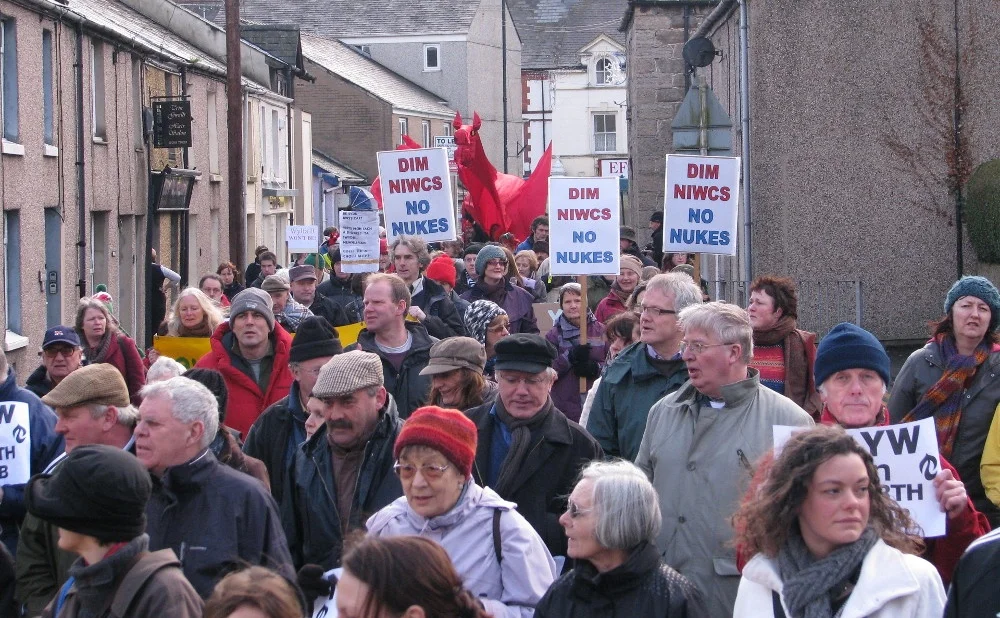
Wylfa Newydd was opposed from the start by a local campaign called PAWB — People Against Wylfa-B, with the helpful Welsh pun that 'pawb' itself means 'everyone'. Their arguments were the standard ones of British nuclear opposition: the money would be better spent on renewables; the construction would be subsidised by consumers and would push up bills; the radioactive footprint of the site would last for generations; the promised local employment was overstated; and German firms had already walked away from the project once for good reason. In January 2012, 300 anti-nuclear protesters marched through Llangefni — the largest such demonstration on Anglesey in a generation. PAWB did not single-handedly stop the project; the funding model did. But the constancy of local opposition was a fact that every successive set of developers had to factor in, and that Hitachi, in the end, decided was not worth the fight.
What Happened Next
The strange afterlife of Wylfa Newydd has been more politically interesting than its decade of pre-construction. In November 2020 a US consortium led by Bechtel, with Southern Company and Westinghouse, opened talks about reviving the site with AP1000 reactors. In January 2021, Shearwater Energy proposed a hybrid wind farm and small modular reactors using NuScale technology. In April 2022 Wylfa and Oldbury were named candidates for two pairs of EPR reactors as part of a planned UK new-build programme of up to eight reactors. In March 2024, Chancellor Jeremy Hunt announced in the Spring Budget that the UK government would buy both sites from Hitachi for £160 million. In May 2025, Wylfa was selected as the government's preferred site for a gigawatt-scale plant. Then a general election delivered a change of government in July 2024, the gigawatt plan was dropped, and in November 2025 Wylfa was instead chosen as the site for the first planned use of small modular reactors in the UK. The land is the same. The intentions keep changing. Whether any actually reactor will ever turn on the lights at Wylfa Newydd is still, in the spring of 2026, an open question.
Flight Context
The Wylfa Newydd site occupies a flat coastal headland at 53.417°N, 4.483°W, immediately east of the existing Wylfa station and west of Cemaes Bay on the north coast of Anglesey. From the air the proposed site is currently visible as a large area of cleared ground and access roads — a building site without a building. The older Wylfa A station, still being decommissioned, sits adjacent to the west, its low concrete reactor buildings recognisable on the cliff edge. The Llanbadrig Point headland (with its small ancient church) is half a kilometre east. RAF Valley (ICAO EGOV) lies 22 km to the southwest. The Skerries lighthouse is 5 km offshore to the northwest, and the open Irish Sea fills the northern horizon.
From the Air
Coordinates 53.417°N, 4.483°W (proposed Wylfa Newydd site, north coast Anglesey, immediately east of existing Wylfa A station). Recommended viewing altitude 2,000–4,000 ft AGL. Nearest airport RAF Valley (EGOV), 22 km southwest. Visible landmarks: the older Wylfa A reactor buildings still being decommissioned, Cemaes Bay just east, Llanbadrig Point with its small ancient church, and the Skerries lighthouse 5 km offshore.
Nearby Stories
- Llandudno Lifeboat Station 3.8 km away
- Glynllifon 6.1 km away
- German submarine U-1024 9.4 km away
- Irish Sea Bridge 11 km away
- Ysbyty Ifan 12 km away
- Irish Sea 18 km away
- Celtic Array 18 km away
- Birkdale Palace Hotel 56 km away