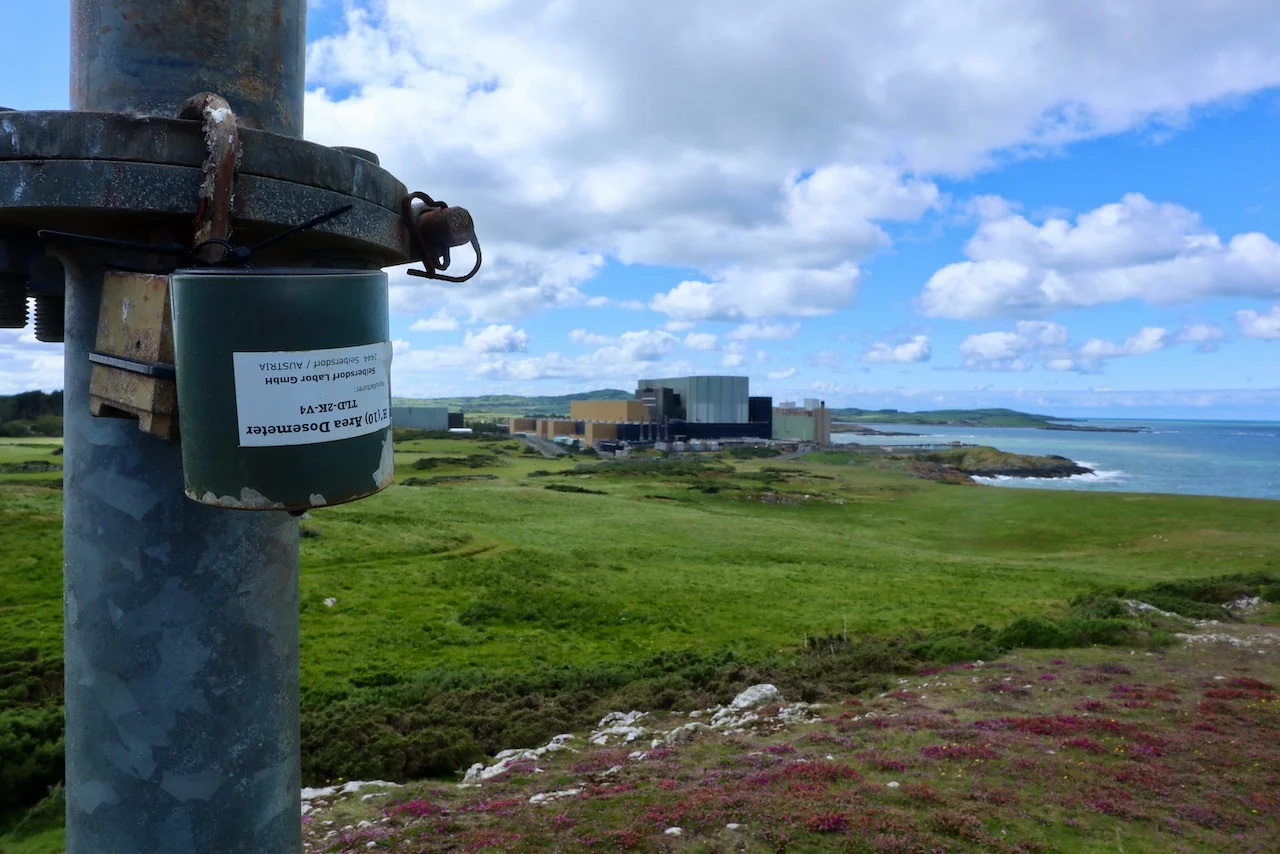

Wylfa nuclear power station
When Reactor 1 finally shut down at Wylfa on 30 December 2015, the British Magnox programme ended. Forty-four years of grid generation, 6,156 vertical fuel channels containing 49,248 natural-uranium fuel elements clad in magnesium-aluminium alloy, two graphite cores each weighing 3,800 tonnes, carbon dioxide gas circulating at scale and pressure that no one in the world was building reactors for any more. Wylfa was the last reactor of its kind anywhere on earth. Demolition of the buildings is scheduled to start in 2096. The 'care and maintenance' phase in between will last seventy years. Some of the people who started work at Wylfa in the 1960s lived to see the place shut down. None of them will live to see it cleared.
Magnox: The British Reactor
Magnox reactors were a British design — graphite-moderated, carbon-dioxide-cooled, fuelled with natural uranium metal clad in a magnesium-aluminium alloy known as Magnox (short for 'magnesium non-oxidising'), from which the reactor type took its name. They were the first generation of British civil nuclear power, designed in the 1950s, and Britain built eleven of them between 1956 (Calder Hall) and 1971 (Wylfa). Wylfa was the second nuclear power station to be built in Wales, after the much smaller Trawsfynydd in the heart of Snowdonia, which opened in 1965 and closed in 1991. From 1991 until its own closure, Wylfa was the only operating nuclear power station in Wales.
Construction and the Quiet Compromises
Construction began in 1963 by British Nuclear Design and Construction (BNDC), a consortium of English Electric, Babcock & Wilcox, and Taylor Woodrow. The two 490-megawatt reactors became operational in 1971. They were the largest and last Magnox-type reactors ever built. Wylfa was also only the second British nuclear plant — after Oldbury — to use pre-stressed concrete pressure vessels rather than steel, an engineering shift that was meant to make future Magnox builds simpler and safer. The original design output had been 1,190 megawatts. But before the first reactor even started up, an unexpected problem appeared: 'breakaway' corrosion of mild steel components in the hot carbon dioxide gas circuit. The channel gas outlet temperature had to be reduced, and with it the power output. The reactors started life at 840 MW; that figure was eventually pushed back up to 980 MW as the engineers learned what their plant could safely do. A considerable portion of that output — up to 255 MW — went straight to the nearby Anglesey Aluminium smelter, which had been built specifically to use Wylfa electricity. When the smelter closed in 2009, an industrial dependency that had defined a quarter-century of north Anglesey's economy ended.
Half a Century of Quiet Trouble
Wylfa ran, mostly without incident, for forty-four years. There were episodes of public anxiety. A safety review in April 2000 found deteriorating welds in critical components; reinforcement work was carried out, but Greenpeace commissioned a critical independent report from Large Associates, and the restart in August 2001 was controversial. The graphite moderator blocks were also slowly being depleted by radiolysis — the radiation slowly eating away at the moderator that made the reactors work. PAWB, the local anti-nuclear group, campaigned throughout for early shutdown. Through all of it, the reactors kept generating. Reactor 2 ceased generating at 19:02 BST on 25 April 2012, partly to allow its remaining fuel to be transferred into Reactor 1. Reactor 1 kept going for another three and a half years before shutting down on the final day of 2015 — the closure delayed several times beyond the original 2010 date because Springfields Fuels had ended Magnox fuel production in 2008 and the existing fuel stock had to be carefully managed.
Decommissioning: A Multi-Generational Project
What happens to a reactor when it stops generating? In Magnox's case: not much, not quickly. Defuelling — removing all 49,248 fuel elements from the cores and sending them to Sellafield — started in 2016 and was completed in 2019. The site is now in a phase that involves removing most surface buildings and structures, scheduled to run until 2025. After that comes 'care and maintenance' — the British nuclear euphemism for letting the buildings sit, sealed and monitored, while the radioactive components inside decay enough to allow human workers to dismantle them safely. That phase will run from 2025 to 2096. The final demolition of the reactor buildings is planned for 2096 to 2101. The site is currently managed by Nuclear Restoration Services (formerly Magnox Ltd, formerly British Nuclear Group, formerly Nuclear Electric, formerly National Power, formerly the Central Electricity Generating Board — a list of organisational rebrandings that itself reads like a brief history of British nuclear policy), under the Nuclear Decommissioning Authority.
The Endless Sequel
Even before Wylfa shut down, the question of what would replace it on the site was being asked. The proposed Wylfa Newydd, with two Advanced Boiling Water Reactors, was approved by the UK regulator in 2017 but cancelled by Hitachi in 2020. A US consortium has discussed AP1000 reactors. A British firm has proposed a hybrid wind-and-small-modular-reactor plant with NuScale technology. The UK government bought the sites from Hitachi in 2024 for £160 million. In May 2025 Wylfa was selected as the preferred site for a gigawatt-scale plant. After the general election in July 2024 brought a new government, the plan changed again: in November 2025, Wylfa was instead chosen as the site for Britain's first small modular reactors. The story of Wylfa A — the actual reactors, the actual electricity, the actual lives of the people who worked there — is over. The story of what comes next is still being written, and may be still being rewritten a long time after this is read.
Flight Context
Wylfa sits at 53.417°N, 4.483°W, on the cliff edge of the north coast of Anglesey, immediately west of Cemaes Bay. From the air the two reactor buildings are still clearly recognisable as squat, paired concrete structures with cooling water intakes at the cliff edge below. The taller boiler hall and turbine hall stand inland. Llanbadrig Point and its small medieval church lie a kilometre east. The Skerries lighthouse is 5 km offshore to the northwest. RAF Valley (ICAO EGOV) lies 22 km to the southwest. Low-altitude transits along the coast (1,500–3,000 ft AGL) show the relationship between the reactor buildings, the cleared land of the proposed Wylfa Newydd site, and the magnificent open Irish Sea.
From the Air
Coordinates 53.417°N, 4.483°W (Wylfa nuclear power station, north coast of Anglesey, west of Cemaes Bay). Recommended viewing altitude 2,000–4,000 ft AGL. Nearest airport RAF Valley (EGOV), 22 km southwest. The twin Magnox reactor buildings remain prominent landmarks on the cliff edge. The Wylfa Newydd proposed site lies immediately east; Llanbadrig Point and its small medieval church a kilometre further east; the Skerries lighthouse 5 km offshore to the northwest.
Nearby Stories
- Llandudno Lifeboat Station 3.8 km away
- Glynllifon 6.1 km away
- German submarine U-1024 9.4 km away
- Irish Sea Bridge 11 km away
- Ysbyty Ifan 12 km away
- Irish Sea 18 km away
- Celtic Array 18 km away
- Birkdale Palace Hotel 56 km away