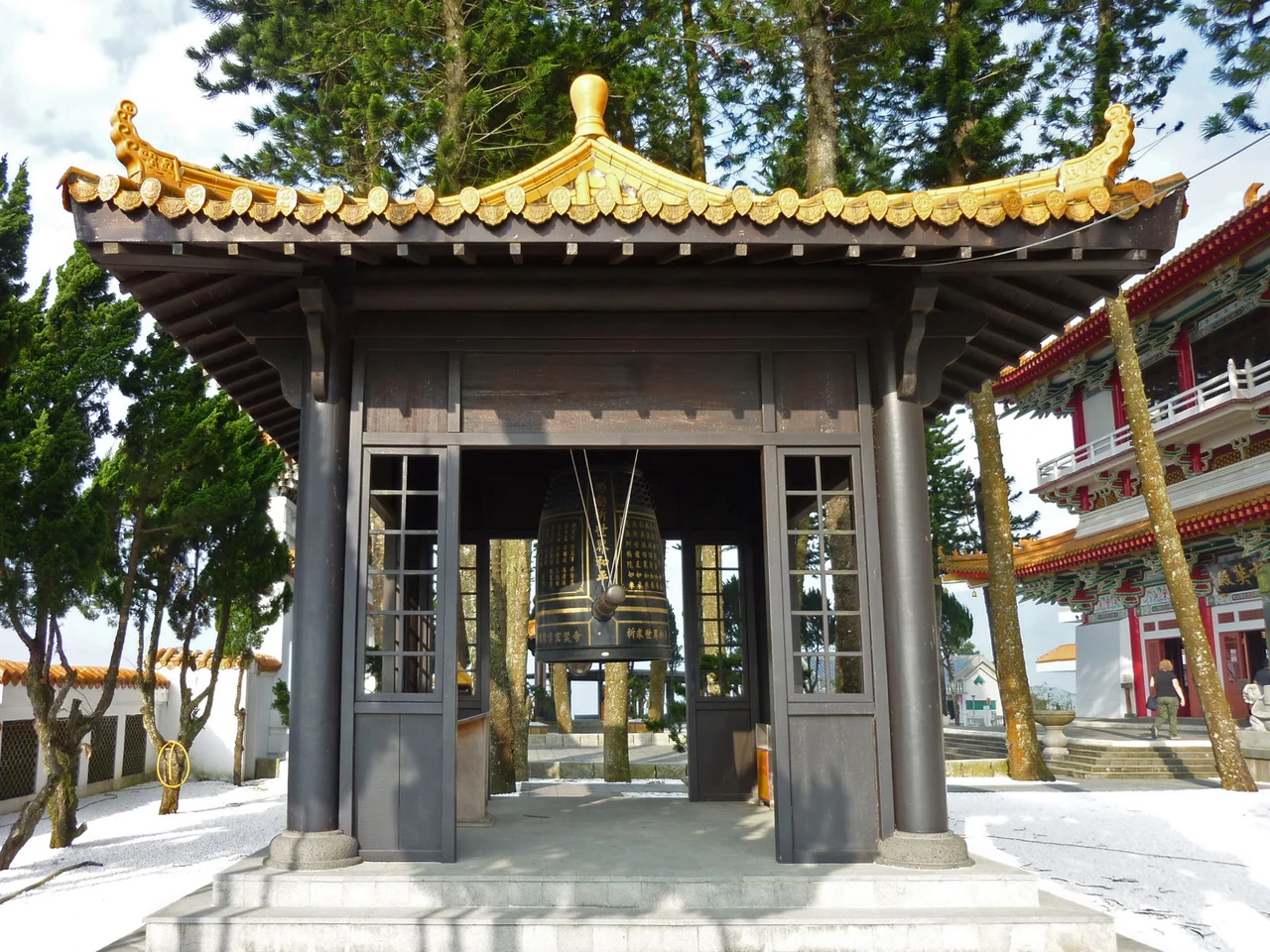

Xuanzang Temple (Taiwan)
Xuanzang died in 664 CE, having spent seventeen years traveling overland from China to India and back, carrying Buddhist scriptures that would reshape East Asian civilization. He spent most of the rest of his life translating them. In the centuries after his death, his skull bones became sacred relics — śarīra in Buddhist tradition — passed between temples, lost during upheaval, rediscovered, relocated. Their journey from the Tang dynasty capital of Chang'an to a hillside above Sun Moon Lake in Taiwan runs through more than a thousand years of war, colonial occupation, and geopolitical accident. The temple built to house them was completed in 1965, modeled after the hall architecture of the Tang dynasty, sitting on a hill named Cinglong above the largest body of freshwater in Taiwan. Three stone stelae stand in the compound. One records Xuanzang's journey to the west. One commemorates Sino-Japanese Buddhist history. One is dedicated to friendship between China and Japan — a diplomatic gesture amid complicated history, placed in a temple that exists partly because of that history.
The Monk Who Walked to India
Xuanzang (602–664) was not supposed to leave China. The Tang dynasty government had not authorized his journey, which began around 629 CE. He went anyway, crossing Central Asia on one of the most ambitious overland pilgrimages in Buddhist history. In India, he studied at Nalanda, the great monastic university, and collected hundreds of Buddhist texts unavailable in China. His return journey, seventeen years after he departed, became legendary — the basis for the sixteenth-century novel Journey to the West, which transformed the historical monk into a literary figure who has shaped Chinese culture for five centuries. The historical Xuanzang was both more modest and more remarkable than his fictional counterpart: a scholar who mastered Sanskrit, translated seventy-five texts, and produced a geographic account of Central Asia that remains a primary historical source for the region. He died at the Yuhua Palace Monastery, and his remains were venerated for centuries afterward.
Relics Through War
The skull bones of Xuanzang had rested in Nanjing — transferred there from Chang'an in 1027 — when the Second Sino-Japanese War reached them. Japanese Imperial Army soldiers digging to establish a Shinto shrine in Nanjing unearthed the remains, which Chinese and Japanese scholars jointly confirmed were Xuanzang's. For safekeeping amid the deteriorating wartime situation, the bones were moved to Ji-on Temple in Saitama Prefecture, Japan. The war ended. Japan returned the śarīra to the Republic of China government in 1955, though the official characterization of the transfer acknowledged that the bones themselves had been, in the Wikipedia source's careful phrase, "plundered war booty" from Nanjing. What that means practically is that the relics' journey to Taiwan involved conquest, scholarly authentication, wartime relocation, and postwar diplomacy. In November 1965, they were enshrined in the newly completed Xuanzang Temple above Sun Moon Lake.
Tang Dynasty Architecture in the Mountains
The Nantou County Government built Xuanzang Temple in 1965 to honor the monk and house his relics. The architects modeled the structure on the hall architecture of the Tang dynasty (618–907), the era in which Xuanzang lived — a deliberate historicism that gives the temple an unusual visual character among Taiwan's religious buildings. The main hall, Hsüantsang Hall, rises three floors. The door lintel carries a plaque with the Chinese characters for the hall's name; a statue of Xuanzang stands near the entrance, depicted in the attitude of the pilgrim setting out to seek Buddhist texts. The second floor contains the monk's shrine. On the third floor, the Hsüantsang Pagoda holds both the śarīra and many of Xuanzang's translated classical works. The building sits on Cinglong Hill, its Tang-style eaves visible from the lake below. The surrounding grounds are planted with the kind of careful, quiet greenery that suits a place built for contemplation.
Three Stelae and a Complicated Peace
Three stone stelae stand at Xuanzang Temple, and together they speak to the tangled relationship between China, Japan, and the Buddhist tradition they share. The central stele records the story of Xuanzang's Journey to the West. The left stele is dedicated to Sino-Japanese friendship. The right stele commemorates Sino-Japanese Buddhist history. The placement of a friendship stele in a temple whose relics were removed from Nanjing by Japanese forces during wartime is a studied act of diplomacy — the kind of careful coexistence that religious sites sometimes manage where political relationships remain strained. The temple does not avoid the history; the stelae name it directly. Sun Moon Lake, below the hill, draws tourists from across Taiwan and beyond. Many arrive at Xuanzang Temple as part of a circuit that includes the lake's ferries, the cycling paths, and the Ci En Pagoda on the ridge across the water. The relics of Xuanzang receive pilgrims and tourists alike, and the distinction between the two categories is not always clear.
From the Air
Xuanzang Temple stands at 23.867°N, 120.917°E on Cinglong Hill above Sun Moon Lake's northern shore in Yuchi Township, Nantou County. From the air, the Tang-style rooflines of the temple complex are visible on the forested hillside above the lake's distinctive twin-lobe form. Sun Moon Lake sits at approximately 748 meters elevation; the temple sits higher on the hill above. Nearest major airport: RCMQ (Taichung International Airport), approximately 33 km to the northwest. The lake is the primary navigation reference — the Xuanzang Temple is on the northeastern hillside above the lake. Recommend viewing altitude 1,500 meters for a clear view of both the temple's position on the hillside and the surrounding lake. The Ci En Pagoda on Mount Shabalan is visible to the south, across the water, from this altitude. Morning light is best for the hillside view; afternoon cloud build-up over the central mountains is common.
Nearby Stories
- Alishan 5.8 km away
- Cultural Heritage Park 10 km away
- Taroko National Park 10 km away
- Ruisui Tropic of Cancer Marker 12 km away
- Taixi, Yunlin 14 km away
- Lintianshan Forestry Culture Park 16 km away
- High-Heel Wedding Church 22 km away
- Taiwan Strait 87 km away