.jpg)
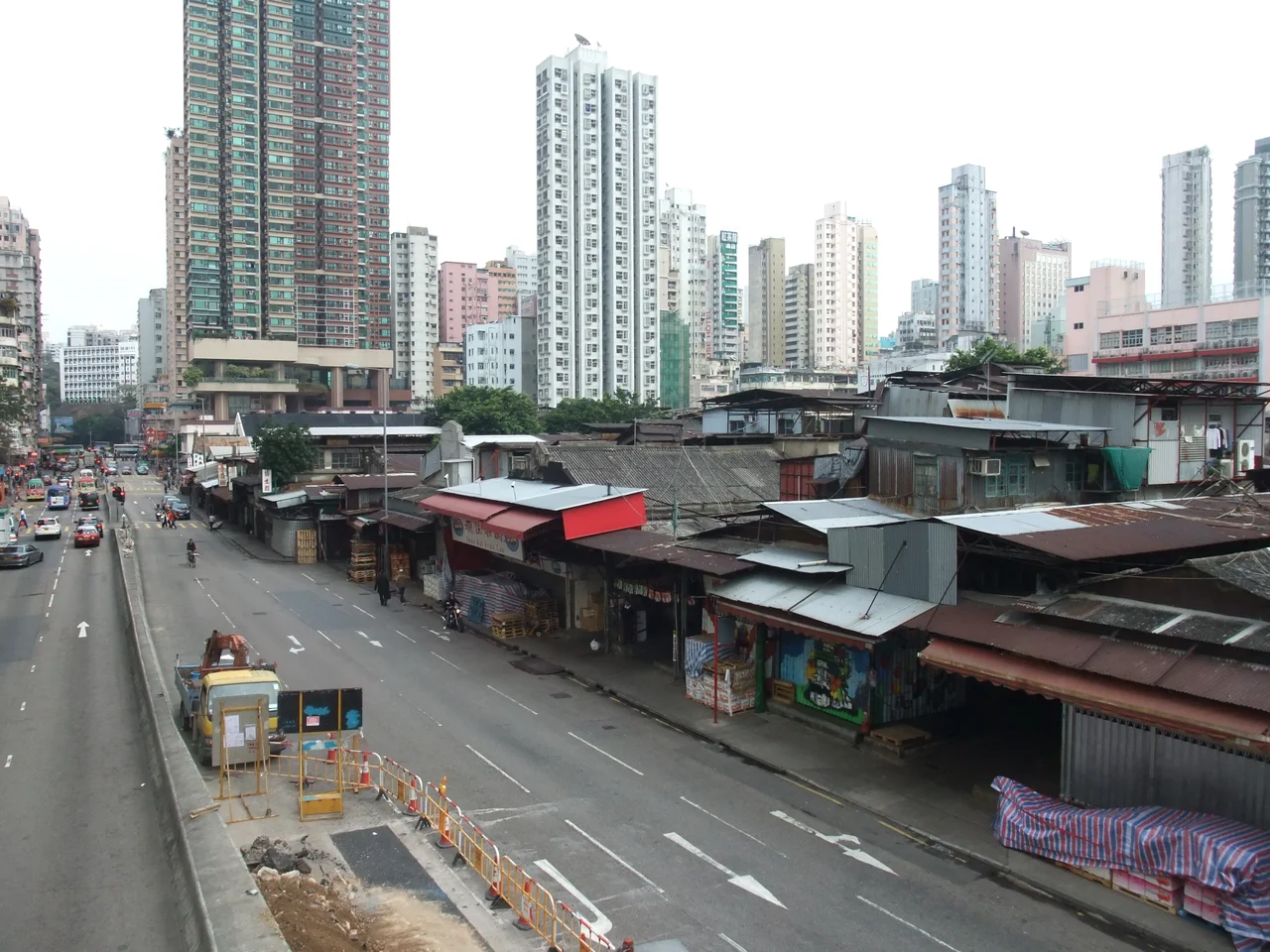
Yau Ma Tei Fruit Market
Between four and six o'clock every morning, Yau Ma Tei's streets fill with the sound of engines and the knock of wooden crates. Lorries maneuver through narrow lanes. Workers stack boxes of mangoes, lychees, and durian under strings of bare bulbs. The rest of Hong Kong is asleep, but the Fruit Market has been awake since 1913, and it has no intention of stopping.
A Market That Outlasted Everything
The market the city now calls simply the Fruit Market opened in 1913 on a block formed by Ferry Street, Waterloo Road, and Reclamation Street, with Shek Lung Street threading through its middle. Its original name was the Government Vegetables Market — a practical name for a practical place that sold whatever the city needed. In Cantonese, the market is still called gwo laan: gwo for fruit, laan for a wholesale trading space, a word derived from the idea of a railed enclosure. Fish traders joined in the 1930s, adding another layer to a market already layered with noise and commerce. In 1965, when Cheung Sha Wan opened its own wholesale vegetable and fishery markets, those trades migrated west. What remained was fruit, and fruit alone — a specialization that gave the market its current identity and its current name.
Walls That Remember
Walk the perimeter of the market's low brick-and-stone buildings — most only one or two storeys — and you notice the signboards. Painted or tiled onto the outer walls, some predate World War II. They advertise companies and products in script styles that belong to another era of Hong Kong commerce, a time before neon and LED made everything temporary. The buildings themselves earned a Grade II Historic Building classification in 2009, a recognition that this collection of squat structures around a working market constitutes genuine heritage — not because it is elegant, but because it survived. Across Reclamation Street, the Yau Ma Tei Theatre is an immediate neighbor, and the two sites together form one of the densest concentrations of pre-war built fabric remaining in Kowloon.
The Hours Before Dawn
The market's real life happens in darkness. Wholesalers take delivery, sort, and sell in the hours between midnight and early morning, with the peak falling between 4 and 6 a.m. Retailers and restaurant buyers arrive to negotiate prices and load up before the city stirs. By the time most of Kowloon has had its morning tea, the market's busiest transactions are already hours behind it. This rhythm — deeply nocturnal, utterly functional — has continued across more than a century of colonial rule, Japanese occupation, postwar reconstruction, and the handover of 1997. The market has never closed for any of it.
On Screen and On the Street
The Fruit Market's particular atmosphere — the stacked crates, the narrow lanes, the low buildings against the Kowloon skyline — has drawn filmmakers as well as fruit buyers. The market appears as a backdrop in the 2018 TVB drama series Apple-Colada, a production whose title is something of an in-joke given the setting. It has also drawn photographers drawn to the contrast between the pre-war signboards and the modern city pressing in around them. There is a quality to the place that is hard to manufacture: genuine age, genuine function, genuine grime. The market does not perform its history. It simply continues it.
From the Air
The Yau Ma Tei Fruit Market sits at approximately 22.3122°N, 114.168°E in the Yau Ma Tei neighborhood of Kowloon, on the Hong Kong mainland peninsula. From the air, Kowloon's dense urban grid is clearly visible south of the hills; the market occupies a city block bounded by Waterloo Road, Reclamation Street, and Ferry Street, just inland from the former waterfront. Hong Kong International Airport (VHHH) is approximately 25 km to the west on Lantau Island. A low approach over Kowloon Bay from the east, at around 1,500 feet, provides a clear view of the Yau Ma Tei district and the relatively low roofline of the market buildings standing against the high-rises to their south.
Nearby Stories
- Lok Ma Chau Loop 2.3 km away
- Portas do Cerco 2.3 km away
- Kweilin Incident 17 km away
- Wanshan Archipelago Campaign 34 km away
- Nanxiong Formation 115 km away
- Battle of Nanpeng Island 148 km away
- Heyuan 169 km away
- Cape Maobitou 632 km away