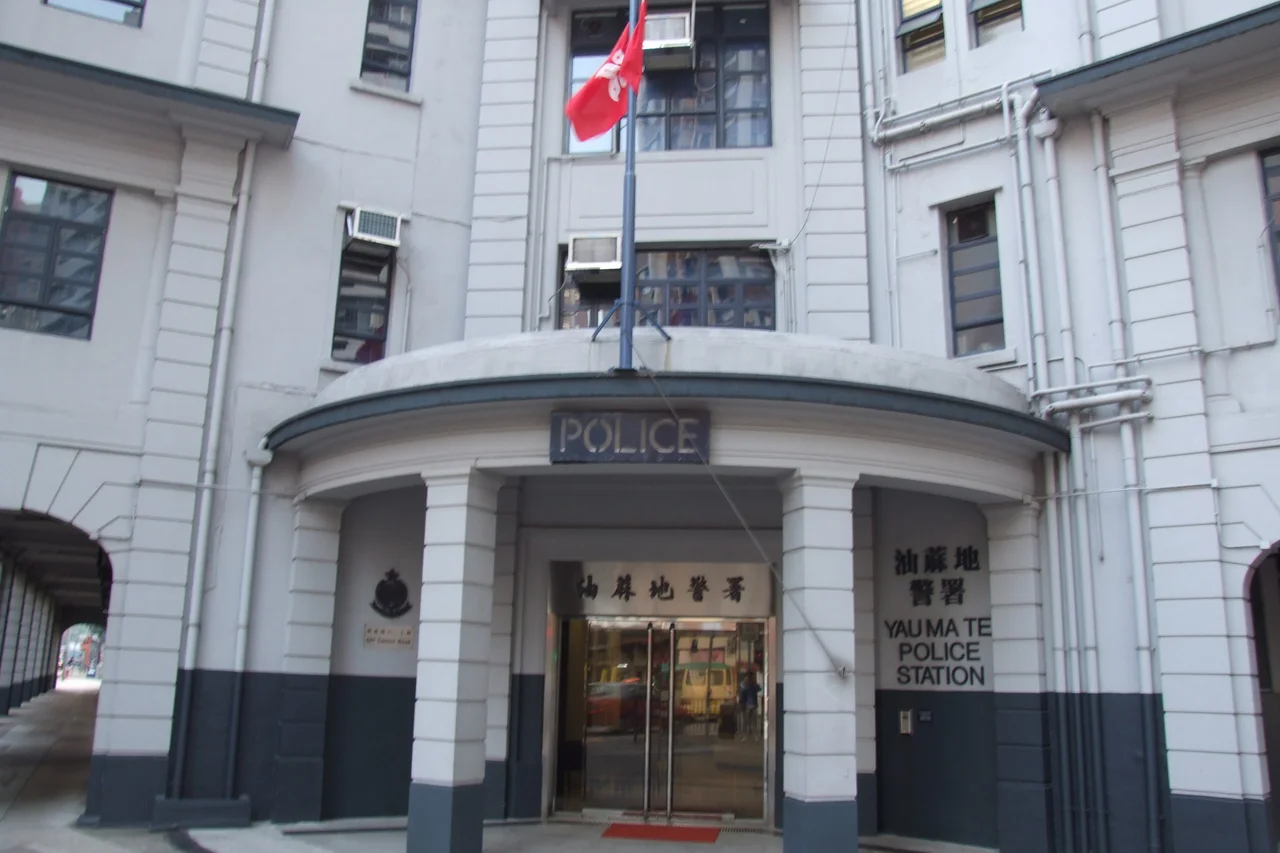

Yau Ma Tei Police Station
There is a side gate at No. 627 Canton Road that nobody uses. It opens onto Public Square Street, and from the outside it looks ordinary enough — a large gate of the kind you would expect at a police compound built in 1922. But officers stopped using it decades ago, some time before the late 1970s, because of a series of shooting incidents involving men who left the station by that route. The gate has been locked ever since. Whether the stories are strictly true, the gate stays locked. Stranger still, in one corner of the same compound, a small shrine sits to counteract the bad feng shui that the adjacent Gascoigne Road Flyover is believed to create. Yau Ma Tei Police Station, even after closing, carries a few layers of unexplained history.
Built for a Growing Kowloon
The station at 627 Canton Road was built in 1922, after an earlier station at the junction of Public Square Street and Shanghai Street was relocated to its current site at the corner of Canton Road and Public Square Street. The main entrance is marked by a semi-circular portico set into an indented corner — a design choice that serves both aesthetic and practical purposes, but one also associated with feng shui in Hong Kong's built environment. Such angled corners were frequently used on commercial and institutional buildings across the city to ease the flow of energy around the structure. After World War II, the station was expanded: a 1957 extension to the west added barracks space and accommodation for officers, enlarging the compound to meet the needs of a Kowloon that was growing faster than anyone had planned.
A Gate, a Shrine, and Persistent Stories
The locked side gate is the feature visitors notice once they hear about it. The gate itself is not remarkable. What is remarkable is the institutional decision to keep it sealed — a formal acknowledgment, embedded in daily operational practice, that something about the gate's history made its continued use inadvisable. The shrine in the compound's corner addresses a different concern: the Gascoigne Road Flyover, which passes near the station, is considered by some to generate disruptive feng shui for the buildings in its shadow. The shrine is the station's hedge against that disruption. Neither the gate nor the shrine is a tourist attraction in any obvious sense. They are simply parts of how the station managed to function in a city where practical engineering and traditional belief have always occupied the same space.
On Screen, Twice
Despite its relatively modest profile as a neighborhood police station, Yau Ma Tei Police Station appeared in two significant productions. The 2001 Hollywood film Rush Hour 2, starring Jackie Chan and Chris Tucker, used the station for one of its Hong Kong scenes — though the sequence's explosive finale required a purpose-built studio set, since real detonations inside a functioning police compound were not on offer. In 2007, the TVB programme On the First Beat used the station repeatedly, filming in the canteen, the locker rooms, and other interior spaces. The productions capture something of the building's character: a working institutional space with enough age and texture to read as authentic.
Closure and What Comes After
After 94 years at 627 Canton Road, the station closed on 22 May 2016. On the same day, a new Yau Ma Tei Police Station opened at No. 3 Yau Cheung Road, carrying the name forward while leaving the old compound behind. A reporting centre continued to operate at the historic building for some time after the main station shut. The old station's fate was complicated by heritage debates that had been building for years — growing conservation awareness in Hong Kong following the 2006 demolition of the Star Ferry Pier at Edinburgh Place had sharpened public attention to what was being lost. The 1922 building, Grade II listed, sits within a district already rich with pre-war structures. Its next chapter was still unresolved at the time of closure, caught between preservation requirements and infrastructure pressures from the Central Kowloon Route project nearby.
From the Air
Yau Ma Tei Police Station is located at approximately 22.3097°N, 114.1687°E on the Kowloon Peninsula, near the junction of Canton Road and Public Square Street. From the air, the site sits in the dense urban fabric south of Mong Kok and north of Tsim Sha Tsui, a few blocks inland from the western Kowloon waterfront. Hong Kong International Airport (VHHH) is approximately 25 km to the west on Lantau Island. At 1,500 feet on approach over Kowloon Bay, the low-rise historic building cluster around Yau Ma Tei is visible against the denser modern development surrounding it.
Nearby Stories
- Lok Ma Chau Loop 2.3 km away
- Portas do Cerco 2.3 km away
- Kweilin Incident 17 km away
- Wanshan Archipelago Campaign 34 km away
- Nanxiong Formation 115 km away
- Battle of Nanpeng Island 148 km away
- Heyuan 169 km away
- Cape Maobitou 632 km away