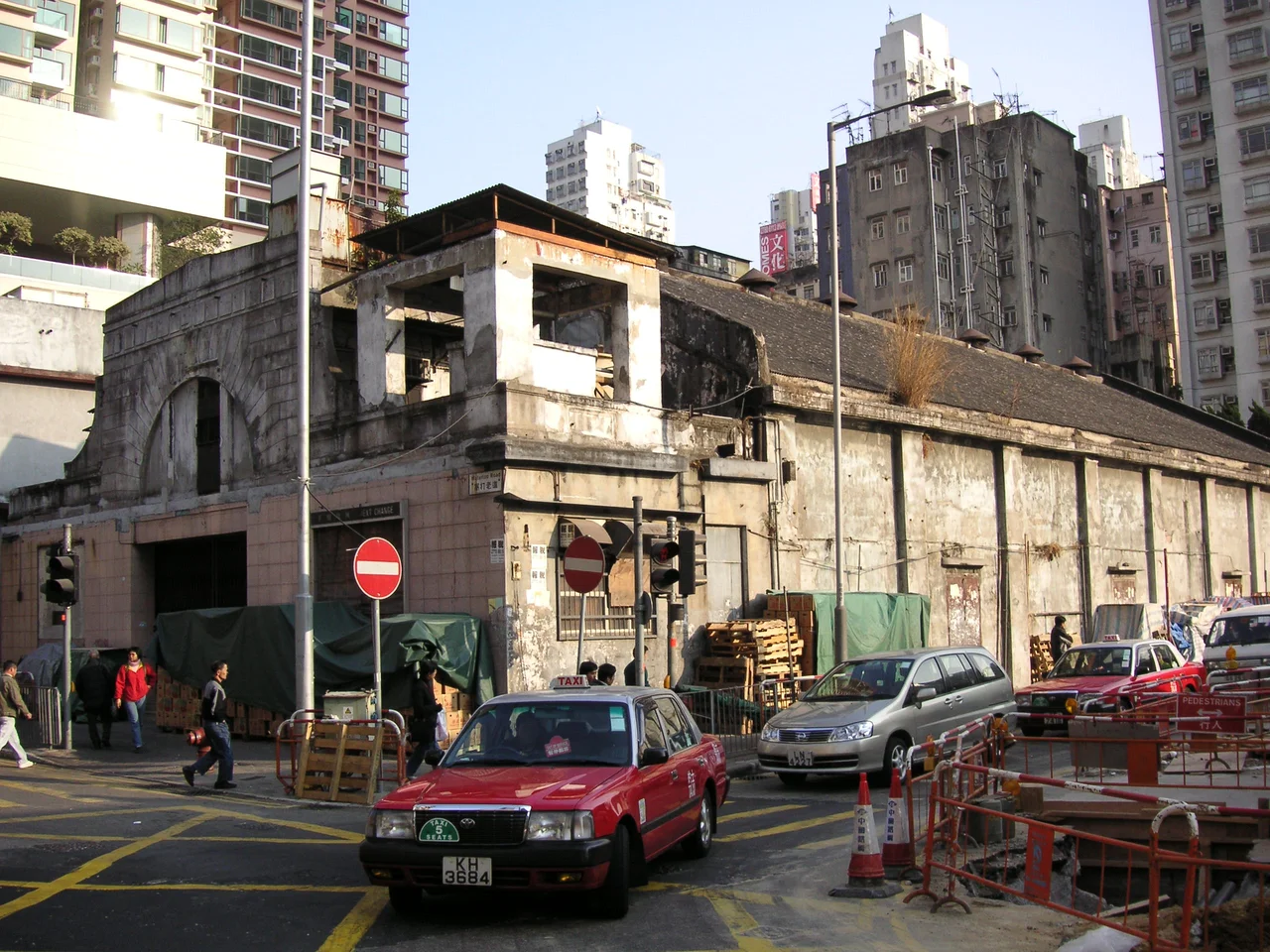

Yau Ma Tei Theatre
The projectors in the projection room gave historians their best clue about when the Yau Ma Tei Theatre first opened its doors. Both machines were manufactured by Strong Electric Corp. of Toledo, Ohio, and one of them carries a patent registration date of 1928. The building could not have opened before that year — and the mix of Neo-classical portico and Art Deco interior suggests it opened not long after. So: a theatre built around 1928, in a Kowloon neighborhood that rickshaw riders, dock workers, and low-income families called home. It is still standing. Almost nothing else from that era in Kowloon is.
The Largest Theatre in Kowloon
When it opened, the Yau Ma Tei Theatre was the largest theatre in Kowloon — a distinction that mattered in a district that was growing fast and hungry for entertainment. The building sits at the junction of Waterloo Road and Reclamation Street, across from what is now the Yau Ma Tei Fruit Market. Its facade carries the restrained classical columns and proportions that were fashionable in the late 1920s; inside, the decorative language shifts to Art Deco, the modernist aesthetic that was just beginning to displace the older style. This architectural seam — neo-classical outside, Art Deco within — is itself a historical record, an accidental document of a moment when tastes were changing and builders were hedging between what was established and what was coming.
A Century of What the City Watched
The theatre's programming history is a compressed film history of Hong Kong itself. Silent movies first, in the pre-war years. Then, in the 1930s up to the Pacific War, both Hollywood productions and films from Shanghai's thriving studio industry. The Japanese occupation of Hong Kong from 1941 to 1945 brought Japanese films and propaganda productions — the theatre screened what the occupying authority required. After the war, Cantonese-language films from local production companies Lan Kwong Film Company and Kong Ngee Company dominated the programme. The 1970s brought Mandarin-language productions from Shaw Brothers Studio and Golden Harvest. The 1980s brought a Cantonese resurgence from Golden Princess Amusement. And then, as home video eroded the audience for traditional cinemas, the theatre made a final compromise: chain showings of adult films, multiple features for the price of one ticket, held together an audience that nothing else could.
The Long Decline and the Locked Door
The theatre closed on 31 July 1998. By then it occupied a strange position in Hong Kong's entertainment landscape: too old-fashioned for mainstream audiences, too structurally inflexible for the mini-cinema format that was replacing large single-screen cinemas across the city, and too historic to be easily demolished. Its pre-war design created technical problems that made it ill-suited for subdivision. So it survived intact, which is precisely what made it valuable. In December 1998, the same year it closed, the building became a Grade II historic monument — and the only pre-World War II theatre still standing in Kowloon.
Cantonese Opera Finds a Home
The theatre's second life came through a 2007 government proposal to convert it into a Xiqu Activity Centre — a permanent performance and practice venue for Cantonese opera. The rationale was both practical and cultural: Hong Kong's Cantonese opera tradition needed dedicated space, and the old theatre's auditorium, stage, and back-of-house facilities offered exactly the kind of infrastructure that purpose-built cultural centers provide. Renovation works began after 2009, and the venue reopened in 2012. A Heritage Impact Assessment carried out in October 2008 guided the conservation requirements, ensuring that alterations complied with preservation standards for the 1920s fabric. The result is a building that has now outlasted every other pre-war Kowloon cinema, and found a new audience — one that comes not for film but for the sung drama that predates cinema entirely.
From the Air
Yau Ma Tei Theatre stands at approximately 22.3124°N, 114.169°E at the junction of Waterloo Road and Reclamation Street in Kowloon, Hong Kong. From the air, the low-profile historic building cluster around this intersection in Yau Ma Tei is visible against the dense modern tower development that surrounds it. The Yau Ma Tei Fruit Market is directly adjacent across Reclamation Street, forming a visible block of pre-war-scale buildings in an otherwise vertical cityscape. Hong Kong International Airport (VHHH) is approximately 25 km to the west on Lantau Island. A southeast approach over Kowloon Bay at around 1,500 feet provides a clear view of the Yau Ma Tei district and the historic streetscape along Waterloo Road.
Nearby Stories
- Lok Ma Chau Loop 2.3 km away
- Portas do Cerco 2.3 km away
- Kweilin Incident 17 km away
- Wanshan Archipelago Campaign 34 km away
- Nanxiong Formation 115 km away
- Battle of Nanpeng Island 148 km away
- Heyuan 169 km away
- Cape Maobitou 632 km away