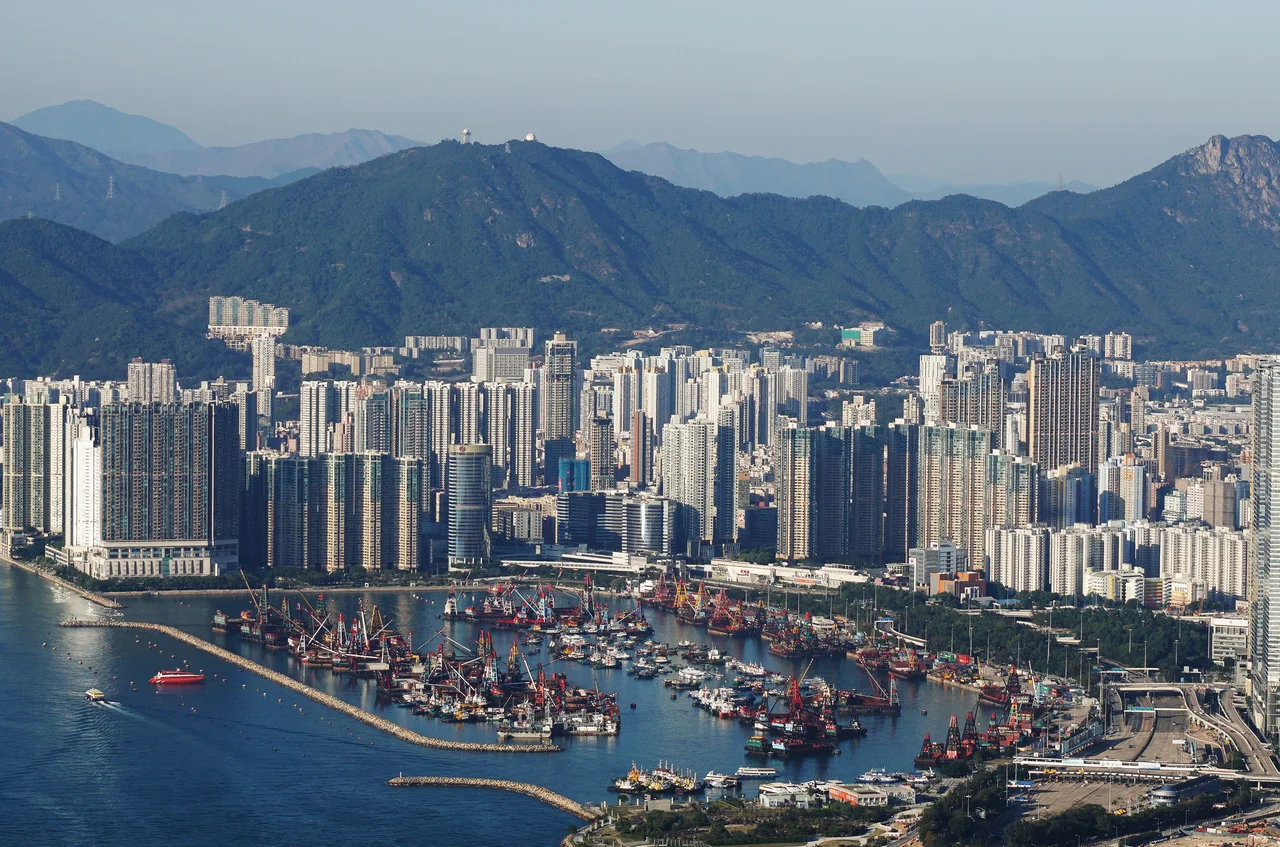

Yau Ma Tei Typhoon Shelter
For seventy-four years, a community of people lived on the water at Yau Ma Tei and called it home. They were the Yau Ma Tei Boat People, and from around 1916 until 1990, they moored their vessels in the typhoon shelter that the colonial government had built at great expense to keep Kowloon's fishing fleet safe from storms. The shelter itself cost HK$2.21 million to construct between 1910 and 1915. The community that formed inside it was not planned at all.
Why Hong Kong Needed Typhoon Shelters
Hong Kong's typhoon season runs roughly from May through November, and the storms it brings can be catastrophic. The territory's position on the South China Sea puts it directly in the path of some of the most powerful tropical cyclones on Earth. For a working harbor city dependent on fishing and maritime trade, this meant that the question of where boats could safely shelter was not merely practical but existential. The colonial government built Hong Kong's first typhoon shelter in Causeway Bay. The Yau Ma Tei shelter — the second — was conceived in late 1906, authorized in 1908, and built by the Public Works Department over five years from 1910 to 1915. Governor Sir Francis Henry May officially opened it on 16 December 1915, a formal ceremony for a piece of infrastructure designed to survive events that no ceremony could anticipate.
The People Who Stayed
Typhoon shelters were built for boats, but boats have crews, and crews have families. By around 1916 — just months after the shelter opened — the Yau Ma Tei Boat People had begun settling in the shelter's protected waters semi-permanently. Over the following decades, a floating community took shape: families living aboard wooden sampans and junks, cooking on deck, raising children on the water, maintaining a way of life that predated the colonial city around them. The Tanka people had historically been associated with this kind of waterborne existence in the Pearl River Delta region, and the Yau Ma Tei shelter became one of the most visible concentrations of that tradition in Kowloon. The community remained through the Japanese occupation, through the postwar boom years, through the rapid urbanization of the 1960s and 1970s, holding on in the water as the land around them transformed.
Reclamation and Displacement
In 1990, the West Kowloon Reclamation Project began. It was part of Hong Kong's Airport Core Programme — the enormous infrastructure effort tied to building Chek Lap Kok airport — and it required, among other things, a new typhoon shelter to replace the original one. The new shelter was built to the west of the old site. The original shelter's waters were filled in. By 1992, the reclamation was complete, and the site where the Boat People had lived for seven decades was solid ground. Three housing estates now occupy that reclaimed land: Park Avenue, Charming Garden, and Hoi Fu Court. The Boat People who had made the shelter their home dispersed — some to shore-based housing, some to the new shelter, some simply lost to the historical record.
The New Shelter
The replacement typhoon shelter, built to the west of the original site, continues to function today. Its waters shelter smaller vessels and serve as a boundary feature on the western edge of the West Kowloon development zone, one of the most intensively built areas in the city. The old shelter's story lives on mainly in photographs and accounts: images of the original harbor packed with wooden vessels, laundry strung between masts, children peering over gunwales at the camera. Work on improving the new shelter's water quality — a dry weather flow interceptor at the Cherry Street box culvert — began in December 2017. The city continues to maintain what it has built to replace what it built before.
From the Air
The Yau Ma Tei Typhoon Shelter is located at approximately 22.3099°N, 114.157°E on the western edge of the Kowloon Peninsula, off the coast of the Yau Ma Tei neighborhood. The new shelter is visible from the air as a protected basin of water just south of the West Kowloon Cultural District, which features the curved roof of the M+ museum. The reclaimed land where the original shelter stood is now occupied by residential towers. Hong Kong International Airport (VHHH) is approximately 22 km to the west on Lantau Island, with direct visual alignment over the approach corridor. At 1,500 feet over West Kowloon, the shelter's relationship to the reclaimed waterfront and the former harbor is clearly readable from the air.
Nearby Stories
- Lok Ma Chau Loop 2.3 km away
- Portas do Cerco 2.3 km away
- Kweilin Incident 17 km away
- Wanshan Archipelago Campaign 34 km away
- Nanxiong Formation 115 km away
- Battle of Nanpeng Island 148 km away
- Heyuan 169 km away
- Cape Maobitou 632 km away