
Yau Ma Tei
The name itself can't make up its mind. Yau Ma Tei translates as either "oil-sesame field" or "oil and jute ground" depending on which character you prefer for the middle syllable — and no one has ever definitively settled it. That ambiguity is fitting for a neighbourhood where every layer of history sits just beneath the next one: a Qing dynasty fort buried under reclaimed land, a fishing bay turned typhoon shelter turned housing estate, a street market that has operated continuously since before anyone reading this was born.
Fortifications and Fishermen
Before the British came, this stretch of southern Kowloon was called Kwun Chung — a river valley with cultivation and a hill near the coast that the Qing military found strategically useful. In 1839, Qing official Lin Zexu ordered a fortification built here to defend against possible British attack. When the First Opium War broke out, that fort saw action during the Battle of Kowloon. The British won, and within two decades Kowloon was ceded entirely. The fort became an administrative footnote. What survived instead were the Tanka fishermen, the boat-dwelling community that had long worked these waters. Before reclamation, Yau Ma Tei was a beach and a bay — their natural gathering point, and a place where the sea still felt close enough to matter. Even after the shoreline moved outward, the fishermen stayed, mooring in the Yau Ma Tei Typhoon Shelter and creating, accidentally, one of Hong Kong's most distinctive culinary traditions.
Shelter from the Storm
Typhoon shelters exist throughout Hong Kong — protected anchorages where vessels can ride out the summer storms. But the Yau Ma Tei Typhoon Shelter became something more. Restaurant boats worked its waters, serving live seafood prepared with techniques that had been refined across generations: garlic-fried crab, steamed prawns with Shaoxing wine, fried rice stirred over a wok flame hot enough to leave scorch marks on the bowl. The food was rough, communal, and intensely flavorful. Diners ate at floating tables while the harbour lights reflected around them. Eventually the typhoon shelter was filled in to create Hoi Fu Court, a public housing estate completed in 1999. But the flavours outlasted the boats. Today the dishes are served in land-based restaurants throughout Kowloon, and "typhoon shelter style" crab remains a recognisable category on Hong Kong menus — a phantom cuisine from a geography that no longer exists.
Temple Street After Dark
Every night, Yau Ma Tei assembles itself. Temple Street fills with stalls selling clothing, electronics, and trinkets of debatable provenance. Fortune tellers set up under bare bulbs at the edges. The air smells of cooking oil and incense. At the heart of it is the Tin Hau Temple, built in 1876 and dedicated to the goddess of the sea — not an incidental choice in a neighbourhood where fishermen once needed her protection. The temple complex on Public Square Street still draws worshippers, its incense coils thickening the air on festival days. Around it, the market has been running so long that it feels like a permanent feature of the landscape, even though every stall is technically temporary. Nearby, the Jade Market on Kansu Street brings together some 400 registered vendors selling jade in every shade: pale green translucent pieces carved into pendants, dark imperial green rings, amber and lavender stones that may or may not be what the vendors claim. Buying jade here requires either expertise or trust, and the atmosphere rewards both equally.
Shanghai Street and the Century That Changed
Before Nathan Road became the commercial spine of Kowloon, the main thoroughfare was Shanghai Street. You can still find it running parallel, quieter now, lined with shops selling cooking equipment — restaurant-grade woks, bamboo steamers, cleaver sets — that seem aimed less at tourists than at the professional kitchen trade. Along Waterloo Road, the century-old Fruit Market still operates, its carts stacked with produce delivered before dawn. The Kwong Wah Hospital, established in 1911 as the first on the Kowloon peninsula, continues to treat patients under the management of the Tung Wah Group of Hospitals charity. Historic buildings cluster in this part of the neighbourhood: the Old Yau Ma Tei Police Station, the Yau Ma Tei Theatre, the red-brick Engineer's Office of the Former Pumping Station. None of them clamour for attention. They simply persist, which in this city of constant redevelopment counts as a form of stubbornness.
The Neighbourhood at Ground Level
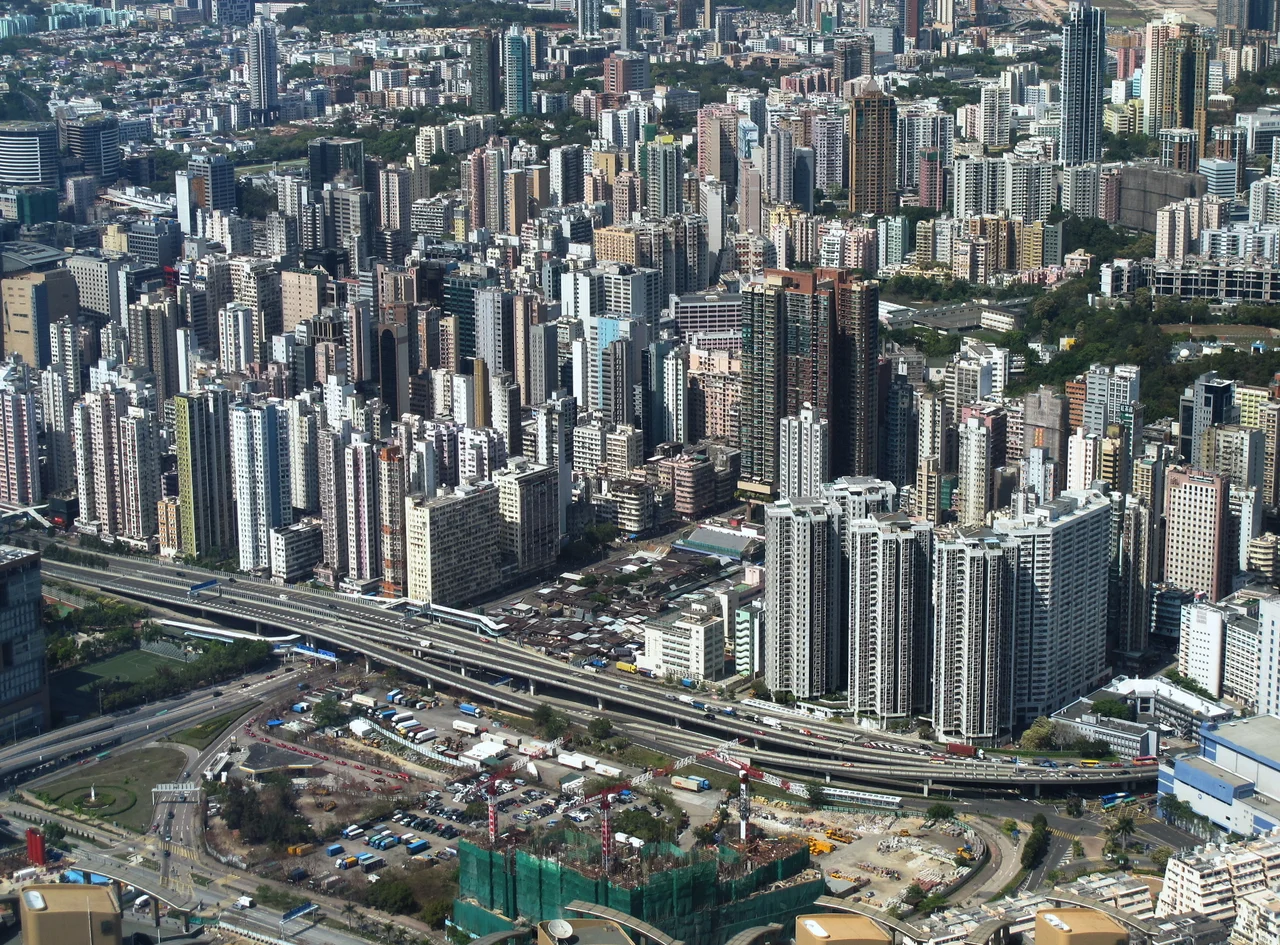
Walk through Yau Ma Tei during the day and it reads as a working-class residential district, dense and functional. Nathan Road cuts north-south through its heart, carrying buses toward Mong Kok and the New Territories. The MTR runs beneath on two lines. Wet markets handle the morning produce trade with brisk efficiency. Noodle shops operate at hours that make no logical sense. The streets between the major arteries — Portland, Canton, Reclamation — fill with the particular pedestrian energy of a neighbourhood that gets things done without making a show of it. In 2021, Covid lockdowns briefly sealed twelve buildings here; the disruption felt especially pronounced in a place accustomed to continuous motion. The Yau Ma Tei of today is not a destination in the way that Tsim Sha Tsui is a destination. It is somewhere people actually live, which is both a less photogenic thing and a more interesting one.
From the Air
Yau Ma Tei sits at approximately 22.310°N, 114.171°E on the southern Kowloon Peninsula, directly facing Victoria Harbour. At 3,000–5,000 feet, you can trace the reclaimed shoreline and the grid of streets radiating from Nathan Road. The temple complex near Public Square Street is identifiable by its distinctive roof tile colours. Hong Kong International Airport (VHHH) at Chek Lap Kok is about 22 nautical miles to the west-northwest. Kai Tak (the old runway) lies roughly 2 nautical miles to the east. From the air, the boundary between Yau Ma Tei and Mong Kok to the north is readable as a slight shift in the density of the street grid.
Nearby Stories
- Lok Ma Chau Loop 2.3 km away
- Portas do Cerco 2.3 km away
- Kweilin Incident 17 km away
- Wanshan Archipelago Campaign 34 km away
- Nanxiong Formation 115 km away
- Battle of Nanpeng Island 148 km away
- Heyuan 169 km away
- Cape Maobitou 632 km away