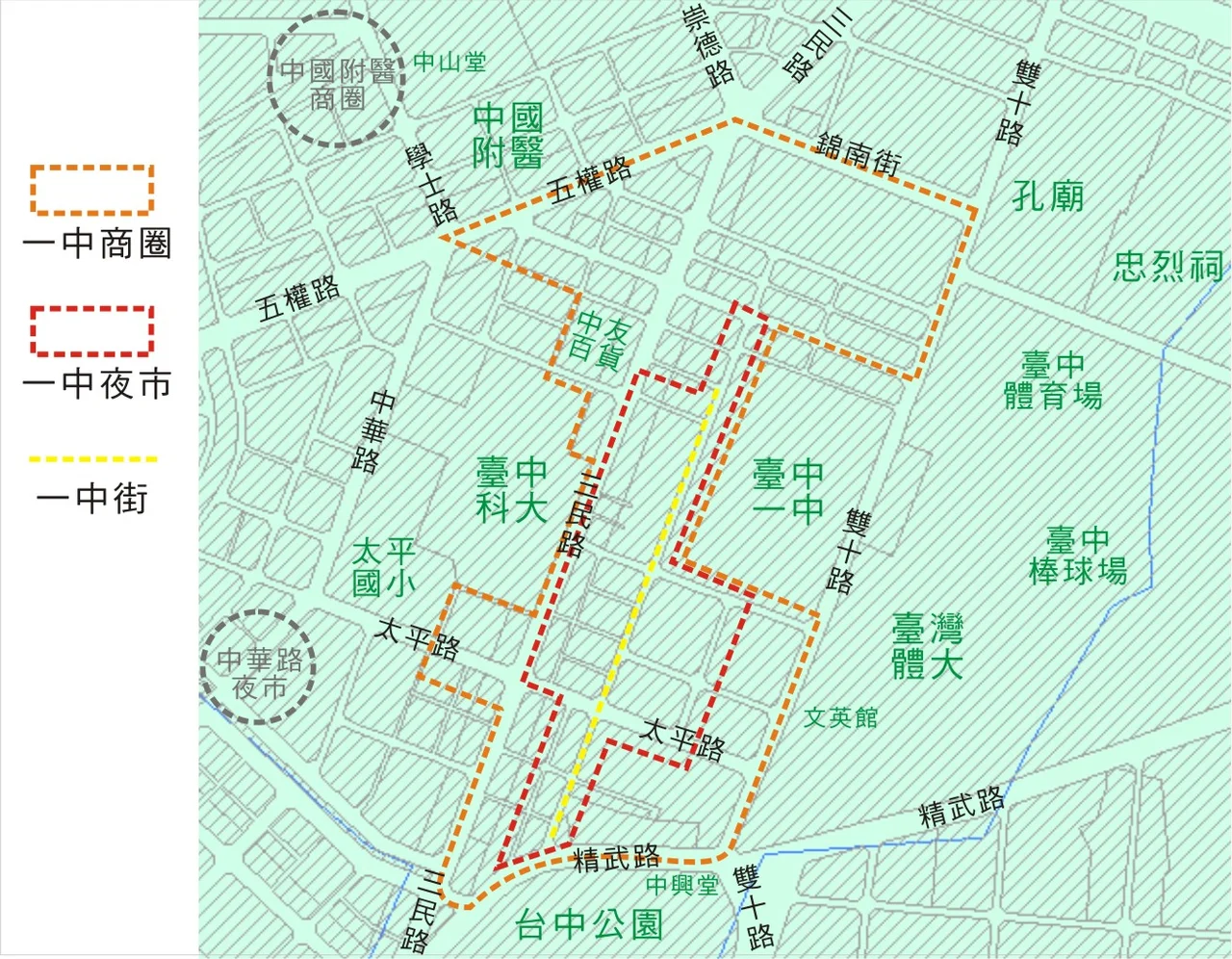

Yizhong Street
During the day, Yizhong Street moves at the pace of students between classes — backpacks, bubble tea, the occasional crêpe eaten standing up. After dark, the stalls come out. Vendors set up along the pedestrian lanes, the crowds thicken, and what was already one of Taichung's liveliest shopping districts becomes, in practice, a night market. The transformation happens gradually, without announcement. It has been happening this way for decades.
Where Schools and Shopping Converge
The geographic logic of Yizhong Street is simple: cluster schools and you get students, and students need places to eat, shop, and spend their evenings. The streets around Yizhong — bounded by Sanmin Road, Yizhong Street proper, Taiping Road, and the Yucai streets — sit in immediate proximity to Taichung Municipal Taichung First Senior High School, National Taichung University of Science and Technology, National Taiwan University of Sport, and several other institutions. ChungHsing Hall and Taichung Park are nearby. The area functions as an educational hub during the week, and that concentration of young people has, over time, drawn the kind of commercial ecosystem that thrives on youthful energy: clothing stalls, accessories, phone cases, food of every description. In 2006, a survey conducted by National Chung Hsing University named Yizhong the most popular shopping area in Taichung.
The Economics of Competition
One of Yizhong Street's notable characteristics is that many of its stores sell similar or identical merchandise. On the surface this might seem like a problem; in practice it creates a price war that works in shoppers' favor. With vendors competing for the same foot traffic, prices in the Yizhong area run noticeably lower than in other parts of Taichung. Students — perennially price-conscious — have reinforced this dynamic by gravitating toward the district precisely because of it, which in turn attracts more vendors, which keeps the competition sharp. Chungyo Department Store, a larger anchor retailer located adjacent to the National Taichung University of Science and Technology, adds a middle-market option that broadens the district's appeal beyond the street-stall economy. The combination — informal stalls, a department store, cram schools bringing in a steady student population — has made the Yizhong commercial district one of Taichung's most durable retail destinations.
After Dark on Yizhong
The transition from shopping street to night market is not a formal one. There is no specific hour when Yizhong Street officially becomes something else. As evening comes on, the character of the street shifts: more food vendors, more foot traffic, more noise, more of the particular atmosphere that Taiwanese night markets have perfected — sensory density without chaos, commerce without pretension. Grilled meats, stinky tofu, scallion pancakes, drinks of improbable sweetness. The stalls that materialize at dusk have their regular customers; regulars have their regular orders. Getting very crowded is, by the account of everyone who knows the district, an understatement on weekends. The pedestrian layout of the street — no vehicles threading through — makes the density feel festive rather than suffocating. It is a place that works best when it is packed.
A Taichung Original
Yizhong Street occupies a specific niche in Taichung's geography of pleasure. It is not a tourist attraction in the curated sense — there are no heritage plaques or guided tours. Its appeal is local, immediate, and entirely practical: good food, low prices, other young people, things to buy that you probably don't need but might want. The street is accessible by bus from Taichung Station on the Taiwan Railway, which makes it reachable without a car or scooter. That accessibility has widened the district's catchment beyond just the immediate neighborhood. Over the years it has grown and expanded, pulled outward by the gravitational field of its own popularity. The cram schools that line the surrounding streets bring in students who need to eat, and those students have been coming back, generation after generation, finding Yizhong Street ready for them.
From the Air
Yizhong Street sits at approximately 24.15°N, 120.69°E in Taichung's North District. Approaching from the west at 8,000 feet, Taichung presents as a dense urban grid spread across a flat inland basin, with the Central Mountain Range forming a dramatic backdrop to the east. Taichung International Airport (RCMQ) is roughly 12 kilometers to the northwest. The North District is positioned toward the upper-center of the city's grid, east of the older city core. The street itself is not visible from altitude, but the broader urban fabric of the North District is clearly defined.
Nearby Stories
- Taroko National Park 4.5 km away
- Jiji, Nantou 9 km away
- Miaoli Ceramics Museum 9.2 km away
- Smangus 17 km away
- Taixi, Yunlin 23 km away
- Lintianshan Forestry Culture Park 24 km away
- Taiwan Strait 52 km away
- China Airlines Flight 611 60 km away