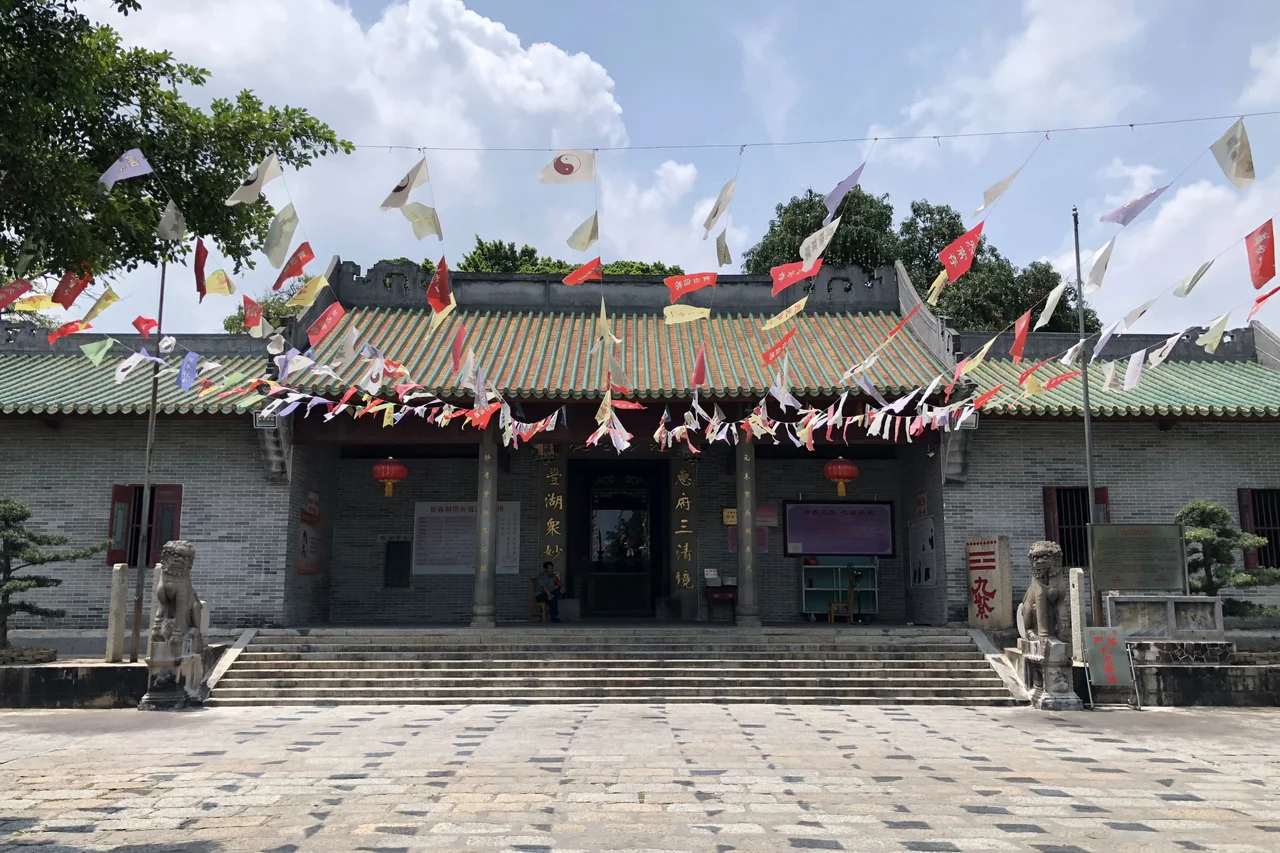

Yuanmiao Temple (Huizhou)
In 633 AD, during the second decade of the Tang dynasty, builders broke ground on a Taoist temple in what would one day become downtown Huizhou. They could not have known they were starting something that would last — in interrupted, rebuilt, repeatedly shattered and restored form — for nearly fourteen centuries. Yuanmiao Temple has been destroyed by war and by ideology. It has been renamed twice, burned, ransacked, and silenced. Every time it has come back. That persistence is not accidental; it reflects something about the communities that kept choosing to restore it.
Tang Foundations, Tang Ambitions
The temple was founded in 633, four years into the reign of Emperor Taizong — a period of extraordinary cultural confidence in China. It grew quickly enough that within a century it merited expansion. In 748, during Emperor Xuanzong's reign, the enlarged temple was renamed first Chaoyuan Temple, then Kaiyuan Temple — the latter a name shared with other prominent Tang-era religious institutions, a mark of imperial favor. The Tang dynasty was a period of relative religious pluralism: Buddhism, Taoism, and other traditions competed and coexisted, and a Taoist temple with imperial patronage enjoyed both prestige and resources. The building that went up in those early centuries reflected that confidence in scale and ornament.
Survival Through Dynasties
The Yuan dynasty (1271–1368) brought Mongol rule and, eventually, a restoration. In 1296, during the reign of Temür Khan — Kublai Khan's grandson — the temple was refurbished. The Ming and Qing dynasties that followed brought cycles of destruction and rebuilding that the records describe but do not fully explain. Wars, fires, neglect, and shifting patronage patterns meant the temple rarely went two or three generations without some major disruption. By the time the 20th century arrived, the temple had survived seven centuries of political instability on the strength of local devotion and periodic official support. Ranked today as one of South China's 'Three Largest Taoist Temples' alongside Sanyuan Palace and Chongxu Temple, it had earned that standing the hard way.
War and Erasure
In 1942, during the Japanese occupation of Guangdong in the Second Sino-Japanese War, the Hall of Three Purities, the Hall of the Jade Emperor, and the wing halls were completely destroyed. Then in 1966, the Cultural Revolution brought a different kind of destruction. Red Guards attacked the temple. They removed, damaged, or destroyed nearly all the scriptures, historical documents, and works of art. The monks and priests who maintained the temple were scattered. The institution that had survived Mongol conquest and wartime bombing could not survive ideological campaigns that targeted the very idea of Taoist practice. For more than a decade, the temple was not a temple.
Return and Rebuilding
After the 3rd Plenary Session of the 11th Central Committee of the Chinese Communist Party in 1978, religious practice gradually regained legal standing in China. The temple was renovated and refurbished beginning in 1982, then officially reopened to the public that same year. In 1989, with local support, the Hall of the Jade Emperor and the Hall of Three Purities were reconstructed. In 1990, Yuanmiao Temple was designated a municipal-level cultural preservation unit. The buildings that stand today include those two rebuilt halls alongside the Hall of Guanyin, the Hall of Lord Guan, a Bell Tower, a Drum Tower, and the Hall of Bao Zheng. The temple now serves as the seat of the Huizhou Taoist Association. On certain mornings, incense smoke rises from the courtyard in steady columns, exactly as it did — in the intervals when no one was stopping it — for thirteen centuries before.
From the Air
Yuanmiao Temple is located at approximately 23.10°N, 114.41°E in Huicheng District, close to the urban center of Huizhou. It is not identifiable as a distinct landmark from the air, but sits within the Huizhou city core near West Lake. The nearest major airport is Shenzhen Bao'an International Airport (ZGSZ), approximately 70 km to the southwest. Huizhou Pingtan Airport (ZGHZ), a domestic-only facility, lies about 12 km to the northeast. The subtropical location means haze and low cloud are common, particularly in summer months.
Nearby Stories
- Dongguan 18 km away
- China Southern Airlines Flight 3456 26 km away
- Dapeng Fortress 29 km away
- Heyuan 49 km away
- Qingyuan Maglev Tourist Line 82 km away
- Penghu Air Raids 465 km away
- Battle of Penghu 468 km away
- Republic of China Air Force Academy 544 km away