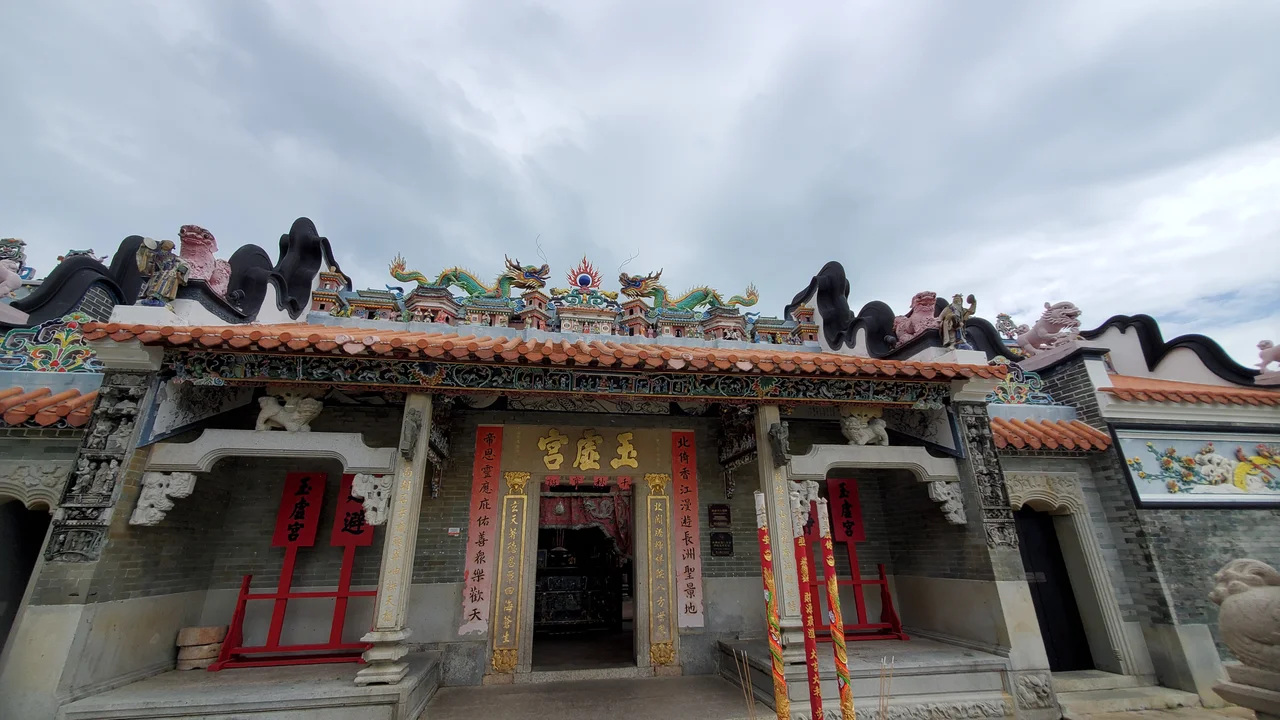

Yuk Hui Temple
In 1777, plague swept through Cheung Chau. The island's fishermen — settlers from Huizhou, Guangzhou, and Chaozhou who had built their lives on these waters — were desperate. According to one account, a resident of Huizhou background brought a statue of Pak Tai, the Taoist god of the sea, to the island. The pestilence, the story goes, miraculously disappeared. Another version says a fisherman discovered the statue rather than transporting it. What both versions agree on is what happened next: the community, led by a man named Lam Yuk-mo, built a temple to honour Pak Tai. It was completed in 1783. That building — renovated many times since, most recently in a project finished in 2003 at a cost of HKD $13 million — still stands on Pak She Street, and its annual festival remains one of the most unusual public celebrations in Hong Kong.
A Temple Designed for the Sea
The fishermen who built Yuk Hui Temple chose its site with the principles of feng shui in mind, positioning it to benefit from the spiritual geography of the island. The temple complex includes a main hall flanked by two smaller side halls — the left bearing an image of a white tiger, the right a blue dragon — both understood as expressions of power and protective energy. At the entrance, an ancient drum and bell stand to drive away evil spirits. At the centre of the main hall, two pillars carved from solid granite take the shape of imperial dragons, distinguished from ordinary dragons by their five-clawed feet rather than four. Between the dragons' teeth: a ball, called the Pearl of the Dragon, associated with good fortune. Four stone lions guard the main entrance, arranged so that two are female — lionesses with a small cub beneath their paws — and two are male, with a ball at their feet. The temple has the most stone lions, four, of any Hong Kong temple.
Patron of the Fishing Community
For the fishing families of Cheung Chau, Yuk Hui Temple has served not as a monument but as a working institution. Fishermen come before setting sail to consult the temple's processes for determining auspicious dates and praying for good catches. They return after voyages to offer thanks. The deities housed within reflect the practical concerns of seafaring people: Pak Tai, the sea god, holds the main altar; Guanyin, the Goddess of Mercy, occupies another position; Tu Di Gong, a local earth god, and the God of Matchmaking are also represented. The temple's administration passed from voluntary local management to the Chinese Temples Committee in 1929. Over the centuries the building has required substantial restoration — in 1822, 1838, 1858, 1903–1904, and 1989 — each intervention extending the life of a structure that the community has evidently decided is worth keeping.
The Sword That Came Back
Among the temple's artefacts, the iron sword commands particular attention. During the Japanese occupation of Hong Kong, a Japanese soldier reportedly took the sword and claimed it as his own. He died soon afterward under circumstances that seemed, to those who knew the story, suggestive. A fellow soldier, frightened by the association, arranged for the sword's return to the temple. A newspaper cutting about the incident remains in the temple today — a small piece of wartime testimony preserved in an institution that predates the war by more than a century and a half. Also among the antiques: a wooden sedan chair made in 1894, used to carry the image of Pak Tai during processions. The chair, the sword, and the renovated stonework of the main hall exist in the same space, each from a different century, each considered worth keeping for different reasons.
Buns, Towers, and Seven Days of Festival
The Cheung Chau Bun Festival takes place on the eighth day of the fourth month of the lunar calendar, usually in late April or early May. It lasts seven days. The centrepiece is the bun-snatching race: tall towers called "Bun Mountains" are constructed in the plaza in front of the temple, covered in lucky buns, and competitors race to climb them and grab as many buns as possible. The buns at the top, closest to the sky, are considered the luckiest. The festival also involves Taoist rituals, a parade of children dressed as historical figures and seemingly suspended in mid-air through concealed metal frames — an effect known locally as "floating children" — and the complete abstinence from meat by the island's residents during the festival period. The Hong Kong Tourism Board promotes the event. Tens of thousands of visitors come from across Hong Kong and internationally each year, pressing into the narrow streets of Cheung Chau to watch the towers rise and fall.
From the Air
Yuk Hui Temple is located on Cheung Chau island at approximately 22.212°N, 114.028°E, in the southern waters of Hong Kong. The island lies roughly 10 nautical miles southwest of Kowloon. At 3,000 feet, Cheung Chau's distinctive dumbbell shape — a narrow isthmus connecting two hilly masses — is clearly visible. The temple sits on the eastern coast of the island facing Tung Wan beach. Hong Kong International Airport (VHHH) at Chek Lap Kok is approximately 8 nautical miles to the north-northeast. The island has no airstrip; access is by ferry from Central Pier.
Nearby Stories
- Lok Ma Chau Loop 2.3 km away
- Portas do Cerco 2.3 km away
- Kweilin Incident 17 km away
- Wanshan Archipelago Campaign 34 km away
- Nanxiong Formation 115 km away
- Battle of Nanpeng Island 148 km away
- Heyuan 169 km away
- Cape Maobitou 632 km away